
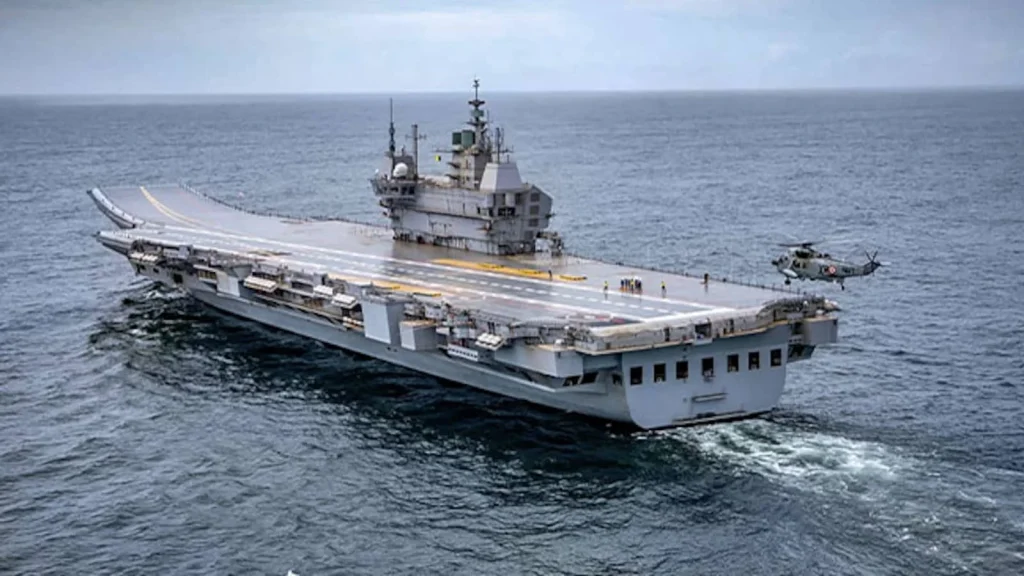
The Indian Navy operates two aircraft carriers — INS Vikramaditya and INS Vikrant. The decision facing New Delhi is not about hardware alone. It is about whether India can put a warship where it needs one, when it needs it, without asking anyone’s permission.
The force awaits the defence ministry’s approval of a third, IAC-2, as China’s newest carrier, Fujian, moves toward full operational capability in 2026.
A carrier does something no missile silo or submarine can do quietly and visibly at the same time. It parks a runway in international waters, launches aircraft without touching another country’s soil, and leaves the moment it arrives. Washington has used this trick for eight decades, moving a carrier strike group toward a crisis zone before a single diplomatic statement is issued. The ship’s presence becomes the statement.
China has drawn the same conclusion from a different starting point. The Indian Navy’s calculation is not about matching China ship for ship. It concerns coverage.
The PLA Navy’s third carrier, Fujian, commissioned in November 2025, is set to move from initial to full operational capability during 2026, according to Chinese state media, with far-sea training expected to follow sea trials conducted in the Bohai Sea earlier this year. China has also built a naval jetty at its facility in Doraleh, Djibouti – reported at somewhere between 320 and 340 metres long enough to berth a carrier alongside, a detail defence analysts flag as evidence Beijing is preparing infrastructure for sustained carrier presence far from home waters, not just in the Western Pacific. With two operational carriers, India can rarely guarantee that one is available, fuelled, and deployed on both its eastern and western seaboards simultaneously, particularly when one is undergoing the kind of extended refit that kept INS Vikramaditya largely at Karwar naval station for stretches after 2019. A third carrier, under the IAC-2 proposal now awaiting the Ministry of Defence’s acceptance of necessity, would let the Navy hold one carrier in reserve or refit while two remain at sea. The Cabinet Committee on Security has not yet cleared IAC-2. Cochin Shipyard Limited, which took roughly 13 years to build INS Vikrant from keel-laying to commissioning, has told Indian officials it can build a sister ship in seven to nine years by reusing the existing design and supply chains – though even that faster estimate implies a commissioning date well into the 2030s once construction actually starts. Every year that clearance is delayed pushes India’s three-carrier navy further from the 2035 window in which China’s own carrier fleet is expected to keep expanding, with some Western assessments projecting as many as nine hulls by then.
