
As cricket enters an era increasingly shaped by artificial intelligence and advanced analytics, data has become as important to the game as talent and technique. From influencing team selection and tactical decisions to transforming the way matches are broadcast, analytics now sits at the heart of modern cricket. In this interview, CricViz Head of Analytics Services Sankar Rajgopal explains how the sport’s relationship with data has evolved over the years, the growing role of AI in enhancing fan engagement, and why players and teams that embrace analytics are gaining a crucial edge in an increasingly competitive landscape.
Ashwin’s has been fairly direct about players who don’t get on top of AI and analytics risking a shorter career, and how data is consumed and used will be a real differentiator going forward. It’s a view I’d echo from the other side of the fence. Let me walk you through what a typical broadcast day looks like from our side. All of these are fed into the graphics engine via APIs, so the moment a commentator wants to bring up a story, the graphic is already sitting there ready to go, no scrambling required. Even before AI became the industry buzzword, we were already running data science models like WinViz (live win probability), PredictViz (score prediction), and PitchViz (pitch behaviour), and more recently Skill Scales (format-specific player skill ratings) – all built for the same purpose: deepening viewer engagement through insight, not just information. On the broadcast side, one moment stands out. We tracked a noticeable spike in viewer retention right after that graphic aired – a good example of how a single well-timed data point can hold an audience through a game that looks all but over.
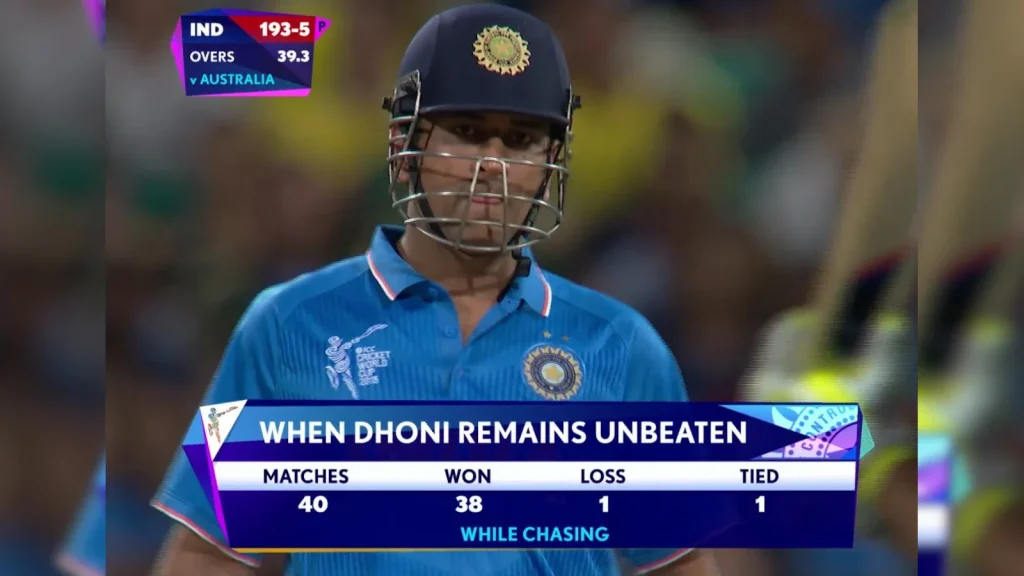
During the 2015 World Cup semi-final, when India’s chase against Australia started to look hopeless, we put out a graphic (attached) showing that as long as Dhoni was still at the crease, India retained a real chance – based on his record of near-unbeaten chases.
A day before the game, every producer and commentator on that match gets a preview document from our analysts flagging the main talking points – the storylines worth building the broadcast around.
Then during the game itself, our Centurion match page is running in the background – a live summary of the game so far, key insights, upcoming milestones, and player strengths and weaknesses, all updating ball by ball. We also use Hawk-Eye ball-tracking data to tell producers and commentators exactly how a pitch is behaving on the day – pace, bounce, deviation, spin – which is something you simply can’t get from just watching. Between the pre-match hooks and the live insights, our analysts are essentially feeding the broadcast a constant stream of story hooks, so there’s always another layer to keep viewers engaged, even when the game itself goes quiet. Broadcast coverage is all about keeping the audience hooked through rich storytelling. AI and pattern recognition help us surface trends that aren’t obvious to the naked eye. For instance, if Virat Kohli brings up a fifty and every boundary has come through the off side, that pattern shows up on our Centurion match page instantly – and that insight gets relayed straight to producers and commentators in real time.
