
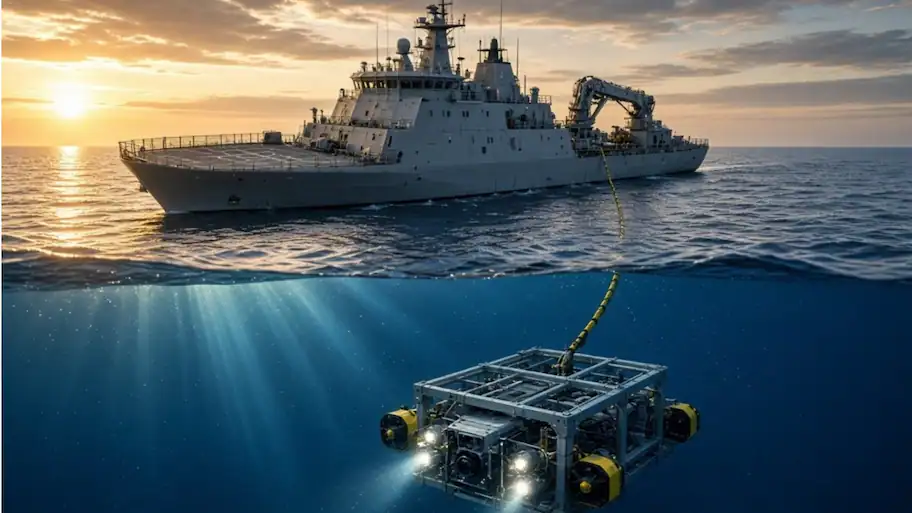
Her name is INS Nipun. She has been built by Hindustan Shipyard Limited in Visakhapatnam, and she is the Navy’s second diving support vessel. The word Nipun comes from Sanskrit and means a person who is skilled and well versed in a difficult job. Once you understand what this ship does, you will agree the name fits her perfectly.
On 31 August, at the Naval Dockyard in Mumbai, the Indian Navy will formally welcome a new ship into its fleet.
But speed is not her real strength. Her real strength is patience. She can stay out at sea for long stretches and carry out very specialised work far below the surface. Very few ships in the world are built for this job. Nipun is one of them. To understand her value, picture the sea as a dark world where the water presses down on the body with great force. Ordinary diving is like holding your breath and going down for a short while. After some time the diver must come up, rest, and go down again. This wastes hours and puts strain on the body. Saturation diving works differently. On Nipun, divers live inside a special pressurised chamber on board. The air pressure inside is kept the same as the pressure at the depth where they are working. The body gets used to it. From this safe home under pressure, they go out, work, and return without the repeated up-and-down strain. They can examine wrecks, repair underwater fittings, and remain on one job for days instead of hours. Nipun also supports simpler air diving and mixed-gas diving, often called heliox diving. With helium in the mixture, they can go deeper in safety. Together, these systems give the Navy a full range of diving choices for different depths and different tasks. Her work is not limited to human divers. She carries remotely operated vehicles, or ROVs, which are underwater robots steered from the ship. They carry cameras and tools. Where the water is too dark, too cold or too dangerous, the ROV goes first. It can stay close to the divers, send back a live picture, and help in salvage. As officers on the ship explain it, the ROV can work along with the divers or simply keep an eye on them. That extra pair of eyes makes the whole operation safer. Nipun is also built as a mother ship for a Deep Submergence Rescue Vehicle. If a submarine is ever in distress on the seabed, this small rescue craft can be lowered from Nipun, reach the trapped submarine, and bring the sailors out. Such a capability is rare and precious, and it is one of the main reasons this class of ships was ordered in the first place. Above the waterline, the ship has a helicopter deck. Suitable naval helicopters can land there to move people, bring stores, or carry an injured person ashore quickly. Safety on board is treated as the first priority. Deep-sea work can go wrong in seconds. Having a small hospital on the very ship doing the job can save a life.
Because breathing ordinary air at great depth can confuse and harm a diver, here helium is mixed with oxygen,. There is an eight-bed sick bay, telemedicine links so that doctors on land can guide the team at sea, and even an operation theatre. Nipun is about 119 metres long and 22.8 metres wide, and she weighs around 10,500 tons. Her top speed is about 18 knots.
Nipun is not just another naval vessel. She brings divers, robots, cameras, medical care and rescue systems together on one Indian-built platform, with nearly three-quarters of her made in India. She will inspect, repair, watch, and, if the worst happens, rescue. Her name fits perfectly. (Girish Linganna is an award-winning science communicator and a Defence, Aerospace & Geopolitical Analyst. He is the Managing Director of ADD Engineering Components India Pvt. Ltd.)
Because it shows Indian yards can now design and deliver a highly specialised ship that very few countries possess, that matters beyond the Navy,.
