
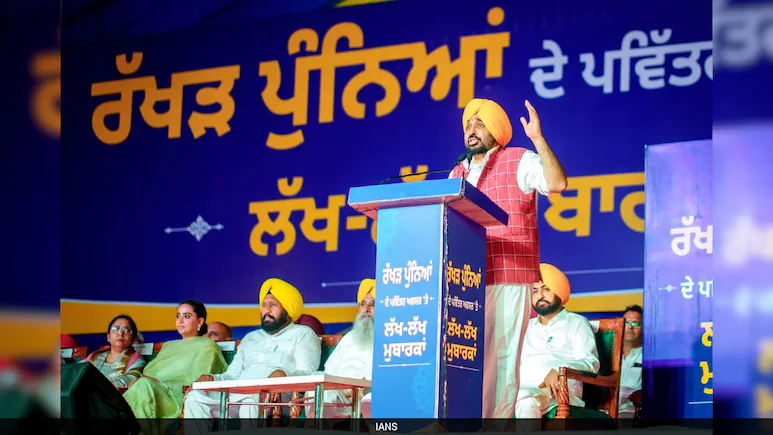
By the weekend, the rallies at Baba Bakala were over. The stages had come down, the crowds dispersed, and the microphones gone quiet. But the political story did not end there.
It was what each party’s own rally revealed about the condition it is in. What Baba Bakala also confirmed, though, was that Punjab Congress president Amarinder Singh Raja Warring stayed away, along with several leaders seen as close to him. Clips from the Rakhar Punia conferences kept surfacing on the internet for days afterwards – packed grounds, sharp speeches, notable absences, claims of development and counter-claims of failure. Watched one at a time, these were just fragments from another rally season. Baba Bakala has hosted rival rallies before. That part is tradition. What made this year different was that all five formations – the Congress, the Aam Aadmi Party, the Bhartiya Janta Party (BJP), the Shiromani Akali Dal (SAD) and the Akali Dal (Waris Punjab De), put up separate stages on the same day, and for the first time, the BJP treated Baba Bakala as a full-scale political conference rather than a courtesy visit. The more interesting story, though, was not whose crowd looked bigger. Congress: Plenty Of Leaders, But Who Sets The Direction? Congress showed up in numbers. Warring’s explanation that no single event requires every senior leader’s presence is reasonable on paper. It is not short of leaders, cadres or constituencies where it remains competitive. What it lacks is agreement on who speaks for the party. A crowd is not the same as a command structure – and factional rivalry that might otherwise sharpen a party’s edge starts, past a certain point, to simply confuse the voter it is trying to win over. BJP: No Longer Content With A Supporting Role The BJP stage conveyed a very different message. The effort projected BJP as more than a former junior partner of the Shiromani Akali Dal. For years, the BJP’s political identity in Punjab was largely shaped by its alliance with the Akalis. That equation has changed, and the party now wants to be judged as an independent contender. Its urban support base is already visible. The real test lies beyond that comfort zone. Can the BJP expand meaningfully into rural Punjab? Can it build greater acceptance among Sikh voters outside its existing base? And, most importantly, can a higher vote share be converted into enough assembly seats to make it a serious statewide force? Baba Bakala suggested that the BJP is increasingly confident about posing these questions directly to Punjab voters. But rallies alone cannot answer them. Its unfinished assignment is to convert political visibility into rural reach, and rural reach into constituency-level victories.
Because the party organised its own major conference, led by Union Agriculture Minister Shivraj Singh Chouhan and Haryana Chief Minister Nayab Singh Saini, its presence at Baba Bakala was politically significant. Watched together, they add up to something more useful: A mid-point reading of where Punjab’s five main political camps stand less than a year before the 2027 assembly election. This is Congress’s real problem heading into 2027.
Former Chief Minister Charanjit Singh Channi, Gurdaspur MP Sukhjinder Singh Randhawa and Kapurthala MLA Rana Gurjeet Singh were all present and vocal, Randhawa reportedly telling the gathering that the leaders on that stage represented the “real” Congress, an unmistakable signal aimed at the party’s own high command. In practice, an Opposition party staging competing rallies on the same day sends its own message, regardless of what anyone says afterwards.
Today, the party is fighting on multiple fronts – against AAP, an independently expanding BJP, and Waris Punjab De, which is seeking support within the same Panthic constituency where SAD historically remained dominant. At Baba Bakala, Bhagwant Mann highlighted delivery – free electricity, jobs, health services, irrigation, infrastructure and welfare measures, including financial assistance to women under the Mawan Dheeyan Satkar Yojana. This gives AAP an advantage: it can point to decisions taken, not just promises made. But incumbency changes the questions voters ask. A beneficiary of free electricity may still worry about unemployment. A family satisfied with one government service may still ask about drugs, crime, migration or economic opportunity. AAP’s unfinished assignment is to prove that its delivery has been broad and credible enough to deserve another term. Akali Dal: Recovery Needs More Than Aggression Shiromani Akali Dal appeared noticeably more aggressive at Baba Bakala, possibly as part of an effort to rebuild confidence within its cadre after repeated electoral setbacks. Sukhbir Singh Badal targeted AAP, but SAD’s sharper attack on Akali Dal Waris Punjab De was equally significant. It reflected how much Punjab’s Panthic political space has changed. Congress was once SAD’s principal rival. Aggressive messaging may energise workers but electoral recovery requires rebuilding trust beyond the committed cadre. SAD’s unfinished assignment is to convert renewed aggression into renewed credibility. Waris Punjab De: Turn Attention Into Organisation Akali Dal Waris Punjab De faces a different challenge. Drugs remain one of Punjab’s most emotionally powerful issues, but electoral success requires more than sentiment. Assembly elections are fought constituency by constituency. They need credible candidates, booth-level workers, local leadership, resources and an organisation capable of operating across different regions. Social-media momentum can create political energy, but it cannot replace electoral machinery. The key question is whether Waris Punjab De can move from issue-based mobilisation to a structured statewide force. SAD’s direct attacks on it also suggest that the traditional Akali leadership sees this competition in the Panthic space as serious. Its unfinished assignment is to turn attention into organisation and organisation into seats. No Single Wave, Many Currents Put together, Baba Bakala showed Congress with strength but no settled command, the BJP with ambition still to be converted, AAP moving from promise to performance review, the Akali Dal fighting battles on two fronts to stay relevant, and Waris Punjab De with energy that has yet to become an organisation. That fragmentation is itself a signal. Every party at Baba Bakala had something to show off. Every one of them also had something it hoped nobody would look at too closely. By election day, the rallies will be bigger, the charges sharper, the promises larger. But the Punjab voter is not going to count chairs at a mela.
Its toughest opponent may therefore be the expectation created by its own 2022 mandate. The challenge for Akali Dal is therefore not only to win more seats, but also to persuade voters who moved away to return. AAP: Defend The Report Card AAP faces a straightforward but demanding test in 2027.In 2022, it represented change. In 2027, it will be judged as the government. By 2027, Punjab will compare AAP’s promises with its performance. At Baba Bakala, the party placed the drug crisis at the centre of its agenda and promised a white paper covering 1997 to 2027, examining narcotics, deaths, supply chains and alleged political and institutional links. With no single dominant wave visible in Punjab today, small shifts in vote share, local alliances and candidate choices could matter more in 2027 than in any recent election. The question that will decide 2027 is simpler and harder than any of the five stages managed to answer: What exactly is your plan for Punjab, and why should anyone trust you to deliver it.
