
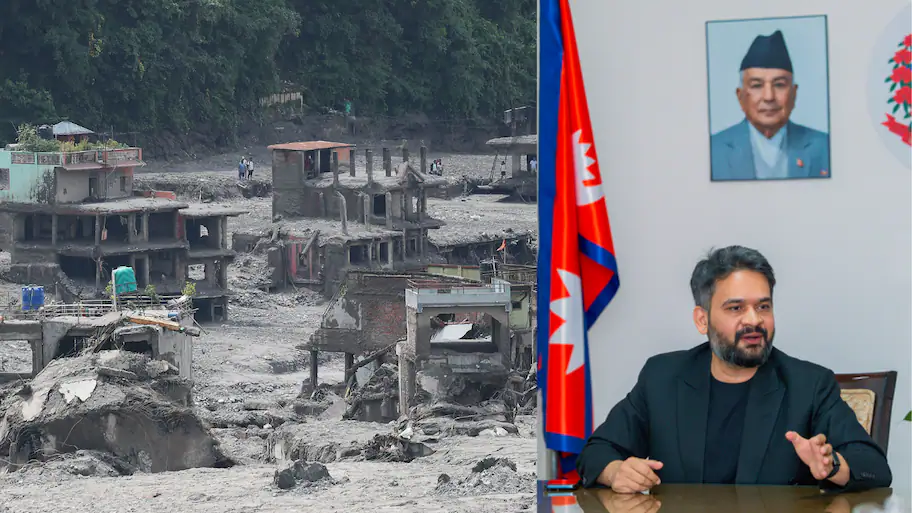
Nepal has stepped up its demand for climate compensation from some of the world’s biggest greenhouse gas emitters after devastating floods in the Himalayan nation killed more than 1,100 people and left thousands missing.
The demand comes as Nepal tries to draw global attention to the growing climate risks faced by the Himalayan region.
Prime Minister Balendra Shah told Parliament on Wednesday that the disaster should serve as a warning about the consequences of a changing climate and the need for a stronger international response. Nepal’s argument is based on a simple climate-justice principle: countries that have contributed relatively little to global emissions should not be left to bear the financial burden of increasingly severe climate disasters alone. Melting glaciers, unstable mountain slopes and glacial floods pose growing risks to communities and infrastructure across the Himalayas. Nepalese Foreign Minister Shisir Khanal has argued that China, the US and India, as major current emitters, have a responsibility towards vulnerable countries facing the consequences of a changing climate. However, the issue is more complicated than simply comparing countries’ total emissions. India, for instance, has consistently argued that climate responsibility must also take into account historical emissions, per-capita emissions and the development needs of developing countries. India’s per-person emissions remain substantially lower than those of the US and China. Water accumulated behind the natural barrier before eventually breaching it, sending a massive surge downstream towards the Trishuli River. The resulting flood carried huge quantities of mud and debris, destroying homes, roads, bridges and hydropower infrastructure and leaving thousands of people displaced. At the same time, experts have cautioned that more scientific investigation is needed to establish exactly how much of the disaster can be directly attributed to human-induced climate change. Initial assessments have pointed to a combination of factors, including a rock-and-ice avalanche, unstable glaciers and changes in the Himalayan ecosystem. Nepal’s Foreign Minister has stressed that the compensation demand should not be viewed simply as a request for humanitarian donations. Kathmandu argues that vulnerable countries should receive financial support for the losses and damage they suffer from climate-related events, particularly when their own contribution to global warming is relatively small. The scale and conditions of the disaster, however, made rescue efforts extremely difficult. Huge amounts of mud and debris meant that even foreign rescue teams could not initially land at the affected sites. Indian and Chinese technicians, together with Nepali technicians and the Army, were able to reach the affected areas only after conditions improved. Rescue operations could begin properly only once stable ground became available and helicopters had suitable places to land. The Nepalese government has also faced questions over its initial response and reports that it was reluctant to accept international assistance. Shah rejected those claims in Parliament, saying Nepal had never adopted a policy of refusing international assistance during major disasters. The Prime Minister also defended the government’s warning and rescue efforts, saying security personnel were deployed to alert residents as soon as authorities received information that the flood was approaching.
Because of its mountainous geography, nepal produces a negligible share of global greenhouse gas emissions but is highly vulnerable to the effects of climate change. At least 1,114 bodies swept away by last week’s floods had been recovered by 9 am Wednesday, according to Nepal’s National Disaster Risk Reduction and Management Authority (NDRRMA), while around 3,916 people remained out of contact. The floods struck the Bhotekoshi River basin on August 26 and devastated parts of Rasuwa, Nuwakot and Dhading districts in Bagmati province.
Nepal has identified China, the United States and India among the world’s largest greenhouse gas emitters and is seeking financial assistance under the global climate framework for countries suffering “loss and damage” from climate-related disasters. He has described Kathmandu’s approach as a shift from seeking traditional aid towards “justice and compensation”. Experts said an avalanche blocked the Lengde Khola, a tributary of the Bhotekoshi River near the Nepal-China border. Nepal has described the disaster as a “Himalayan Tsunami”. Prime Minister Shah told Parliament that India and China sent technical experts who began reconnaissance operations from the first day. Shah said there was initially no stable ground for excavators or even personnel from the Army and Armed Police Force. He said Kathmandu had been coordinating with other countries from the beginning and had sought assistance according to requirements on the ground. Some of those personnel, he said, subsequently went missing during the operation.
The request seeks assistance not only for immediate relief but also for resettlement, reconstruction and specialised support, including tunnel-rescue teams, forensic experts and Bailey bridges. Nepal’s demand comes at a sensitive time for its relations with its two giant neighbours, India and China. Both countries have already been involved in Nepal’s response to the disaster.
Nepal has therefore formally approached the UN-backed Fund for Responding to Loss and Damage for urgent financial assistance. The fund was agreed upon at the COP27 climate summit in 2022 and operationalised at COP28 to support developing countries particularly vulnerable to climate change. Nepal’s Finance Minister Swarnim Wagle has said the country could require around $4-5 billion to rebuild after the disaster — nearly 10 per cent of its economy.
What happens next? Nepal may reach UN
Nepal is now taking its climate-justice argument to international forums. Prime Minister Balendra Shah may travel to New York for the 81st United Nations General Assembly, where he could personally highlight the flood disaster and press Nepal’s demand for climate compensation. The UNGA general debate is scheduled to begin later in September. Nepal has also mobilised its diplomatic missions to brief governments and international organisations about its requirements. For Kathmandu, the issue goes beyond rebuilding after one catastrophic flood. The argument is that the Himalayan region is becoming increasingly vulnerable to climate-related disasters, while the countries most exposed to those risks are not necessarily the countries responsible for the largest share of global emissions.
The disaster has therefore turned a devastating flood into a larger international debate — over who should pay when climate change causes destruction, and whether vulnerable nations such as Nepal should continue relying primarily on aid or have a stronger claim to climate-related compensation.
