
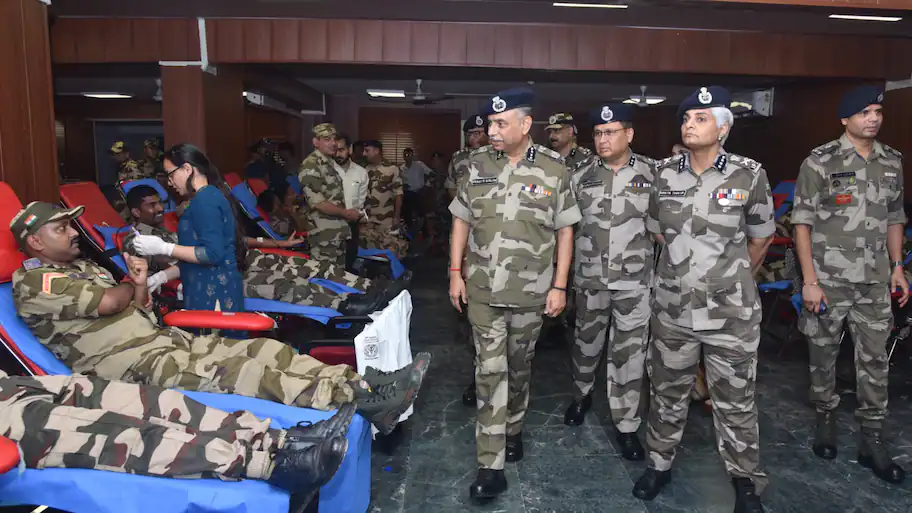
The Central Industrial Security Force (CISF), in coordination with the Blood Centre, Main Hospital, AIIMS, Delhi, organised a mega voluntary blood donation drive at the CISF NHCC Hospital in Mahipalpur on Wednesday.
Senior officers, including Inspector General Navajyoti Gogoi, IG Sonia Narang and IG Vinay Kajla, also donated blood. The event was attended by Vijay Prakash, IPS, ADG (HQrs), Binita Thakur, IPS, ADG (Airports), and Dr Shalini Tiwari, Director Medical, CISF. The AIIMS team coordinating the drive was led by Dr Poonam Kaushik, HOD, Blood Centre, Main Hospital, AIIMS, Delhi, and Ms Anju A.S., Medical Social Welfare Officer, along with their medical team. The initiative assumes significance amid the shortage of blood in the national capital. Addressing the gathering, CISF Director General Praveer Ranjan appreciated the voluntary participation of the Force personnel. He also thanked AIIMS, New Delhi, for its cooperation in organising the camp. CISF and AIIMS jointly appealed to members of the public to donate blood, encourage friends and colleagues to do the same, and become regular voluntary blood donors. As a gesture of appreciation, Praveer Ranjan presented a memento to Dr Poonam Kaushik for the AIIMS team’s support. The visiting AIIMS doctors, in turn, presented saplings to the CISF Director General and ADG (HQrs) as a token of goodwill, symbolising life and the spirit of collaboration between the two institutions.
The camp was inaugurated at 11 am by CISF Director General Praveer Ranjan, IPS, who also voluntarily donated blood, leading the initiative from the front. Nearly 500 CISF personnel participated in the voluntary blood donation drive, with officers and jawans coming forward to support the initiative. Delhi requires approximately 1,400 units of blood every day, while only around 960 units are currently made available, leaving a deficit of about 440 units daily, according to the CISF.
The CISF said the strong participation reflected the Force’s commitment to community welfare and public health, going beyond its core security responsibilities. He said members of a uniformed force should take the lead in initiatives that serve society and stressed that such drives should continue in the future with even greater participation.
The demand for blood is expected to continue rising with population growth and advances in medical and surgical procedures. Since there is no artificial substitute for human blood, voluntary blood donation remains essential to maintaining adequate supplies and saving lives.
