
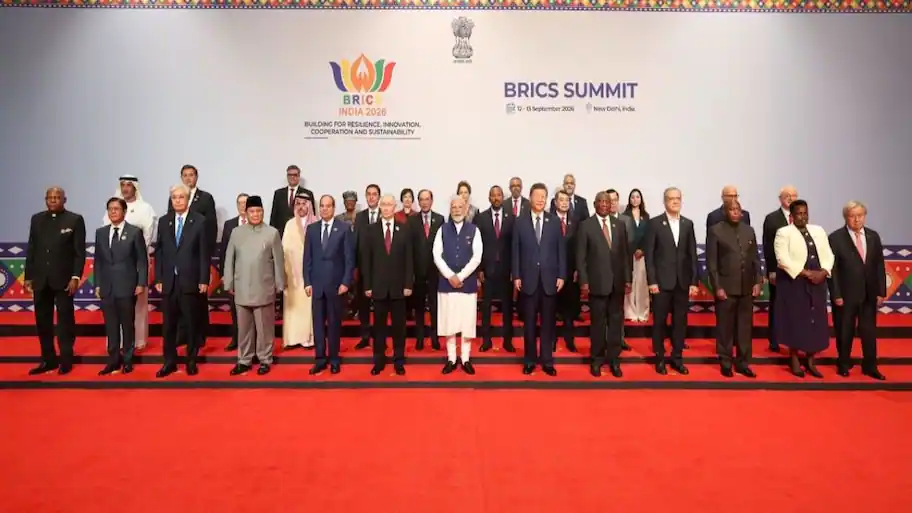
New Delhi: The 18th BRICS Summit in New Delhi has issued a strong statement on the Middle East, with several paragraphs supporting the Palestinians and criticising attacks on Gaza and Lebanon. Israel has not been named directly in the declaration, but the message is clear enough to raise questions about how India managed its BRICS role along with its close ties with Israel.
The joint declaration called for a peaceful solution to the crisis in the Middle East. It discussed the Palestinian issue first and then referred to the war between the United States and Iran, which has made the situation in the region worse. Iran and the United Arab Emirates (UAE) also supported the call for a peaceful solution. The two countries have stood on opposite sides of the larger conflict involving the United States. Their agreement helped BRICS members adopt common language on the Middle East. The wording was seen as a reference to tariffs imposed by Washington on India, China and other countries. The BRICS declaration condemned attacks on civilian infrastructure and protected nuclear facilities. It also expressed serious concern over the humanitarian situation in Gaza and the occupied Palestinian territories. The member countries called for the Gaza ceasefire to be maintained and for humanitarian aid to reach civilians without obstruction. The declaration opposed the forced displacement of Palestinians and condemned violations of international humanitarian law. These violations include using starvation as a weapon of war, targeting civilians and civilian facilities, attacking healthcare centres and other public infrastructure and placing illegal restrictions on humanitarian assistance. BRICS also reaffirmed its support for the United Nations Relief and Works Agency for Palestine Refugees (UNRWA). The joing statement referred to the interim orders issued by the International Court of Justice in the case filed by South Africa against Israel. The court had reiterated Israel’s legal responsibility to ensure the supply of humanitarian assistance to Gaza. The BRICS countries also repeated their support for a two-state solution. On Lebanon, the document called on Israel to follow the ceasefire and withdraw its troops from the remaining areas of Lebanese territory. It also called for an inclusive political transition in Syria involving all sides. “Four paragraphs in the Delhi Declaration use strong language in support of the Palestinian cause. Israel is one of India’s major partners. However, given the position of the new BRICS members, India’s own position and the broad acceptance of the Palestinian cause across the Global South, this was a sensible step to maintain consensus within BRICS,” he wrote on X. “India speaks of strategic autonomy. Under this approach, it maintains close relations with countries from different camps. This strategic autonomy places India in a useful position to build consensus among countries with different views. Most BRICS countries are close partners of India, and tensions with China, India’s only rival within BRICS, have also eased,” he wrote. Ken Moriyasu, a senior fellow for Greater Asia at the Hudson Institute, also commented on the declaration. “India had upgraded its relations with Israel to a ‘special strategic partnership’ just six months ago. Despite this, it chose to retain this language in the BRICS declaration. I like this multi-dimensional foreign policy. The declaration also faced criticism for its treatment of the ongoing military confrontation between the United States and Iran. But this document condemns neither the US-Israeli actions nor the attacks carried out by Iran against countries in the region,” he wrote. “The entire episode is described only as ‘rising tensions in the Middle East/West Asia’. At the same time, they strongly criticise Israel’s attacks in Lebanon and Gaza,” she wrote. The BRICS declaration criticised unilateral economic sanctions and attacks on peaceful nuclear facilities without naming the United States.
“Because Iran and the UAE agreed to the language, the paragraphs on West Asia make no specific mention of the US-Iran war or Iran’s attacks in the region. The declaration backed the creation of a Palestinian state within the 1967 borders, with East Jerusalem as its capital. This language, he said, also appeared in the 2025 Rio Declaration but had not appeared in the 2024 Kazan Declaration or in earlier BRICS summit declarations. The 2025 declaration condemned the attacks on Iran.
It expressed “deep concern” over the worsening situation and urged all sides to show maximum restraint and use diplomacy. Though the declaration also did not name US President Donald Trump or refer directly to American tariffs, it criticised “unjust and unilateral protectionist measures” that have harmed several countries. Michael Kugelman, a senior fellow for South Asia at the Atlantic Council, said the language is aimed at maintaining agreement within BRICS. He said India’s policy of strategic autonomy allowed it to maintain close relations with countries holding different views. India has recently upgraded its relationship with Israel to a “special strategic partnership”. He said the document supported the “right of return” of Palestinians. “The BRICS joint declaration issued under India’s chairship supports the Palestinians’ ‘right to return home’,” he wrote on the microblogging website. “The declaration says a just and lasting solution to the Israel-Palestine conflict is possible only when the legitimate rights of the Palestinian people are fulfilled, including the right to self-determination and the right of return,” he said. But Israel will not like it,” he said. Manoj Kewalramani, a fellow at the Takshashila Institution, said the BRICS statement was weaker than the language adopted at last year’s summit in Rio. This is followed by the condition ‘recalling the respective national positions’,” he said. “This leaves room for differences among the countries and shows a weak and softer expression of concern instead of presenting a common BRICS position on the issue,” he added. The Hindu’s Diplomatic Affairs Editor Suhasini Haidar said the wording was influenced by the positions of Iran and the UAE.
“On the attacks against Iran, the declaration also appears to step back from the language adopted in Rio last year.
It opposed sanctions imposed without approval from the United Nations Security Council. The wording echoed long-standing criticism from Russia and Iran, both BRICS members that face strict US sanctions. The document also criticised unilateral tariffs and non-tariff measures that go against World Trade Organisation rules. The United States was not named, but the language was seen as a message against Washington’s tariff policy. After Trump returned to the White House, US tariffs affected imports from almost all BRICS countries, with Russia being the main exception. Iran has faced tariffs along with strict sanctions. Its language showed the difficulty of maintaining agreement among countries with different foreign policy positions, while India continues to manage its relations with Israel, the United States, Iran and other BRICS members.
The BRICS declaration therefore carried messages on Gaza, Iran, sanctions and tariffs.
It said unilateral sanctions imposed in violation of international law have a broad negative impact and affect poor people disproportionately. Trump has repeatedly described BRICS as “anti-American” and threatened additional tariffs against countries joining the grouping. India has called the additional US tariffs imposed over its purchase of Russian oil “unfair, unjustified and unreasonable”. New Delhi has also said it will take all necessary steps to protect its national interests.
