
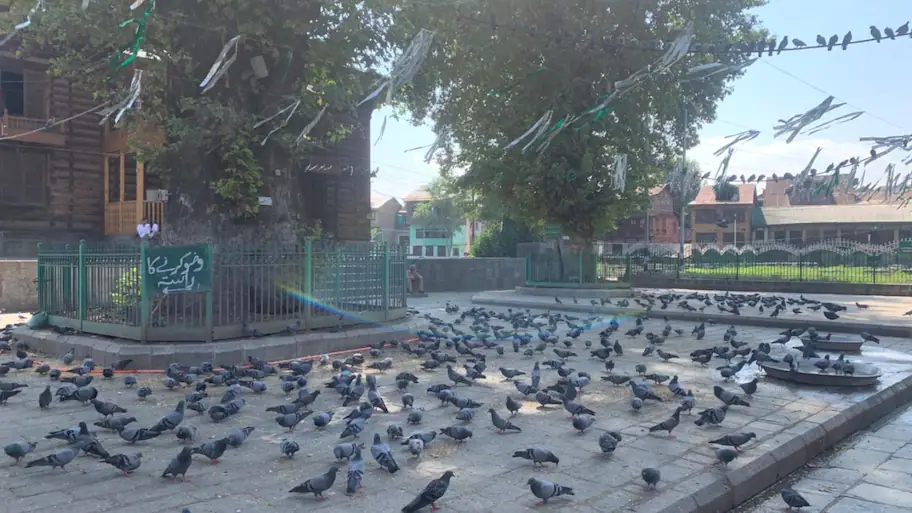
The Jammu and Kashmir Waqf Board has issued a new directive that bans the distribution of Tahari, a traditional rice dish often prepared as a religious offering, and prohibits feeding pigeons and other birds at Waqf-managed shrines. This decision has sparked significant outrage among devotees in the Kashmir Valley, leading to widespread protests. The directive has raised concerns among the local community about the impact on cultural and religious practices.
Devotees and common people have described the move as direct interference in age-old faith practices that have been carried on for centuries at the region’s revered dargahs and khanqahs. She directed that devotees and visitors must not feed birds or distribute Tahari and other food items, including nazar-o-niyaz, mutton, halwa, etc., within the premises of any Waqf shrine across Jammu and Kashmir. The stated reasons were to maintain cleanliness, hygiene, sanctity and a peaceful environment for worship. In her initial statements, Andrabi used strong language, saying, “I am asking people to not bring Tehri to any shrine, and I am asking that there should be no bird feeding. And I am announcing a ban on both these things. People should cooperate. The directive, however, immediately triggered criticism from devotees, who argued that feeding pigeons and distributing Tahari are deeply rooted in Kashmir’s Sufi and popular Islamic traditions. These practices have continued for generations at major shrines across Kashmir. Devotees routinely scatter grain for birds in courtyards, while families prepare and share Tahari as an act of faith and community sharing during religious occasions.
On September 13, 2026, J&K Waqf Board Chairperson Dr Darakhshan Andrabi, a BJP leader holding Minister of State rank, announced the restrictions during a visit to the shrine of Sheikh Noor-ud-Din Noorani (RA) at Charar-i-Sharief.
The Board said such practices lead to the accumulation of food waste, attract stray dogs and other animals, create unhygienic conditions and disturb devotees engaged in prayers.
“Yesterday evening I spoke with the Andrabi. People have offered Niyaz, Tahri and food at shrines for generations, we grew up seeing it. These are practices we have grown up seeing, rooted in generations of faith and devotion. PDP spokesperson Iqbal Tramboo also took a jibe at the Waqf Board, saying that it was running away from its responsibilities. People’s devotion is attached to it. If you have seen, pigeons are also fed grains in the Haram, and there, offerings and charity are also distributed within the Haram. But despite that, cleanliness is maintained in the Haram, and there is no dirt anywhere. Otherwise, people’s devotion is attached to this practice. “In every shrine, every holy place, and here even in the Haram Pak, this practice is ongoing. However, the solution is not to stop this practice, but rather the solution is to mobilize our staff and make complete arrangements for cleanliness there, rather than stopping a practice with which people’s emotions are connected. “As far as I also talked to many people, as I submitted, this is a sentimental issue. So, in this matter, whenever you bring about any change, a person should always keep in mind that people’s emotions and feelings are deeply connected to religious things. Facing the backlash and the immediate hue and cry on social media and locally, where the directive was described as unnecessary and an attack on tradition and faith, Andrabi and the Waqf Board quickly clarified and softened their stance. The restriction applies only to carrying out these activities inside the shrine premises. Devotees have instead been directed to use sheds and spots outside or at specific points within or near the premises for organised distribution and feeding. She has been misquoted. “I request all the pilgrims that there is no such order in which Tabrukaat has been stopped or Tahari has been stopped. However, do not bring it inside the Astan-e-Aliya. Firstly, the floor gets ruined, secondly, it amounts to disrespect of Tabrukaat, and thirdly, it creates a bit of a mess. “Regarding the matter of bird feeding, bird feeding can never be stopped. This is the command of our Prophet, peace be upon him, and of Allah, to feed voiceless animals. “Now, in this, we only need to be a little careful. We only need to do this much: that it should be placed in such a place where it does not spread mess and there is no desecration or wastage. However, even the amended position does not appear to have satisfied many people. Devotees continue to maintain that a centuries-old tradition should not be tampered with and should be allowed to continue as it is. For them, the distribution of Tahari and feeding of birds are not merely practices related to food or cleanliness but matters of faith and devotion that have been passed down through generations.
“So, I feel that somewhere, to shirk their responsibilities, those who run our Auqaf are looking for an ease for themselves, so that this practice is stopped and the burden of work does not fall on them. “Therefore, all political parties and all leaders should refrain from hurting these things and these sentiments. The controversy has therefore brought the Waqf Board’s stated concerns over cleanliness and hygiene into direct conflict with devotees’ insistence that long-standing religious practices must be respected.
A ruling party spokesperson wrote on X, “Our traditions and culture did not begin in 2019, nor with the present Waqf Board.
Tramboo said, “This is a practice that has been going on for many years at shrines and holy places. They said there is no blanket or complete ban on Tahari distribution or bird feeding. Social activist Tariq Ganie, who is close to the Waqf Board, said he spoke with Andrabi and claimed that her initial statement had been misquoted. She did not say that Tahari should not be brought, rather she said that we have made a separate arrangement for Tahari and the shed here.
Critics of the order argue that restricting these practices inside sacred spaces amounts to interference in the living faith practices of ordinary people. Putting in maki to pigeons, you can see in Qibla-e-Awal (Saudi), the first house of God, there is Pigeon Chowk on one side. I have gone there five times. They put maki there for them. We also offer prayers, and the pigeons eat the maki too. It is also permissible. “Tahri is not wrong. Distribution of Tahri solves hardships. If anyone has difficulties, our elders used to say, ‘Go, put something outside shrine, give it to the poor and needy’ — this is Tahri. Another devotee, Bashir Ahmed, questioned who could stop the practice. “Who can stop this? From our elders to children, this is our duty. Banning Tahri, who will ban Tahri? This is a wrong decision. Banning Tahri, in which book is this written in? If Hindus distribute laddu, why can’t we? They also distribute them right outside the temple. So, what sin did we commit? Farooq Ahmad, another devotee, also criticised the move. “No, no, where is there garbage? This is Allah’s charity. This charity should never be stopped. Charity brings abundance. There is interference in religion here. This is interference in religion. A lot, what is this, what is the benefit of this? This is a lot of interference; this should not be done. The rest, the other issues that exist here, like alcohol, should be stopped. “Distributing Tahri, this should not be the case. “Yes, I mean, grain has to be put [for] pigeons. Instead of ban, keep a drum. Where there is distribution of Tahri, keep something for that. This is a wrong decision, completely, A to Z a wrong decision. The criticism was not limited to common people. Political parties also criticised the Waqf Board’s decision.
Angry devotees said no one can stop them from practising their age-old traditions. Devotee Ghulam Nabi Qadri said, “If someone dies and we distribute Tahri, put maki (corn/grain) to birds, its spiritual reward reaches to them. Muhammad Ismail, a devotee, said the practice should not be stopped and suggested an alternative arrangement.
