
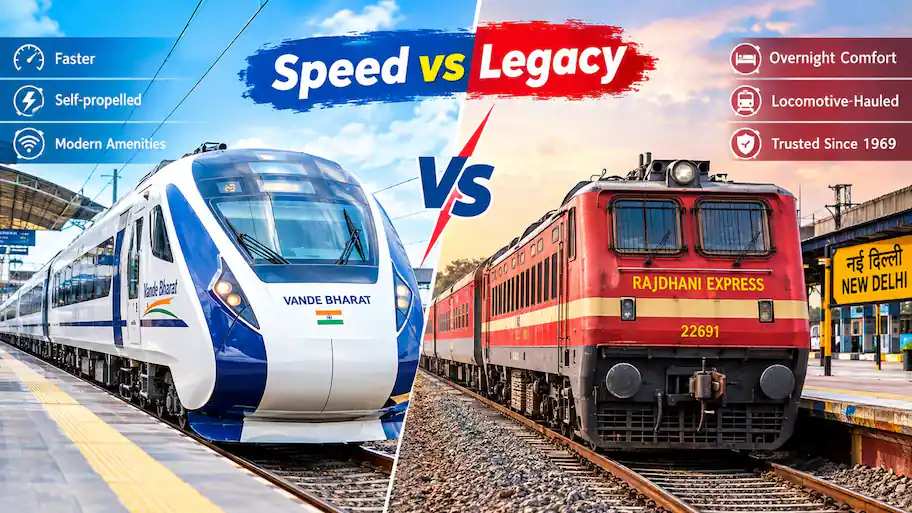
Choosing the best train for your journey depends on whether you prefer the rapid acceleration of a self-propelled Vande Bharat or the traditional overnight comfort of a Rajdhani Express. the newer Vande Bharat network—including expanding sleeper options—redefines speed and modern passenger amenities across Indian Railways While the Rajdhani has defined long-distance premium rail travel since 1969.
Traditional pull system : Most Rajdhani Express rakes rely on a centralized locomotive to haul the entire train set along traditional tracks. Modern integration : This decentralized architecture delivers superior energy efficiency, smoother braking through regenerative systems, and faster turnaround times at stations. Operational speeds and structural designs dictate which train suits specific travel distances and itineraries. Intercity vs. long haul : Vande Bharat primarily serves daytime intercity routes where passengers complete journeys within a single day, whereas Rajdhani remains optimized for overnight sleeper transit. Both premier services offer comprehensive onboard hospitality, though passenger configurations differ significantly between chair cars and sleeper layouts. Onboard catering : IRCTC manages meal services on both networks, offering pre-booked menus ranging from breakfast items to full multi-course dinners depending on the itinerary. Modern interiors : Vande Bharat stands out with automatic doors, onboard Wi-Fi, CCTV surveillance, and bio-vacuum toilets, though upgraded Tejas-Rajdhani rakes now match several of these modern safety and aesthetic standards.
The Rajdhani Express was launched in 1969 to connect New Delhi to state capitals, starting with the historic New Delhi-Howrah route. Distributed traction : Vande Bharat uses a self-propelled trainset design with motors distributed across multiple coaches, allowing it to accelerate from 0 to 100 km/h in just 52 seconds. Operational limits : Vande Bharat trainsets are engineered for speeds up to 160 km/h, outpacing standard Rajdhani operations that typically cap around 130 km/h. The sleeper shift : The introduction of Vande Bharat sleeper variants featuring 16 AC sleeper coaches directly challenges Rajdhani’s long-standing monopoly on overnight journeys.
Seating and privacy : Standard Vande Bharat services feature reclining chair cars and executive coaches with rotating seats, while Rajdhani offers First, Second, and Third AC compartments with enclosed sleeper berths.
