
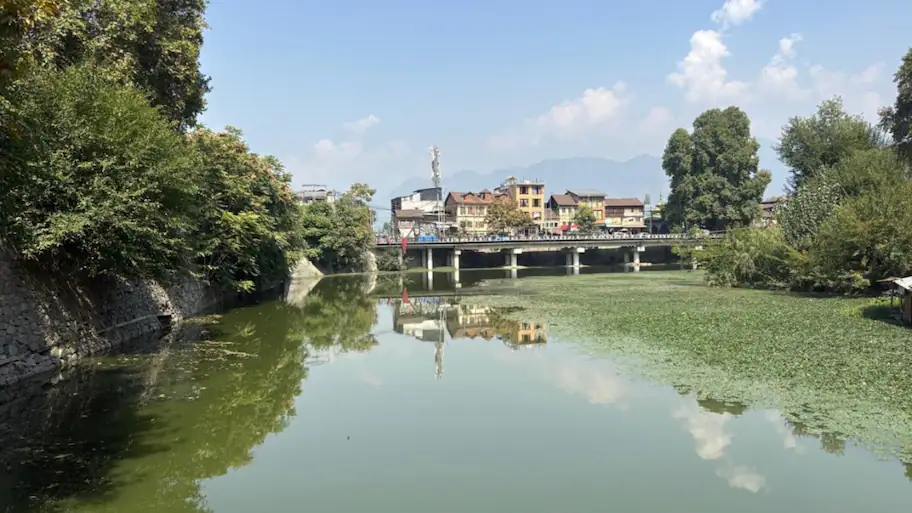
A recent scientific study highlights a severe threat to Kashmir’s renowned water bodies, the Jhelum River and Dal Lake. The research indicates that approximately 147 million liters of untreated sewage from Srinagar are being discharged into these vital ecosystems every day. This alarming situation raises concerns about the environmental impact and the future of these iconic water bodies.
Dr. So, in terms of depth, it is dead. The two lifelines, Jhelum and Dal Lake, are in bad condition. “It’s bad, it’s totally bad. You look at the color of the water; you are here, I am also here, and there is no need to exaggerate. That entire sewage—how much treatment have you done? So, the problem is at multiple steps, and we need solutions at multiple steps, not just at one step.
The peripheral load of Dal has increased quite a lot; it has increased from 2 lakh to 3 lakh, and it is growing exponentially. You installed STPs in all areas, but the untreated water coming out of those STPs 100% is not treated.
Tauseef Bhat (researcher of the study) said, “The cosmetic approach that is going on everywhere is also happening with these water bodies. We are trying to give it cosmetic makeups so that people will come and say, “Oh, we have seen a wonderful water body,” but just 500 meters or 1000 meters from the main Nigeen Park you go, the depth of Dal Lake, what we have checked, is not even 2.5 feet; it’s not even 2 feet.
It is useless, it is released just like we drop it into the drain. The government has launched several sewage treatment and pollution control projects to address infrastructure gaps. Volunteers working to clean and protect Dal Lake have raised alarm bells, accusing the government of failing to take meaningful steps to preserve these water bodies despite repeated warnings. They say decades of official apathy have allowed pollution and encroachment to push the lake to the brink. It does not get filtered. They put it In the river, the water coming from Nigeen, Shalimar, they put it in that same river. At one time, houseboats used to run in it, large shikaras used to run, dungas used to run. It is our negligence as well as theirs, not that it isn’t, they spent a lot of money on it, but all useless. Entire Rainawari water goes here, and the rest from Shalimar, people living in Hazratbal, that too comes into this. It goes into the Dal. It is in the Dal, then it goes into Nigeen Lake. Everything is getting dirty in it. Without cleaning it, it happens just like this, you go and see for yourself how it is. Money is being wasted, what else. Look at our drain here, this is also getting blocked. There are many issues, we are also troubled, this has not been fully successful. The people who live around it have more trouble. There is no doubt about it. The government should take steps. People should get some relief, some benefit. Chief Minister Omar Abdullah acknowledges the severity of this crisis, noting that it has intensified over the past two years. He emphasizes that while there is no overnight fix, every effort is being made to save the region’s water bodies. Researchers attribute this decline to human activities and pollution caused by untreated wastewater. The study notes, “Excessive nutrient levels can fuel algal growth, degrade water quality, and disrupt the natural balance of the aquatic ecosystem. Previous research by scientists at the University of Kashmir identified numerous drains carrying urban waste into the Jhelum River from Srinagar and recorded a deterioration in several water quality parameters. Experts have issued a stern warning: unless concrete measures are taken immediately, the very existence of Dal Lake and the Jhelum River—considered the lifelines of Kashmir—could be at risk. However, experts, volunteers, and locals argue that treatment plants alone cannot solve the problem; it is essential to connect households to a functional sewer network and stop untreated drains and outfalls from discharging into water bodies.
Because of this, today it is useless. Because of it, diseases spread because of filth, mosquitoes fly, diseases happen. Therefore, the challenge lies not just in increasing treatment capacity, but in ensuring that sewage does not reach the rivers or lakes in the first place.
Another area resident Bashir Ahmed said “It’s not cleaned, what is happening?
On one side, the National Conference is doing it; on the other side, the PDP has done it. we won’t even see the lake in the coming times. All the pump stations of the UEED dump all the untreated water and all the filth directly into them. They are the people, the department, who are destroying our water bodies. We built roads; vote banking has ruined the Dal. If we go into the lake, look at Green Power, look at how many dead fish there are we have seen it. Every single day, and I can show you even now, fish are dying in the thousands. But my point is that we couldn’t control the sewage, nor can this department do much about it. They can go on motorboats, they can inspect from afar, but they are not experts on the lake. For that, we need experts; we need foreigners, we need white-collar people who come here and completely take over, just like in the Netherlands or countries that have water bodies. They can bring those experts here. Otherwise, future generations will not be able to see our Dal. Directly.All the filth and dirt come there. Sometimes, a little bit once within a month When Some officer will come to see it. Water from areas of Rainawari, Haslabad, Puzmohalla, Kasai Mohalla is over there, they all bring it here. the waste of cows goes into that and then they filter it and give us for to drink. We requested a lot to MLA. Who will do it, sahab? Which machine is there to clean it? The machine is the same, they leave it inside the river, that’s it. Sometimes they take it ( water) to Khaniyar for treatment. That’s it.
Because we laid roads, because inside the lake we don’t need roads or pathways, you look at the 80 pump stations at Dalgate, take a video there, and see how much filth comes right in front of Zainakadal, or in front of Ansari Motors, or if you go to Nawaidyar, Khanyar, or near Zojilanger, you will see how much filth there is. it has been ruined. If we simply do one thing convert those pump stations into STPs (Sewage Treatment Plants)—we can save 80% of the water body. I have filed an RTI regarding this; there are 80 pump stations.
Tariq Ahmed Patloo a volunteer who works for Dal Cleaning said “I raise this issue repeatedly you see, the biggest culprit that I currently hold responsible is the UEED(Urban Environmental Engineering Department) in Jammu and Kashmir, India, or. Someone says someone put medicine in it, someone says something else; everyone has their own story. I want to appeal to the Honorable Prime Minister—since he spoke about me in “Mann Ki Baat” please hand this over to some private company, to foreigners, or to major experts within India. Mohammad Shafi Baba a resident of zojilankar downtown living near dal lake when said “Where does this water go now? Baba said “Into the Dal.
