
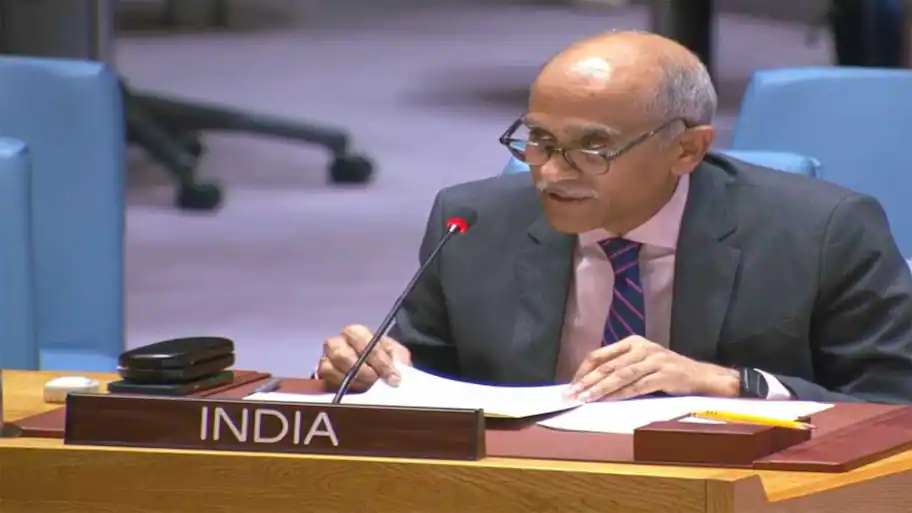
New Delhi: Drawing on the history of the September 11 attacks to make its case at the United Nations Security Council (UNSC) meeting on September 16, India has urged the international community to act against terrorist networks and safe havens that have allowed extremist groups to operate across borders.
India’s Permanent Representative to the United Nations, Ambassador Parvathaneni Harish, also criticised the forced return of millions of Afghans. He called for their return to be voluntary, safe and dignified. The Permanent Mission of India to the United Nations lists the statement under that date. He called for measures to prevent terrorist organisations from finding shelter, support and operational space, an issue India has raised in its Afghanistan policy. He then referred to the fate of several senior al-Qaeda leaders involved in planning and carrying out the attacks. He cited the places where the men were eventually found, saying the network’s senior members had operated in settled communities and residential areas. The ambassador also referred to Khalid Sheikh Mohammed, whom he described as the principal architect of the attacks. Harish further named senior al-Qaeda operative Walid bin Attash, who helped select and prepare several hijackers, and Mustafa Ahmed al-Hawsawi, whom he described as a financial and logistical facilitator. He followed that with the line that gave his counter-terrorism message its strongest expression. Harish drew a parallel between the history of al-Qaeda’s network and the threat posed by terrorist organisations operating in South Asia. The ambassador alleged that these organisations had adopted different identities to evade UNSC’s sanctions. The statement did not detail specific operations or sanctions cases involving the two organisations during the meeting. Its demand was for the international community to address the conditions that allow terrorist networks to operate and prevent further attacks. The Afghanistan meeting also addressed the humanitarian situation of people returning to the country. India criticised the large number of Afghans being sent back, with many returning against their will.
His statements included direct references to al-Qaeda, the 9/11 attacks, the Lashkar-e-Taiba (LeT) and the Jaish-e-Mohammed (JeM). Harish recalled the international campaign against terrorism launched after the September 11, 2001 attacks in the United States. “The international community supported the global campaign to counter terrorism in the wake of 9/11. The US operation killed him in Abbottabad, Pakistan, in May 2011. India’s statement came shortly after the 25th anniversary of the September 11 attacks. The anniversary was observed in the United States on September 11, with remembrance ceremonies for the victims.
He said al-Qaeda had developed a terror network that extended beyond Afghanistan through affiliated organisations. Let us, not forget, however, that Al Qaeda’s terror eco-system established its strategic depth beyond Afghanistan through its affiliates,” he said. “The leaders of Al Qaeda who conceived and directed these 9/11 attacks did not escape justice in the wilderness of some ungoverned frontier,” he said. “Osama bin Laden, who ordered and financed the plot, was tracked down and killed in a fortified compound within a settled and guarded community under Operation Neptune Spear,” he said. “Khalid Sheikh Mohammed, the principal architect of the operation, was found sheltering in an ordinary residential house,” he said. He added that Ramzi Binalshibh, who coordinated the hijacker cell after being denied a visa to join the other plotters, was “sheltering in an urban centre”. Both, he said, were captured separately. “In each case, these were not fugitives hiding in caves or badlands; they were men who had for long evaded detection,” he said. “Draining this swamp that provided an enabling environment for such monsters of humankind to prosper is important,” he said. “The same permissive environment that sheltered the architects of 9/11 has, in the years since, continued to provide space, support and impunity to affiliates of Al Qaeda such as the Lashkar-e-Taiba and the Jaish-e-Mohammed and their like,” he said. He also said their leadership and terror training infrastructure had been shielded from consequences. “The international community must join hands to address the continuity of such sanctuary in order to ensure that more such individuals are not thrust upon any country or its citizens and no one loses family and loved ones,” Harish said.
Harish cited data from the UN Secretary-General’s report on Afghanistan. He criticised the international response to the scale of the returns, saying a similar situation elsewhere would have brought a stronger political reaction and more humanitarian assistance. The assistance includes housing, food and essential provisions. The country also recently gifted family tents to Afghanistan’s Ministry of Refugees and Repatriation. The government has maintained that returns should be voluntary, safe and dignified, with support for people trying to settle back into Afghan communities. The latest statement is part of India’s ongoing work on Afghanistan at the Security Council. “We reiterate the importance of incentivising positive actions. India has also backed humanitarian assistance and capacity-building initiatives for the Afghan people. Nineteen al-Qaeda terrorists hijacked four passenger planes. Two were flown into New York’s World Trade Centre towers, one hit the Pentagon in Virginia and the fourth crashed near Shanksville, Pennsylvania. At the United Nations, India’s message was that preventing another such attack requires international cooperation against the networks and environments that allow terrorist organisations to operate.
He said 2.9 million Afghans were returned in 2025 and another 1.15 million had returned by August 22, 2026. In June 2026, Harish called for changes to the UN sanctions regime, saying the political reality of Afghanistan has changed over the previous five years. Its March 2026 statement at the UNSC described the country’s relationship with Kabul as rooted in centuries of civilisational ties and said India would continue supporting peace and stability there. The September 11 attacks killed 2,977 people, according to official US data.
Most of the returns in the latter period, he said, were involuntary. “We also reiterate our deep concern at the humanitarian plight of the Afghan returnees,” Harish said. “A forcible return of this nature that is neither safe nor dignified, of over 3 million individuals, in any other part of the world would have elicited a political outcry in this Council, urgent provision of large-scale humanitarian support and efforts to ensure better re-integration and assimilation,” he said. “That there is no such reaction is a sad reflection on the times,” he said. India said it is cooperating with UN agencies and Afghan authorities to support returning populations. The political reality of Afghanistan has changed in the last five years, and the current UN sanctions regime must take that into account,” he said at the time.
