
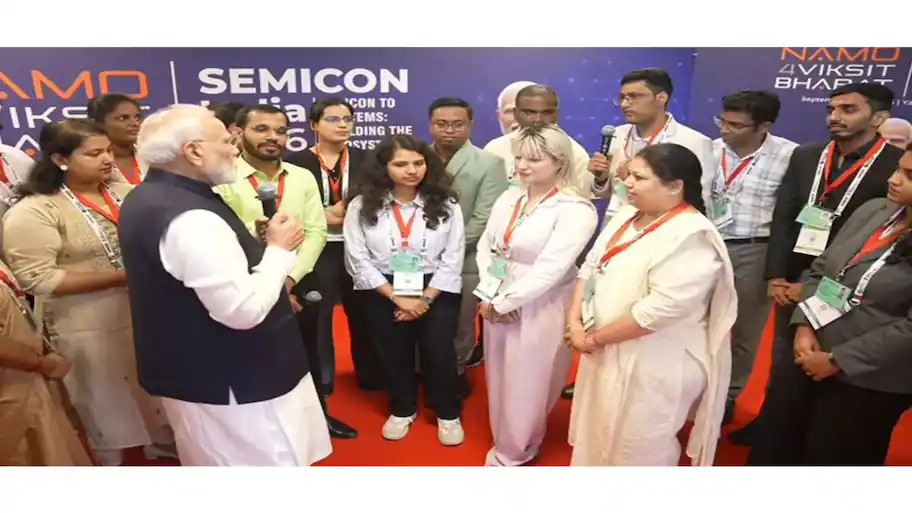
New Delhi: India is positioning itself as a significant player in the semiconductor industry amid ongoing disruptions in global chip supply chains. Prime Minister Narendra Modi has called on international chipmakers and equipment suppliers to expand their operations in India, indicating the country’s readiness to enhance its role in semiconductor manufacturing.
Modi Highlights Expansion of India’s Semiconductor Initiative
Prime Minister Narendra Modi announced that India’s semiconductor program has expanded to include compound semiconductors and silicon photonics, with essential groundwork already established for these technologies. Speaking at an event attended by equipment and component manufacturers, Modi urged industry leaders to seize the emerging opportunities in this sector.
India’s semiconductor strategy encompasses various aspects including chip design, fabrication, assembly, testing, packaging, equipment, and materials. In July, the Union cabinet approved the Semicon 2.0 initiative with a budget of Rs 1.275 lakh crore, aimed at bolstering support for semiconductor design, manufacturing, equipment, materials, Indian intellectual property, and supply chains.
This expansion has been further underscored by US semiconductor equipment manufacturer Applied Materials, which announced plans to invest $5 billion in India over the next decade. This investment is expected to enhance research, supply-chain development, and workforce training within the country.
Earlier reporting noted: Highlighting India’s aggressive push to build resilient global supply networks through far-reaching structural reforms, Prime Minister Narendra Modi on Thursday called upon international semiconductor leaders and equipment manufacturers to seize emerging opportunities in the country’s high-tech ecosystem, stressing that the foundation for next-generation tech like compound semiconductors and silicon photonics has already been laid. The new phase comes with India moving towards commercial chip production and a larger domestic supply network. India has also begun commercial production at semiconductor packaging facilities. Modi also highlighted the workforce needed to support the industry.
The government had approved 12 semiconductor projects under the first phase of its programme by July. Modi said India has entered the second phase of its semiconductor programme, with a target of $13.5 billion. A government update in April said commercial production had begun at two plants, with two more expected to start production during 2026. The same update listed investments of about Rs 1.6 lakh crore across 10 approved projects at that stage. The government has set a target of training 1 lakh engineering students for semiconductor-related jobs. More than 70,000 students have been trained, according to the prime minister. Earlier reporting noted: Addressing the SEMICON India 2026 conference in the national capital, Prime Minister Modi highlighted that India has already laid the critical groundwork required to support cutting-edge semiconductor technologies. Earlier reporting noted: Addressing the SEMICON India 2026 conference in the national capital, Prime Minister Modi highlighted that India has already laid the critical groundwork required to support cutting-edge semiconductor technologies and future-ready digital infrastructure, especially at a time when supply chains were being weaponised.
Three projects had begun rolling out chips, according to the Ministry of Electronics and Information Technology.
