
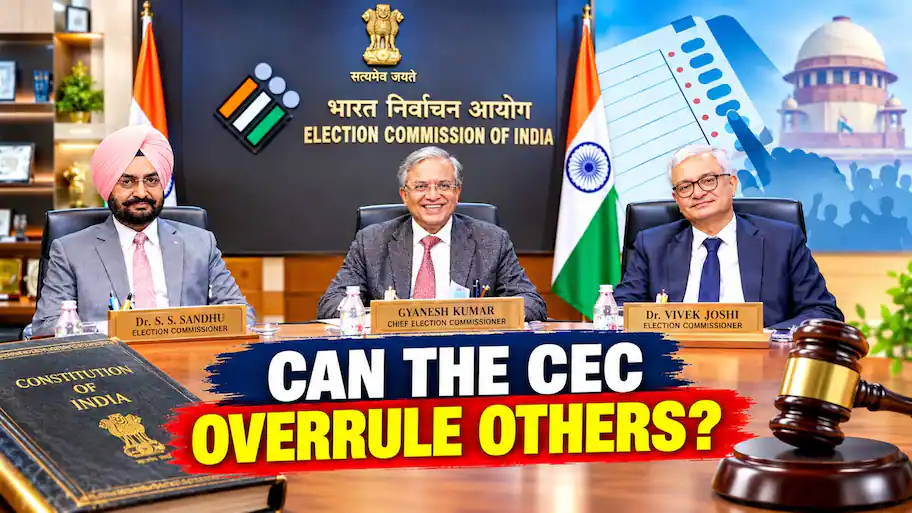
No, the Chief Election Commissioner (CEC) does not possess unilateral veto power to overrule fellow Election Commissioners.
Under the Chief Election Commissioner and Other Election Commissioners Act, 2023, and Supreme Court precedent, the three-member poll panel operates on a majority-rule principle where the CEC functions as “first among equals.”
Union of India verdict, the Supreme Court held that the other commissioners are not mere advisors. They constitute an essential element in the decision-making process. How are disagreements and dissent resolved Where there is a dispute or disagreement internally—like recent differences over the process of updating the voter list—the matter is decided based on collective decision-making or majority voting. Majority wins: Where two commissioners adopt a certain position different from the CEC, the majority view wins. Alternatively, where the CEC and one commissioner adopt the same view, the two form the majority position. Nevertheless, this administrative difference does not put fellow commissioners at an inferior status when deliberating. the final result is determined through majority voting Although it is normal for there to be dissenting opinions and differences in the notes of the individual commissioners during deliberation.
What the Constitution and Article 324 state Article 324 of the Indian Constitution creates the Election Commission, wherein the superintendence, direction, and control of elections are vested in the panel. it does not confer any decision-making supremacy in the office Although Article 324(3) appoints the CEC as the Chairman of the multi-member body upon appointment of other commissioners. A collective body: In the well-known 1995 TN Seshan v. The ‘ornamental’ warning: The Supreme Court further said that giving the CEC the final authority would reduce fellow commissioners to merely being ornamental, which is not the intention under Article 324. First among equals: The CEC enjoys unique security of tenure under Article 324(5), which requires impeachment similar to the judges of the Supreme Court, while other commissioners may be dismissed by the CEC’s recommendation.
