
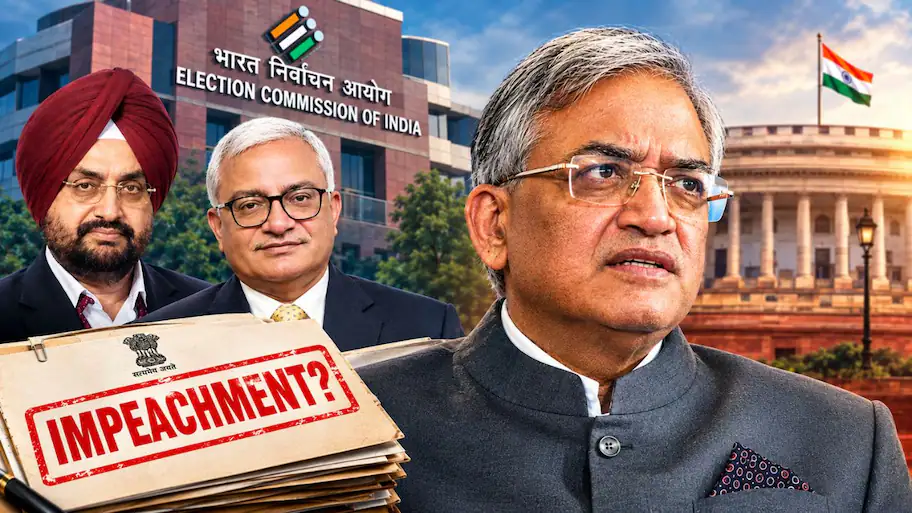
Opposition parties are preparing a fresh parliamentary move to remove Chief Election Commissioner Gyanesh Kumar after records showed repeated objections from the Election Commission’s other two members over voter list changes and registration rules. The dispute centres on electoral rolls, new voter registration and the Special Intensive Revision, or SIR, and has opened a new fight over how key decisions were taken inside the poll body.
The Indian Express reported that questions linked to the SIR exercise were added to the online form. The latest political confrontation follows an investigation by The Indian Express into decision-making within the three-member Election Commission. The issues included voter additions and deletions, changes affecting new voter registration and control of electoral roll software. It is a three-member constitutional body, with the CEC serving as its chairman. Sukhbir Singh Sandhu agreed with that position. Election Commissioner Sandhu later raised the matter again after the disputed version remained on the online system. The concerns also extended to the way voter databases and software systems were being controlled. The Election Commission has rejected the suggestion that the internal notes prove its final decisions were divided. “They are a part of the decision-making process before a final decision is taken.
Because the Election Commission is not run by the Chief Election Commissioner alone, the disclosures matter. The newspaper reported that Election Commissioners Sukhbir Singh Sandhu and Vivek Joshi put concerns on record at least 14 times over 10 months. One dispute involved Form 6, which is used by people applying to join the electoral roll. Vivek Joshi recorded his objection in May, arguing that Form 6 is prescribed under the Registration of Electors Rules, 1960 and could not be changed in this manner without amending the rules.
Some of the objections concerned decisions or orders that the two commissioners said had been made without their knowledge. It acknowledged that commissioners can record different views while an issue is being examined but said this is part of the institution’s normal decision-making process. “Differing views and observations are a normal part of deliberation in any institution,” the Commission said. The Commission also said that “written notes, observations, technical suggestions and internal checks-and-balances” were “standard, ongoing practices”, and that “the suggestions given by the Commissioners were for further improving the electoral processes.”
The internal records have given Opposition parties new material for their campaign against Kumar.
Its final decisions during the past year, including those linked to SIR, were unanimous, according to the Commission.
This means filing a notice is only the opening step. The allegations must first survive the admission and inquiry process before Parliament can reach the final removal stage. The ruling Bharatiya Janata Party (BJP) distanced itself from the controversy.
Earlier reporting noted: Rift, dissent and more: The many Election Commission controversies over the years India’s three-member poll panel finds itself embroiled in a controversy amid speculations of rift between chief election commissioner Gyanesh Kumar (CEC) and two election commissioners Sukhbir Singh Sandhu and Vivek Joshi. Earlier reporting noted: After a news report that Sandhu and Joshi had objected to certain key decisions of the Election Commission of India (ECI), including those related to the contentious Special Intensive Revision (SIR) process, opposition parties called for Kumar’s resignation and the Supreme Court’s intervention, also questioning the integrity of the poll process. Earlier reporting noted: The poll body rejected charges of one-sided decision-making, saying differences are part of the deliberation process but all ECI decisions are unanimous.
The Opposition listed nine charges against him. Yes, but the Constitution deliberately makes the process difficult. Reaching that number does not automatically begin an inquiry. The Lok Sabha Speaker or Rajya Sabha Chairman can admit or refuse the motion after considering the material placed before them. If a motion is admitted, a three-member committee is formed to investigate the allegations. It includes a Supreme Court judge, a High Court Chief Justice and a distinguished jurist. The final hurdle is much higher than an ordinary parliamentary vote. Removal requires each House to pass the motion with a majority of its total membership and at least two-thirds of the members present and voting. The constitutional grounds are proved misbehaviour or incapacity.
Opposition MPs submitted notices in both houses on March 12, 2026. The Lok Sabha notice carried 130 signatures, while the Rajya Sabha notice had 63. Lok Sabha Speaker Om Birla and Rajya Sabha Chairman C P Radhakrishnan refused to admit those notices on April 6. Another notice was submitted in the Rajya Sabha on April 24. Article 324(5) says a Chief Election Commissioner can be removed only in the same manner and on the same grounds as a Supreme Court judge. The 2023 law governing the appointment and service conditions of Election Commissioners repeats this protection. Under the Judges (Inquiry) Act, a notice seeking to start the process requires signatures from at least 100 Lok Sabha MPs or 50 Rajya Sabha MPs.
Congress sources cited in media reports said a fresh notice is being prepared with legal input and is expected to be submitted on behalf of Opposition parties. It was signed by 73 Opposition MPs and sought Kumar’s removal on the ground of alleged “proven misbehaviour”.
The planned move follows several earlier attempts to start removal proceedings against CEC Gyanesh Kumar.
