
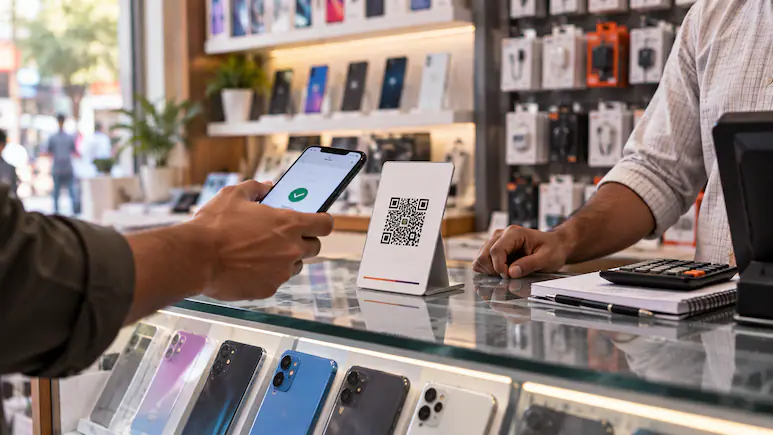
The Centre’s decision to introduce a Merchant Discount Rate (MDR) on selected high-value Unified Payments Interface (UPI) transactions from October 15 has prompted questions over whether the move amounts to a new tax on digital payments.
The government and the National Payments Corporation of India (NPCI), which operates UPI, have said that MDR is a merchant-side payment-processing charge, not a tax, cess or surcharge.
The money is not credited to the Government of India’s Consolidated Fund and is instead distributed within the payments ecosystem. The introduction of MDR does not change the Maximum Retail Price of a product. The MDR is a cost of processing the payment rather than a tax imposed on the underlying purchase. The government does not receive a share of the MDR as tax revenue.
NPCI’s latest statistics show that UPI processed 24,508.96 million transactions worth about Rs 29.82 lakh crore in August 2026 alone. A product priced at Rs 5,000 remains a Rs 5,000 product whether the customer pays using UPI, a debit card or another payment method. UPI had 55.49 crore users by June 2026, according to the Ministry of Finance. Only around 4 per cent of P2M transactions were above Rs 2,000, according to the government’s breakdown, although those higher-value transactions represented a much larger share of the value flowing through UPI.
The government and the National Payments Corporation of India (NPCI), which operates UPI, have said that MDR is a merchant-side payment-processing charge, not a tax, cess or surcharge. The government says the change is intended to provide a more sustainable funding model for an infrastructure that now handles tens of billions of transactions every month.
The argument put forward by the government is that merchants have historically absorbed the MDR associated with debit-card transactions within the same MRP.
