
Lieutenant General Dominique Tardif, Vice Chief of the French Air and Space Force, has said that France’s sixth-generation future system will not simply be a more advanced fighter aircraft but a “sixth-generation combat system” built around collaborative combat.
“We are currently working on the sixth generation and, sixth generation doesn’t mean a sixth generation of fighter. It is not a fighter of the sixth generation. “For that, I think the main inflection will be the manner in which we will be able to enter collaborative combat. To enter collaborative combat means that we have to go a long way in the manner that we can interconnect the different aircraft, platforms, and sensors to be sure that we really enter collaborative combat,” he added. France is developing its next-generation combat capability through the Future Combat Air System, or FCAS, which is intended eventually to succeed the Rafale. “Even if you are in a contested electromagnetic field, you also have to continue to be connected. It means that we also have to imagine some bubble of connection, sometimes fully connected with other bubbles and sometimes very constrained and shrunk in a small bubble. “In this bubble, you are probably able to continue to have connectivity. It means that you also have to develop some directional connectivity between the different bubbles. I think that is a very big point. If we are able to reach that, we are about to reach collaborative combat. After that we are able to imagine another manner to organize all the different platforms,” he added. Rather than relying on one fighter to carry out all the functions required during a mission, General Tardif described a system in which different platforms could perform different roles while remaining connected.
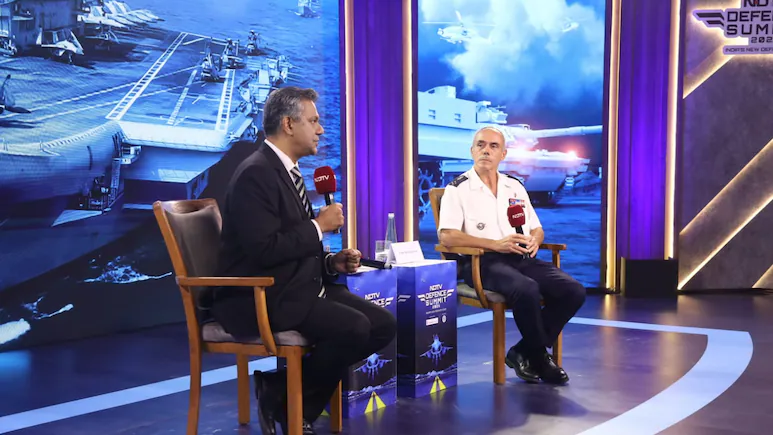
Speaking at the NDTV Defence Summit 2026 , General Tardif said the central change would be the ability to connect different aircraft, platforms and sensors so that they can operate together as part of a single combat system.
It is a sixth-generation combat system,” he told NDTV’s Vishnu Som. His comments came after Defence Minister Rajnath Singh said at the summit that India was looking beyond fifth-generation aircraft and was also looking towards sixth-generation capabilities. “We also have to consider that, because we have learned from different conflicts, the electromagnetic field can be contested,” General Tardif said. General Tardif said France was already considering how artificial intelligence could change the Rafale and future aircraft.
That was why we started with the F1, F2, F3R, and now we are on the F4 and tomorrow we will be on the F5,” he said. “The Rafale has been designed to be able to support different versions. “What is very interesting within this design established by Dassault is being able to, each time, improve the different performances of the different systems, sensors, and weapons, etc. “How will it be able to enter the AI environment? I think it is a big change and I don’t see any air force being able to say right now, ‘We have to do that with AI. “For us in France we will work in order to put more AI in the F5, the next generation of Dassault aircraft. “Right now we also want to start on AI. The reason why, with the Mirage 2000D, we developed two specific aircraft with more calculator capacity on board was in order to be able to fit this calculator with AI to help the crew on different missions,” he added. “For France we are commonly used to training in Europe. In Europe you have NATO so NATO is a good framework in which you can standardise every procedure. “When we come here there is a double advantage: to discover other nations, other air forces, other procedures, and also to discover other platforms. Right from this exercise around here, for the French Air Force, I think they will get a lot of good experience flying with the aircraft,” he added.
General Tardif also said training with aircraft such as India’s Russian-designed Su-30 offered French pilots experience outside the framework in which they normally train.
On artificial intelligence, however, General Tardif said there was still uncertainty over exactly how the technology should be used by air crews. We don’t know very clearly what the AI help should be for the crew,’ he said. It is easier to train together in Europe thanks to NATO,” he said.
