
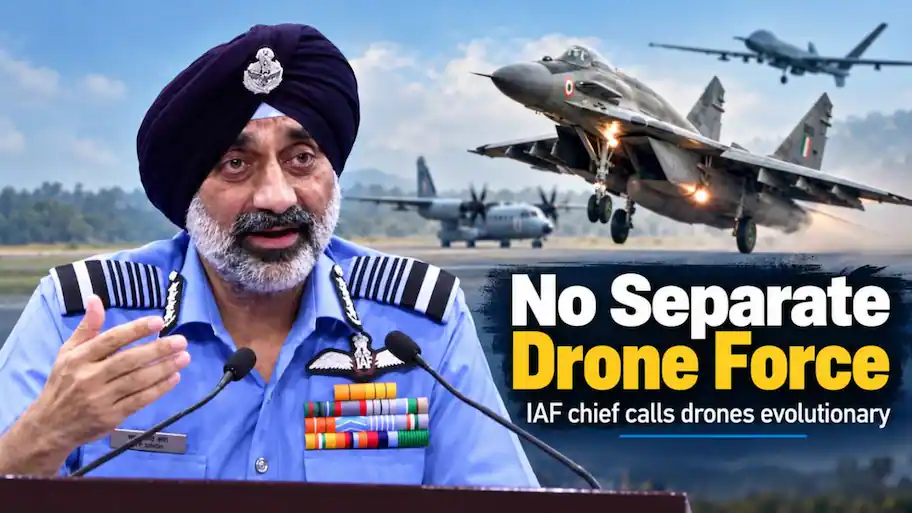
Indian Air Force chief Air Chief Marshal AP Singh has ruled out creating a separate drone force as the service expands unmanned systems and deals with falling fighter numbers. His message is that drones should work inside the existing force, alongside aircraft and other weapons, as the IAF pushes faster induction of Tejas fighters and future combat platforms now too.
“Drones are not revolutionary to the Indian Air Force but evolutionary. We are growing the number of drones and loitering munitions. Whether we need a separate drone force, I don’t think so. We cannot be operating one type of weapon separately somewhere and another type of weapon separately. The IAF already has specialist units handling unmanned systems and can add more when needed. Singh also pointed to their use in combat.
“These have to be together along with other weapons so that they bring in that effect.
The IAF is adding more drones and loitering munitions, but Air Chief Marshal Singh said they should stay inside the existing command structure. They should be a part of the same setup, and we have to be operating together,” Singh said at the IAF’s annual press conference in New Delhi. He said the force wants drones, aircraft and other weapons to operate as one system. So we have not thought of having a separate drone force,” he said. “Loiter ammunition did help us in creating chaos and also taking down some of the AD assets,” he said.
The IAF also released an Unmanned Aircraft System (UAS) roadmap for industry. The policy fits with the IAF’s recent Dronathon-2026 programme at Pokhran.
The Ministry of Defence said the event tested surveillance, swarm, autonomous, electronic warfare and counter-drone systems under operational conditions.
The drone expansion comes at a time when the fighter fleet is under pressure. Air Chief Marshal Singh acknowledged that planned aircraft have arrived more slowly than expected. The IAF is counting on Tejas Mk-1A, the planned multi-role fighter aircraft programme, and Tejas Mk-2 to help cover the gap. Russia has offered the Su-57, though no decision has been taken.
“Everybody understands this fact that our numbers are decreasing; the aircraft that were supposed to come, on which we were relying, they have also come slow,” he said. Air Chief Marshal Singh also said delays in the Advanced Medium Combat Aircraft programme could force the service to study other options. Air Chief Marshal Singh said these programmes need a “whole-of-nation approach” so aircraft reach the force on schedule.
