
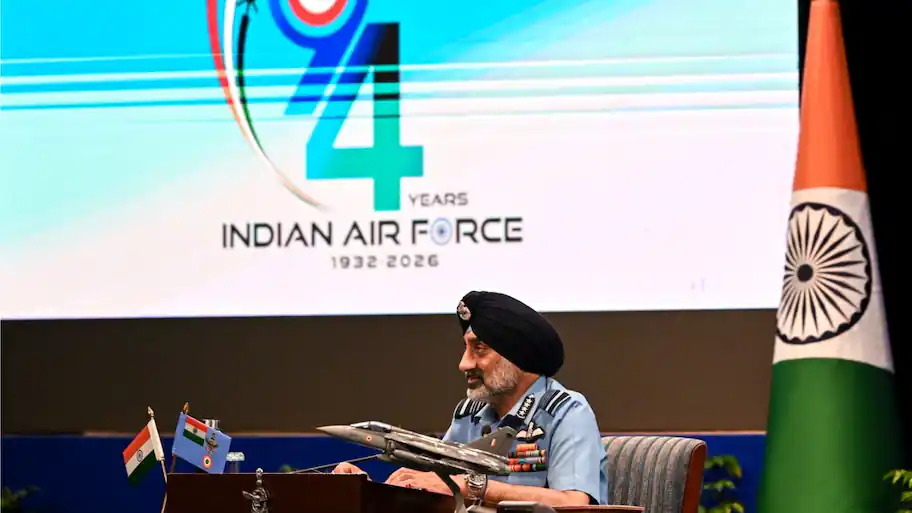
Indian Air Force Chief Air Chief Marshal A P Singh on Saturday said reports of Pakistan working with China on fifth-generation fighter aircraft were a “cause for concern” for India, while stressing that the IAF currently has the capabilities to deal with the potential threat. Speaking at his annual press conference ahead of Air Force Day, Singh said India must speed up the induction of next-generation fighter aircraft and push ahead with the Advanced Medium Combat Aircraft (AMCA) programme.
“Reports suggest that Pakistan may acquire them in the near future. There are even reports that their pilots are already undergoing training in China. Undoubtedly, this is a cause for concern. However, is it a no-go situation?
I wouldn’t agree with that,” he said.
“Pakistan has possessed other platforms in the past, yet they haven’t been able to achieve anything significant with them during Operation Sindoor. Singh also stressed that India cannot afford prolonged delays in its fifth-generation fighter programme. “We must prioritise the early induction of an aircraft of this generation. Price negotiations and other key issues concerning the proposed deal are currently under discussion. Singh also addressed the growing use of drones and loitering munitions, saying the IAF does not see a need to create a separate drone force. “As far as a separate drone force is concerned, in the Indian Air Force, these things have existed for decades. These capabilities have been with us for decades. So, if I can say, drones are not revolutionary to the Indian Air Force. “We are growing in drones; the number of drones, the number of munitions, and the types of drones and ammunition are increasing. The Air Chief also highlighted the role of emerging technology in the IAF’s modernisation, particularly artificial intelligence. He also stressed the importance of self-reliance in India’s defence capabilities and underlined the need to develop and manufacture a fighter jet engine domestically. He noted that the exercise has brought new aircraft and participating countries to India, with F-35s taking part in a multilateral exercise in the country for the first time.
Russia has already offered its Su-57 fifth-generation fighter to India, although Singh made it clear that no decision has been taken on the proposal. The government cleared a proposal in February to acquire 114 Rafale fighter jets from France through a government-to-government arrangement. The proposed acquisition is part of India’s wider effort to strengthen the IAF’s fighter fleet, which currently has 29 squadrons against an authorised strength of 42. Singh said the force needs to induct around 36 to 40 fighter aircraft every year over the next few years to arrest the decline in squadron strength. Tarang Shakti Phase 2 is being held at Jodhpur airbase from September 26 to October 12, with more than 80 aircraft and over 2,000 personnel from 40 countries taking part. (With agencies’ input)
Singh said the capability of a fighter aircraft cannot be judged by the platform alone and depends heavily on how well it is integrated with a country’s wider military system. Similarly, if we effectively integrate the platforms we are purchasing and inducting, we should be able to counter this threat, at least for the time being, until they fully integrate these new aircraft into their own systems,” the Air Chief Marshal said. He said the AMCA project needs to move ahead quickly and indicated that the IAF could consider other options if the programme is delayed. We need to push the AMCA program forward; if there are delays, we must make alternative decisions,” he said. “Russia has offered us Su-57 jets, but no decision has been made on it,” he said. The IAF chief also said India is looking to finalise the long-pending Multi-Role Fighter Aircraft (MRFA) deal within the current financial year, provided the ongoing process moves as planned. Yes, they are evolutionary,” he said. He said the IAF is expanding its inventory of drones, munitions and different types of unmanned systems, but these capabilities should operate alongside other weapons rather than as an independent force. Whether we need a separate drone force, I don’t think so,” Singh said. At the same time, he said the IAF already has specialised drone units and could increase their numbers if required. “We have to have an AI-augmented force,” he said. Speaking about the multilateral Tarang Shakti exercise, Singh said such exercises are aimed at improving interoperability, building closer ties and allowing participating forces to learn from one another. “The whole idea of any multilateral exercise, international-level exercise, is to generate bonhomie and to have interoperability and to learn from each other’s experiences and each other’s way of working,” he said.
