
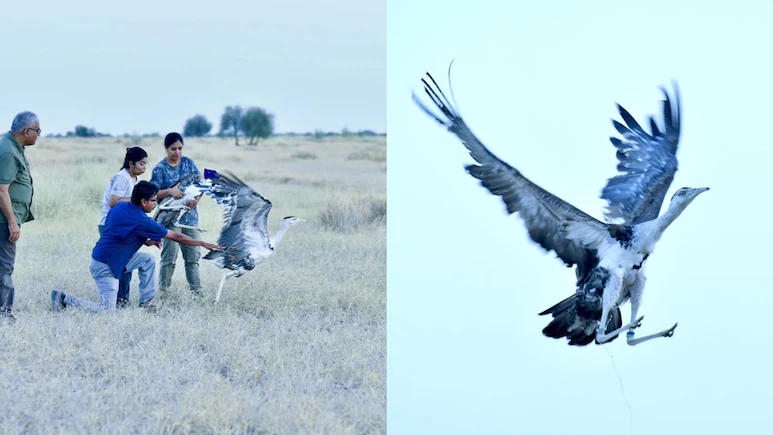
As India celebrated a landmark conservation achievement with the release of two captive-bred Great Indian Bustards into the wild in Rajasthan’s Desert National Park, scientists are simultaneously sounding alarm bells over the growing threats facing the country’s birdlife.
The birds are among those bred under a conservation programme jointly run by the Ministry of Environment, Forest and Climate Change, the Rajasthan Forest Department and the Wildlife Institute of India. Eleven birds have been selected for eventual release, with the first two now taking flight in the deserts of Rajasthan. A comprehensive new study published in the journal ‘Indian Birds’ warns that the country’s avifauna or bird life is facing unprecedented pressures. Two species have already gone extinct from India, suggest experts. The paper identifies a wide range of dangers confronting birds across India. These include habitat loss and degradation, monoculture plantations, rapid urbanisation, environmental pollution, illegal hunting and trade, climate change, avian diseases, sand mining, wind farms and associated energy infrastructure, and expanding networks of power transmission lines. The study warns that conservationists still lack sufficient long-term data to fully understand how many bird populations are being affected and at what rate.
Conservation centres at Sam and Ramdevra currently house 97 Great Indian Bustards. Of these, 40 originated from wild-laid eggs while 57 have been bred in captivity. Scientists produced 24 live chicks in 2025 and another 29 in 2026. The paper, authored by Prof Ghazala Shahabuddin and 10 other ornithologists published this week titled ‘A Review of the Threats to Indian Birds and Habitats’, examines the multiple threats driving declines across India’s bird populations.
“India’s avifauna faces a complex array of anthropogenic and emerging threats that affect both species and ecosystems,” writes Dr Ghazala Shahabuddin of Ashoka University, Sonepat and her co-authors in the review.
Climate change is increasingly affecting bird distributions. Mountain species in the Himalayas and Western Ghats are expected to be particularly vulnerable. Stark, rapid development, infrastructure expansion and continuing habitat loss are exerting increasing pressure on bird populations across India. scientists say that the future of India’s birds will ultimately depend on ensuring that development and biodiversity conservation proceed together While two young bustards taking flight over Rajasthan’s desert represent hope.
Scientists say that nearly 70 per cent of Indian bird species may shift northward or move to higher elevations as global temperatures rise.
