
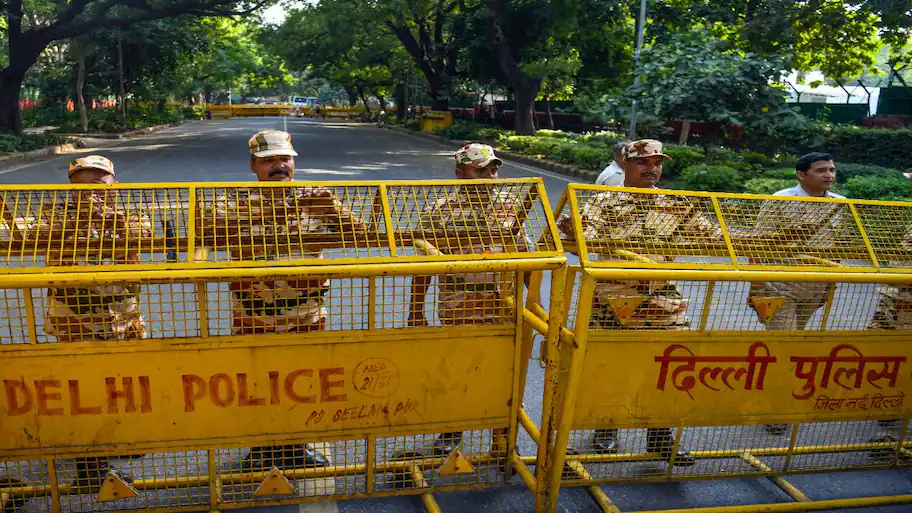
New Delhi: A protest over the conduct of an election watchdog has turned into a test of how much disruption a democracy is prepared to tolerate. Delhi is witnessing an extraordinary lockdown on Saturday (October 10) in the wake of the protest by the Cockroach Janata Party’s (CJP) against Chief Election Commissioner (CEC) Gyanesh Kumar. Around 30,000 police and paramilitary personnel have been deployed, entry and exit gates at 45 metro stations were closed and traffic restrictions affected routes leading to the national capital.
The sweeping restrictions in Delhi have tested the balance between public order and the right to protest. How should a government respond when people want to demonstrate against the very institutions responsible for carrying out impartial elections? Public safety is a legitimate priority, particularly when the police anticipate clashes or attempts to breach barricades. At the same time, restrictions on transport, movement and public gatherings also affect people who have no intention of joining a protest. The episode has echoes of student-led movements in France, where demonstrations have time and again brought public anger into the streets and forced governments to confront demands that could not be addressed only through elections. The movement began with grievances over university conditions and mounting opposition to traditional authority. The arrests and clashes that followed brought more students onto the streets. France’s more recent experience also illustrates the difficult balance between protest rights and public order. Some protests descended into violence, while the police response faced criticism from rights groups. That experience explains why a democracy must address violence, damage to property and threats to public safety. The police have a duty to protect residents, commuters, businesses and protesters. The same duty requires authorities to ensure that restrictions are justified by specific risks and do not become a blanket response to political dissent. The security operation in Delhi went far beyond the barricades around Jantar Mantar. A passenger heading to a railway station may have to find an alternative route through the capital. Shopkeepers and small businesses near restricted areas can lose customers when movement is curtailed. These costs affect ordinary residents, including those with no connection to the CJP or its demands. The authorities have a case to make if they believe a gathering could lead to clashes or a breach of public order. Delhi has also witnessed protests that have required substantial police deployment. However, the scale of a security operation should be assessed against the actual threat, the size of the proposed gathering and the availability of less disruptive measures. The CJP was denied permission to hold its planned demonstration at Jantar Mantar. The rules governing the venue and the timing of the application are relevant to the police decision. The denial of permission does not automatically settle whether every restriction imposed across the city was necessary. Authorities can enforce reasonable conditions, limit crowd sizes, designate a venue and take action against unlawful conduct. They must also consider whether the same objectives could be achieved without extensive disruption to the city. The experience of France shows how protests can spread beyond their original demands, while its more recent demonstrations show why police conduct and the treatment of protesters also need scrutiny. In Delhi, the immediate dispute revolves around CJP’s demand for action against CEC Kumar. In Delhi, the immediate dispute revolves around CJP’s demand for action against the chief election commissioner. The judgment acknowledged both the importance of public protest and the need to manage competing public interests. The debate is not simply about whether the CJP should be allowed to protest. It is also about how the state can protect public order while preserving the ability of citizens to gather, speak and demand accountability without imposing unnecessary costs on an entire city.
Because of a blocked route, a daily-wage worker travelling across the city may lose a day’s earnings. In May 1968, a student protest in France escalated into a national crisis. The situation snowballed after the police intervened at a student gathering at the Sorbonne in Paris on May 3. By May 13, trade unions had joined demonstrations across France, and a wave of strikes followed. In 2023, demonstrations against President Emmanuel Macron’s pension reform brought large crowds onto the streets. The closure of gates at 45 metro stations disrupted access to public transport, while traffic restrictions threatened delays on as many as 30 routes leading towards New Delhi. The group had applied only three days before the event, although the applicable process required an application at least 10 days in advance. In its 2018 ruling on protests at Delhi’s Jantar Mantar and Boat Club, the court recognised the right to peaceful demonstrations and directed authorities to set rules governing protests at these sites. Delhi’s October 10 restrictions have put that balance to the test.
The police also deployed personnel at “sensitive” locations across the capital.
The Supreme Court has previously addressed this balance.
The episode offers an important lesson about the relationship between public order and protest. A gathering that begins with a specific demand can acquire a much larger meaning when people feel their grievances are being dismissed. In Paris, university protests spread beyond campuses and became part of a national movement involving workers and trade unions. The comparison with Delhi has limits. The historical parallel lies in the role of public protest as a means of challenging institutions and demanding accountability. The report questioned the legal basis for some detentions and warned against preventive detention becoming routine. The United Nations Human Rights Committee, in its General Comment No. Restrictions must meet the requirements of legality, necessity and proportionality. The right does not give organisers unlimited freedom to occupy roads or disregard lawful directions. However, it does require authorities to treat peaceful assembly as a constitutional right rather than an inconvenience to be eliminated.
France in 1968 faced a far-reaching social and industrial crisis, while the October 10 demonstration in Delhi is being organised around demands targeting the CEC. A report published in May 2023 by France’s Controller General of Places of Detention and Imprisonment criticised arrest and detention practices during the demonstrations. 37 on the right of peaceful assembly, describes peaceful protest as an important part of participatory governance. India’s Constitution protects the right to assemble peacefully and without arms under Article 19(1)(b), subject to reasonable restrictions in the interests of public order and the sovereignty and integrity of India.
It says public gatherings allow people to express support or opposition, bring grievances into the public domain and seek peaceful solutions to disputes.
