
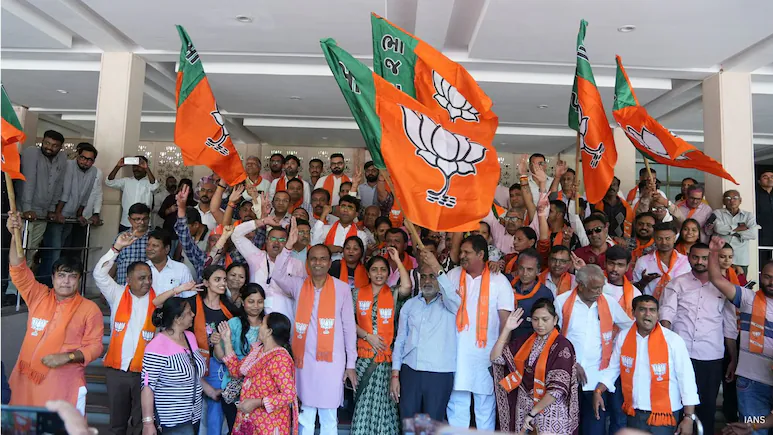
The election results for the Gandhinagar Municipal Corporation have reaffirmed the ruling Bharatiya Janata Party’s firm grip over the state capital, while simultaneously reshaping the contours of Gujarat’s opposition politics.
The outcome underscored the continuing electoral pull of the ruling party in key urban centers, while serving as a strategic test for opposition parties seeking to regain lost ground in the state’s political core. Falling under the Gandhinagar Lok Sabha constituency represented by Union Home Minister Amit Shah, the administrative headquarters of Gujarat has long been a prestigious political battlefield. Historically, the civic body witnessed fierce tussles, with the Congress exercising substantial dominance before 2012, when urban expansion and organisational shifts firmly anchored Gandhinagar as a formidable bastion of the BJP.
The most dramatic narrative of the election unfolded around the Aam Aadmi Party, which suffered a devastating setback in the state capital. The complete erosion of AAP’s electoral base highlighted the structural challenges confronting third-party politics in Gujarat’s bipolar urban landscape. Beyond local administrative control, the civic poll carries broader political significance for Gujarat’s electoral map. The results demonstrate that while the BJP remains comfortably entrenched in Amit Shah’s parliamentary constituency, the Congress has managed to revive its grassroots presence after past setbacks. As the municipal body prepares for a new term, the outcome signals a return to classic two-party dynamics in Gandhinagar, setting a compelling backdrop for upcoming regional political contests.
The AAP saw its vote share plummet from 13.91 percent in 2021 to 4.36 percent, failing to win a single seat. In a stark reflection of its waning urban momentum, all 32 candidates fielded by the party lost their security deposits.
