
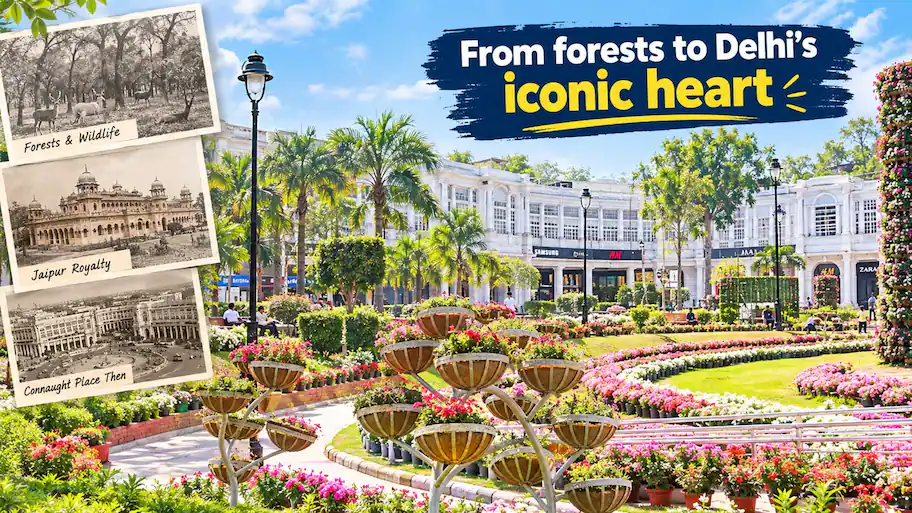
Today, the site frequently makes headlines for major civic events, political rallies, and high-security traffic diversions—most recently drawing attention ahead of a planned Tiranga March by Cockroach Janta Party (CJP) founder Abhijit Dipke. Long before white-pillared colonnades and luxury brand showrooms defined Delhi’s commercial center, Connaught Place and its famous Central Park were nothing more than a rugged forest dotted with small villages.
The green oasis known today as Central Park was shaped by massive infrastructure changes over the decades. How did a wildlife-filled expanse of babool and scrubland transform into the pulsing epicenter of Lutyens’ Delhi? The answer lies in a century of sweeping urban transformation. At the turn of the 20th century, the land encompassing modern Connaught Place was a rural landscape of thick brush, home to partridges and wild game. The Jaipur rulers : The area was primarily comprised of villages like Jaisinghpura and Raja Ka Bazaar. This territory belonged to the rulers of Jaipur—originating from a grant given to Sawai Jai Singh II by Mughal Emperor Muhammad Shah. Sacred landmarks : The terrain housed ancient focal points, notably the historic Hanuman Temple and the Jantar Mantar observatory. Tuesday visitors : Old Delhi (Shahjahanabad) residents occasionally journeyed through the wilderness on Tuesdays solely to visit the temple. Residents of Jaisinghpura were relocated toward Karol Bagh and Paharganj. Designed by architect Robert Tor Russell in a two-story Georgian architectural style, the layout featured two concentric circles. Royal naming : The complex was named Connaught Place and Connaught Circus in honor of Prince Arthur, the Duke of Connaught and Strathearn (third son of Queen Victoria). Early character : Initially famous for its outdoor bookstores, footpath vendors, iconic coffee houses, and legendary eateries like Wenger’s, the district later saw unofficial local renaming to Rajiv Chowk and Indira Chowk (though Metro station names stuck permanently).
When the British administration decided to expand Delhi in 1912, they initiated land acquisition proceedings that took over a decade to finalise by 1925. Construction of the grand commercial market began in 1929 and finished in 1933. In 2001, the Delhi Metro Rail Corporation (DMRC) took over the subterranean space to build the Rajiv Chowk interchange station, completely redesigning the surface above. Reopening in 2006 : The modern Central Park reopened in 2006, spanning 27,000 square meters of meticulously landscaped greenery. Flora & features : DMRC planted roughly 700 trees and 2,750 shrubs—including white champa, royal palms, and pink tabebuia—alongside 21 fountains, water bodies, and a cascading waterfall. Amphitheatre & gates : The park features a 500-seat open-air amphitheatre and nine entry gates, two of which connect directly down into the Rajiv Chowk Metro Station.
Before the Delhi Metro arrived, the inner circle featured open green spaces, fountains, and informal meeting spots near popular coffee houses.
