
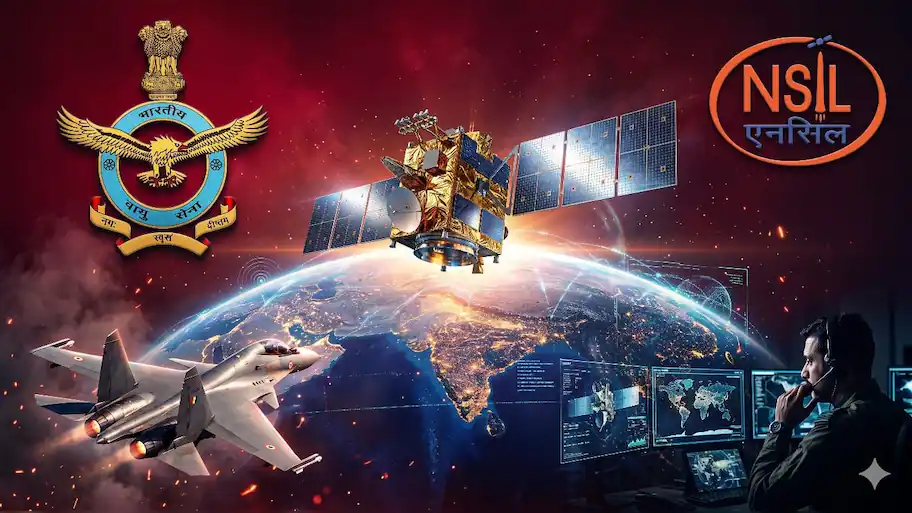
It must keep Indian Air Force (IAF) pilots, bases and command centres in contact even when other communication systems fail. Its name is GSAT-7C. In a Bengaluru laboratory, engineers at the U R Rao Satellite Centre are building a machine that will one day orbit nearly 36,000 kilometres above the Indian Ocean.
To understand its importance, imagine a fighter pilot streaking over the Arabian Sea or a transport crew threading a Himalayan valley. Ordinary radios work much like shouting across a field. Once the signal slips beyond the horizon or behind a mountain, the voice simply cuts out.
On October 15, 2026, it moved from a long-held promise to a signed commitment, when the Ministry of Defence inked a contract worth Rs 2,563 crore (about US$270 million) with NewSpace India Limited, an ISRO’s commercial arm, to build and launch it. The signing took place in New Delhi along with a Rs 1,543 crore deal for Varunastra torpedoes for the Navy, taking the day’s total to roughly Rs 4,106 crore.
What sets this spacecraft apart is its single-minded purpose. More are planned under the same family. For the men and women in blue, the stakes are intimate rather than abstract. A reliable link can mean a rescue helicopter that reaches a stranded village in time. It can mean a warning that reaches a pilot before danger does, or a voice from home that steadies a nervous heart on a lonely forward airbase.
India’s first military communication satellite, GSAT-7, has served the Navy since 2013, and the GSAT-7A later gave the Air Force its first satellite link.
Those earlier satellites handle a range of different duties.
The GSAT-7C exists to solve that ancient problem. It will be parked in geostationary orbit, a special height where a satellite circles the earth at exactly the planet’s own rotation speed and so appears to hang motionless over one spot. There it becomes a fixed relay in the sky. A message sent upward from one corner of the country bounces back down to another, no matter how far apart the two ends are. In plain terms, an air commander in Delhi can speak clearly with an aircraft over the Andaman Sea as though they were in the same room. The GSAT-7C, the Air Force’s second dedicated satellite, will serve that force exclusively and will be devoted entirely to secure links for modern radios that can change their behaviour through software. Think of a smartphone compared with an old rotary telephone. A traditional radio has its frequencies and codes fixed in hardware. A software-driven one can rewrite itself on the move, hopping channels, changing encryption and adapting to the battlefield in real time. The forces use such sets, known in service as BNET tactical radios. Pairing them with a dedicated satellite gives the IAF a private and encrypted conversation that an adversary cannot easily jam or eavesdrop upon. That day the Defence Acquisition Council, chaired by Defence Minister Rajnath Singh, gave the project its first green light, the formal approval that the need was real and worth funding. The sanction applied to both the satellite itself and the ground hubs. These are the earthbound stations that connect the orbiting relay to the radios in cockpits and control rooms and keep the whole network alive, minute by minute. The spacecraft will be built on a proven ISRO platform. That leaves engineers free to design the specialised communication equipment on top. Lifting it skyward will be the GSLV Mk II, India’s workhorse rocket for heavier payloads bound for high orbits. Every stage of the journey, from the first sketch to the final countdown, will take place on Indian soil and by Indian hands. That is not a small boast. For decades the country’s defence relied on borrowed or purchased capability. The GSAT-7C stands as proof that the ambition of self-reliance, Atmanirbhar Bharat, has reached even the most sensitive corner of national security. Behind the specifications are thousands of people – welders and coders, orbital experts and radio engineers. Many will never see their names in print. Yet when the rocket clears the tower at Sriharikota, each will know that a piece of their lives is climbing with it. In that sense GSAT-7C is more than hardware in the heavens. It is a promise written in silicon and steel that no Indian airman will ever again be out of reach. (Girish Linganna is an award-winning science communicator and a defence, aerospace and geopolitical analyst. He is the managing director of ADD Engineering Components India Pvt. Ltd.)
The road to this contract began on November 23, 2021. At that stage the programme was valued at Rs 2,236 crore, roughly US$280 million in today’s money. In this case, the frame is ISRO’s I-2K bus, built for satellites of around 2,000 kilograms. Launch is planned for 2027 or 2028, with the system expected to be operational by 2030.
Engineers call this “beyond the line of sight” communication. Just as a city bus is a standard chassis onto which different bodies can be fitted, a satellite “bus” is a ready frame that supplies power, steering and temperature control.
