
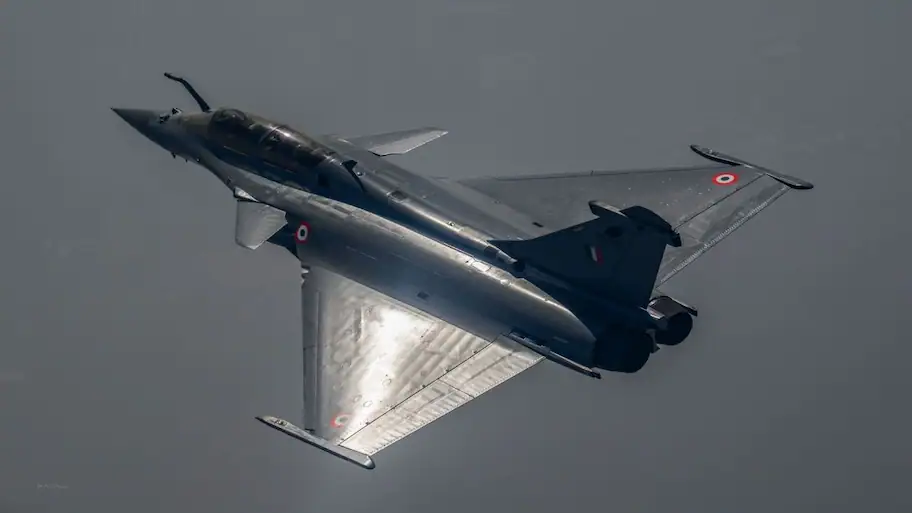
New Delhi: India’s planned induction of the Rafale Marine fighter hinges on a technical challenge that goes beyond buying a new combat aircraft. The Indian Navy has begun trials of the French-built jet at its facility in Goa to assess its suitability for operations from INS Vikrant and INS Vikramaditya, both of which use ski-jump ramps for take-off instead of the catapult systems used by some foreign aircraft carriers.
The trials at the Navy’s Shore-Based Test Facility at INS Hansa are aimed at verifying the aircraft’s performance against the requirements of Indian carrier operations. The facility replicates the ski-jump design used on both aircraft carriers. Indian carriers use the short take-off but arrested recovery (STOBAR) system. Aircraft accelerate up a ski-jump ramp to take off, while arresting wires help bring them to a halt when they land on the deck.
Because the Rafale Marine was developed for operations from France’s aircraft carrier Charles de Gaulle, which uses a catapult to launch aircraft, the technical issue is important. The development precedes the induction of 26 Rafale Marine aircraft under India’s agreement with France.
India’s trials will help establish how the Rafale Marine performs within this different carrier-launch system. The Navy had also tested the aircraft at the Goa facility during a 12-day evaluation in January 2022, when India was assessing carrier-based fighter options.
What the Rs 63,000-crore deal includes
The Ministry of Defence has confirmed the technology-transfer provision, which creates a route for Indian weapons to be adapted for use on the Rafale Marine. Carrier operations place different demands on a fighter from those faced by aircraft operating from conventional runways. A jet must take off from a short deck, operate in a maritime environment and land at sea with the help of arresting equipment. Its landing gear and airframe must withstand the forces generated during repeated carrier landings. The Rafale Marine has reinforced landing gear and foldable wings for carrier use. Folding the wings helps the Navy store more aircraft in the hangar below the flight deck. The Navy’s existing carrier fighter fleet depends on the Russian-origin MiG-29K. The Rafale Marine is expected to replace these aircraft gradually and provide a newer option for air defence and strikes against maritime and land targets. The four twin-seat aircraft will be used for training on land. The contract also provides for technology transfer to support the integration of Indian weapons into the aircraft. It includes a production facility for Rafale fuselage sections in India and maintenance, repair and overhaul facilities for engines, sensors and weapons. These provisions could give Indian companies a role in the aircraft’s supply chain and support work beyond its initial purchase. The ability to integrate locally developed weapons could become one of the more consequential parts of the programme. Such integration requires technical work and testing. A weapon must be compatible with the aircraft’s software, mission systems and operating limits before it can be cleared for service. The agreement does not mean every Indian weapon will automatically be available for use on the jet. Sharing the same aircraft family could help the Navy and Air Force coordinate some aspects of training, maintenance and logistics, although the naval version has additional requirements for carrier operations. With the new order, India is set to operate both land-based and naval versions of the Rafale. The immediate task in Goa is to establish the aircraft’s suitability for India’s carriers. The main test will be whether the Navy can bring the jet into service while building the training, maintenance and weapon-integration capabilities needed for its long-term use.
The Navy will therefore need to prepare its crews and support teams for the operational version through the training package and other provisions included in the agreement. The aircraft has a reported combat radius of around 1,000 km, giving carrier commanders the ability to deploy fighter missions over considerable distances from the ship. India and France had signed an inter-governmental agreement on April 28, 2025, for 26 Rafale Marine aircraft. The package comprises 22 single-seat fighters and four twin-seat aircraft for training. Deliveries are scheduled to be completed by 2030. The Indian Air Force already operates 36 Rafale fighters.
The aircraft can carry air-to-air weapons, including Meteor and Mica missiles, along with precision strike weapons such as Hammer and Scalp, according to The Tribune. The Ministry of Defence had said the deal includes weapons, simulators, associated equipment, crew training and performance-based logistics support. The twin-seat Rafale Marine has not been cleared for carrier operations, according to India Sentinels.
