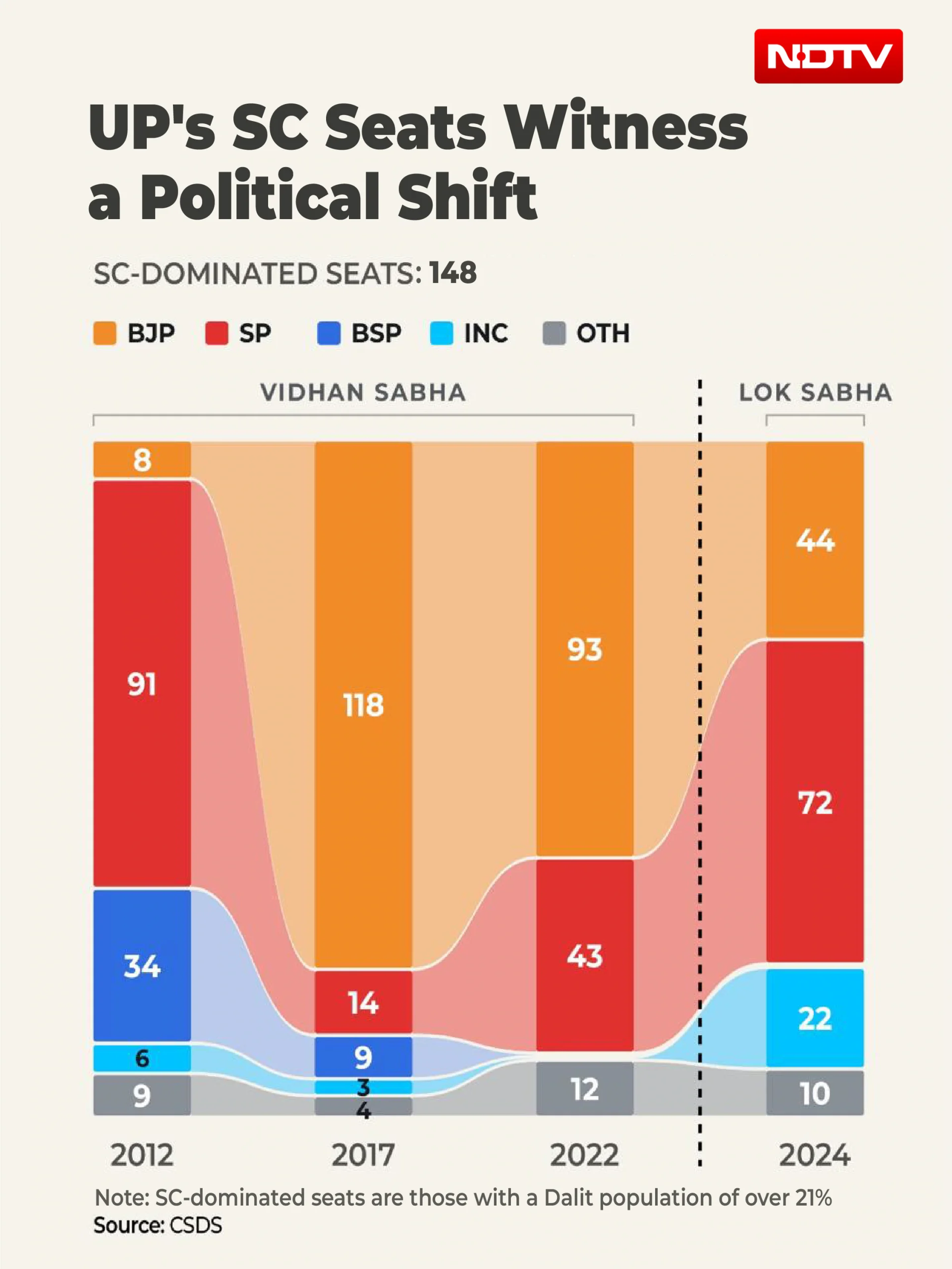
Uttar Pradesh’s politics has long run on caste arithmetic, and no bloc has been more consequential or more contested in recent years than the Dalits. For decades, they were seen as the private preserve of Mayawati’s Bahujan Samaj Party (BSP). That is no longer true. A vote that reaches far
As the 2027 election approaches, Dalits, who make up about one in five voters, could decide who governs India’s most populous state. Scheduled Castes (SCs) account for about 21% of the state’s population. Ahead of the 2027 assembly election, the BJP, the Samajwadi Party (SP)-Congress alliance, and newer outfits like Azad Samaj Party are all courting Dalit voters, and their outcome could shape the next government.
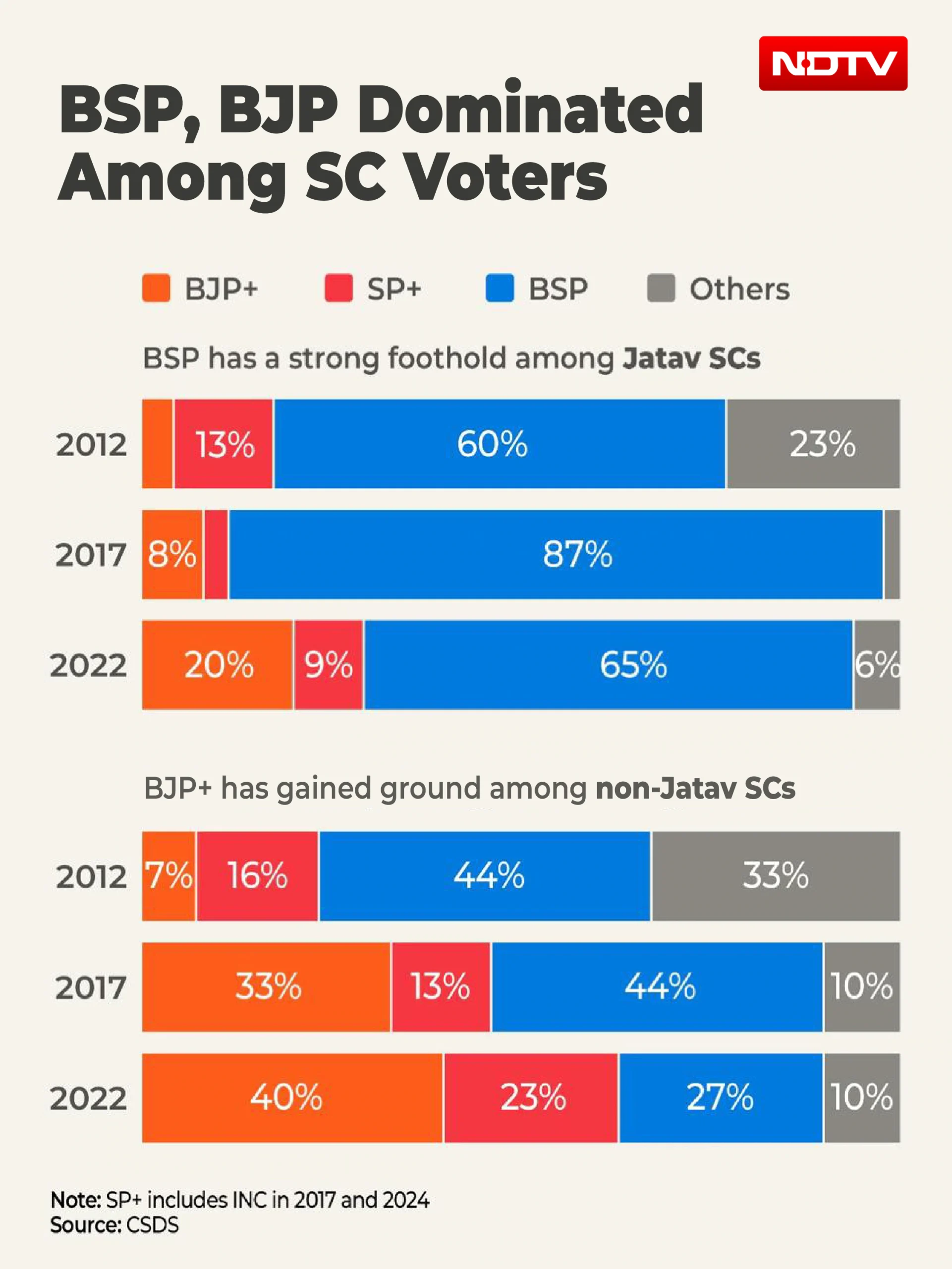
The BSP’s lost votes did not go to one place. The Dalit population is not evenly spread. Two communities, not one The Dalit electorate is not monolithic. Jatavs stayed loyal for two decades. Non-Jatavs moved first The non-Jatavs left first. The presence of the Congress in the alliance helped, as did the campaign warning that the Constitution and reservations were in danger. Jatavs moved too. Non-Jatavs went mostly to the SP+, while Jatavs split between the SP+ and the BJP. Even where its base is most concentrated, it is no longer the force it was, and it may not even play spoiler. A weakened Mayawati, a growing challenger The BSP’s decline has hurt the party’s standing beyond arithmetic. New players are trying to fill the space. The parties’ strategies Each major party is tailoring its pitch. The SP is planning to field SC candidates even in general, unreserved seats. It is also reportedly adopting blue, the colour associated with Dalit identity and Ambedkarite politics, for the dress of its student wing, the Samajwadi Chhatra Sabha. The BJP faces a more delicate task. It hopes to win back non-Jatavs through welfare schemes and to attract Jatavs through political representation. Having built its rise on non-Jatav support, it cannot afford to lose that base for good. The BSP is attempting to revive its SC votebank through Aakash, who is decently popular amongst youth and is Mayawati’s counter to Ravan. Who benefits from the BSP’s fall? If the remaining Jatav loyalists drift toward the SP+, the BJP’s prospects could be dented further. Every party is thus eyeing the Jatav bloc, the last large piece of the old BSP base still up for grabs. Non-Jatavs are the swing group. It’s also important to see whether BSP holds onto its last support base of Jatavs and gets back a slice of non-Jatav votes. With Dalits potentially deciding the outcome in more than a third of the state’s seats, the answer may determine who governs Lucknow. (Amitabh Tiwari is a political strategist and commentator.
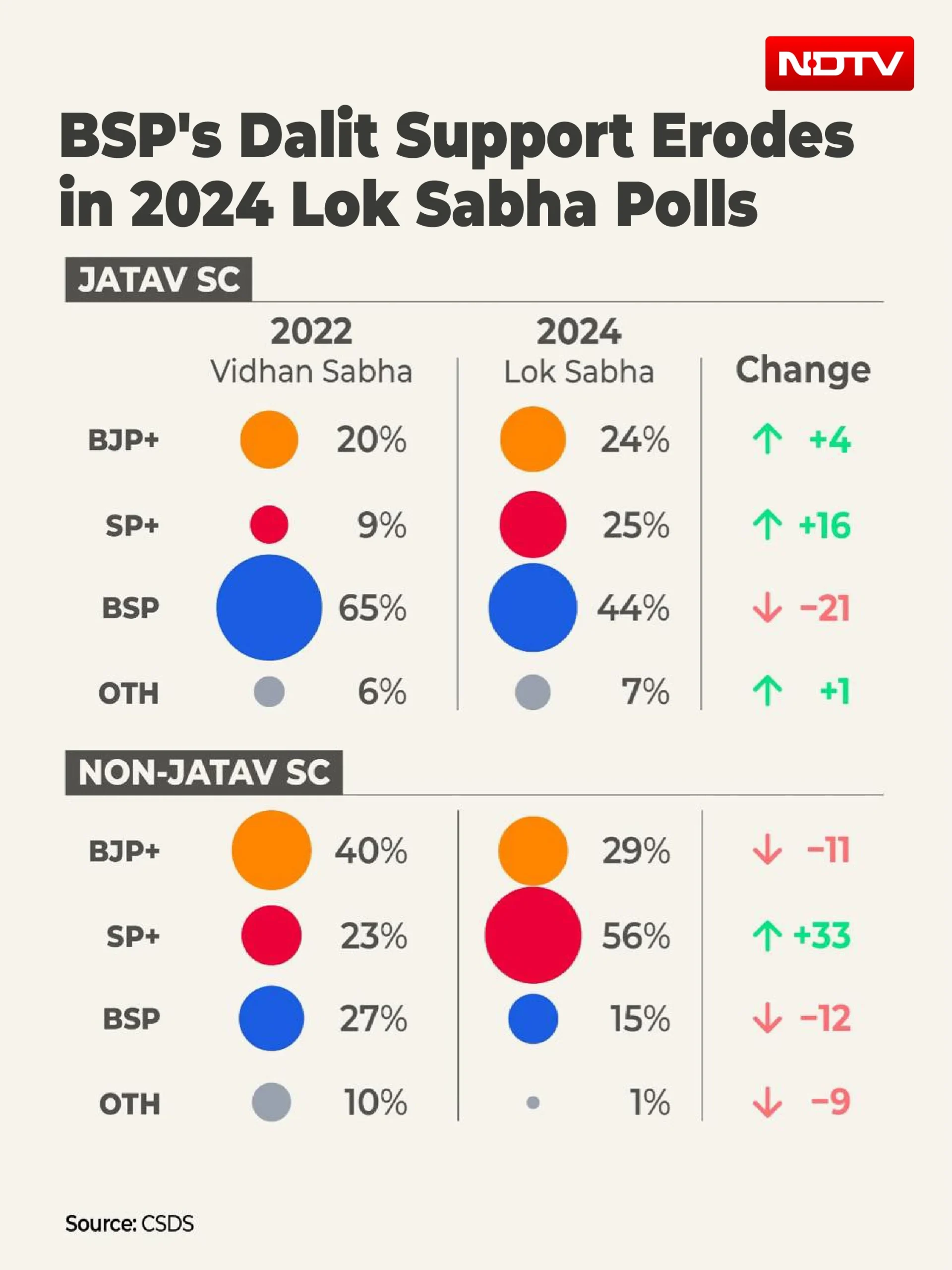
Kaushambi, Sitapur, Hardoi, Rae Bareli, and Unnao districts each have SC populations above 30%. At the other end, Shamli, Baghpat, Moradabad, Bareilly, and Balrampur districts sit between 11% and 13%. Eight assembly seats have an SC population above 40%, while 144 seats have less than 10%. It matters most in the 122 seats where SCs make up 20-30% of the population. Across 148 of the state’s 403 seats, the Dalit share exceeds the state average, and these are the seats where the community can most influence the result. Jatavs, about 12% of voters, are the BSP’s traditional core. Non-Jatav SCs, about 9%, are a more fragmented group, and the BSP was never as dominant among them. Its support there ran between 44% and 54% through 2017. BSP support in the community ranged from 60% to 87%, and it held firm even in 2022, when the party won a single seat. The break came only in 2024, when the BSP’s Jatav share fell to 44%. The BJP’s share among them jumped from 7% to 33% in 2017, a gain of 26 points, and reached 40% in 2022. The BJP exploited the differences between the two Dalit groups and built a coalition of upper castes, non-Yadav OBCs, and non-Jatav SCs that accounted for roughly 60% of the population. Meanwhile, the BSP’s non-Jatav support fell to 27% in 2022 and 15% in 2024. The BJP’s Jatav numbers stayed in single digits until 2017, then rose to 20% in 2022 and 24% in 2024. 2024: the reversal The 2024 general election broke the pattern. The BJP’s share among non-Jatavs dropped from 40% to 29%. Their support for the SP+ nearly tripled from 9% to 25%, matching the BJP among the community for the first time. The loss of the non-Jatav bloc cost the BJP a crucial 9% support gained by the SP+. Projected onto assembly segments, the SP+ led in about 225 seats and the BJP+ in 174, against a simple majority mark of 202 largely on account of this movement. The seat-level story The shifts show up clearly in the 148 seats with above-average Dalit populations: The BSP has gone from 34 seats in these constituencies to zero. Aakash Anand, Mayawati’s nephew, who was reappointed as national coordinator on October 5, just 25 days after being expelled on September 10, is trying to revive the BSP vote base. The tactic worked in 2024, when the party won Faizabad (Ayodhya) with a Dalit candidate. He addressed his first post-reinstatement public rally in Bulandshahr on October 28, pledging his loyalty to Mayawati and urging workers to prepare for the elections. The BSP’s decline has so far helped the SP more than the BJP, in both 2022 and 2024. That matters for 2027. The road to 2027 The Dalit vote in Uttar Pradesh has moved from a BSP monopoly to a genuine three-way contest. They powered the BJP’s gains in 2017 and 2022 and the SP+’s lead in 2024. The question for 2027 is whether the SP+ can hold on to its non-Jatav gains while continuing to draw Jatavs, or whether the BJP can win them back.
This “non-Jatav SC consolidation” was central to the party’s 2017 sweep. Non-Jatav SC support for the SP and its ally, the Congress, together constituents of the “INDIA bloc”, rose from 23% in 2022 to 56%. Mayawati is seen as less active and less forceful than in her prime, and the “B-team of the BJP” label has stuck to her, feeding the perception that the BSP splits opposition votes to the ruling party’s benefit. Chandrashekhar Azad “Ravan” of the Azad Samaj Party (ASP) is gaining some traction among Dalit youth, having won the Nagina Lok Sabha seat, though his party’s reach is still limited.
In his earlier avatar, he was a corporate and investment banker) Disclaimer: These are the personal opinions of the author