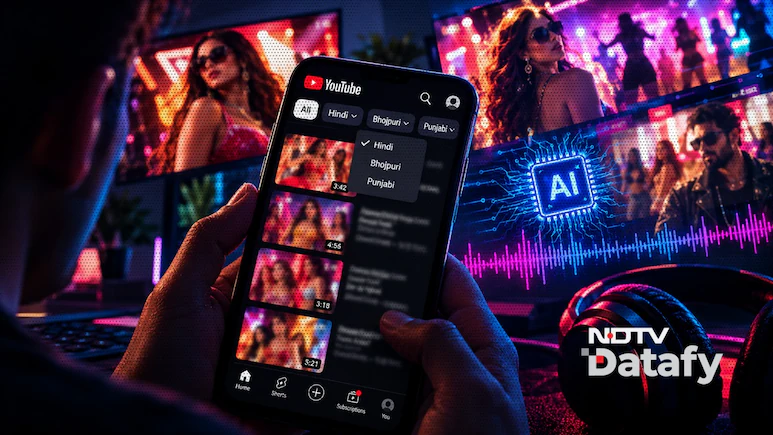
YouTube is serving AI-generated songs describing graphic sexual acts, incest and the sexualisation of children to accounts set up for Indian minors, an NDTV investigation has found.
Over three days of testing, NDTV Datafy found hundreds of songs in Hindi, Bhojpuri and Punjabi describing sexual acts in graphic detail, often accompanied by explicit thumbnails and titles. Research has linked exposure to sexually explicit media among adolescents with a range of behavioural and psychological outcomes, though findings vary across studies. Over the course of three days, we found hundreds of songs describing sexual acts in graphic detail and depicting problematic sexual behaviour. Many carried explicit thumbnails and titles in Hindi, Bhojpuri and Punjabi. The content appears to raise questions not only about compliance with YouTube’s own policies, but also about whether some material could potentially violate Indian laws governing obscene and child-related content online. NDTV Datafy ran tests in three scenarios: logged-out YouTube use, and two minors’ accounts set under parental supervision. YouTube returned songs describing sexual acts in explicit terms. Their thumbnails carried sexual slogans in large letters. When one song ended, YouTube did not stop there. Such supervised child accounts should never show explicit sexual content, whatever setting a parent picks. In our test, they did. We asked this question to Sagar Vishnoi, who works on the intersection of AI, policy and online safety, and shared our samples. “It looks like they are meant for sexual gratification. Many of the videos were flagged as AI-generated by Quicksilver, an AI music detection a browser extension developed by the University of Chicago.
The songs surfaced both while signed out and on supervised accounts set up for children under 13 years of age. Parental settings allowed these accounts to watch content suitable for 9+ years and 16+ years. Other content, such as sexually suggestive material or vulgar language, can be age-restricted and cannot be watched by anyone signed out or under 18.
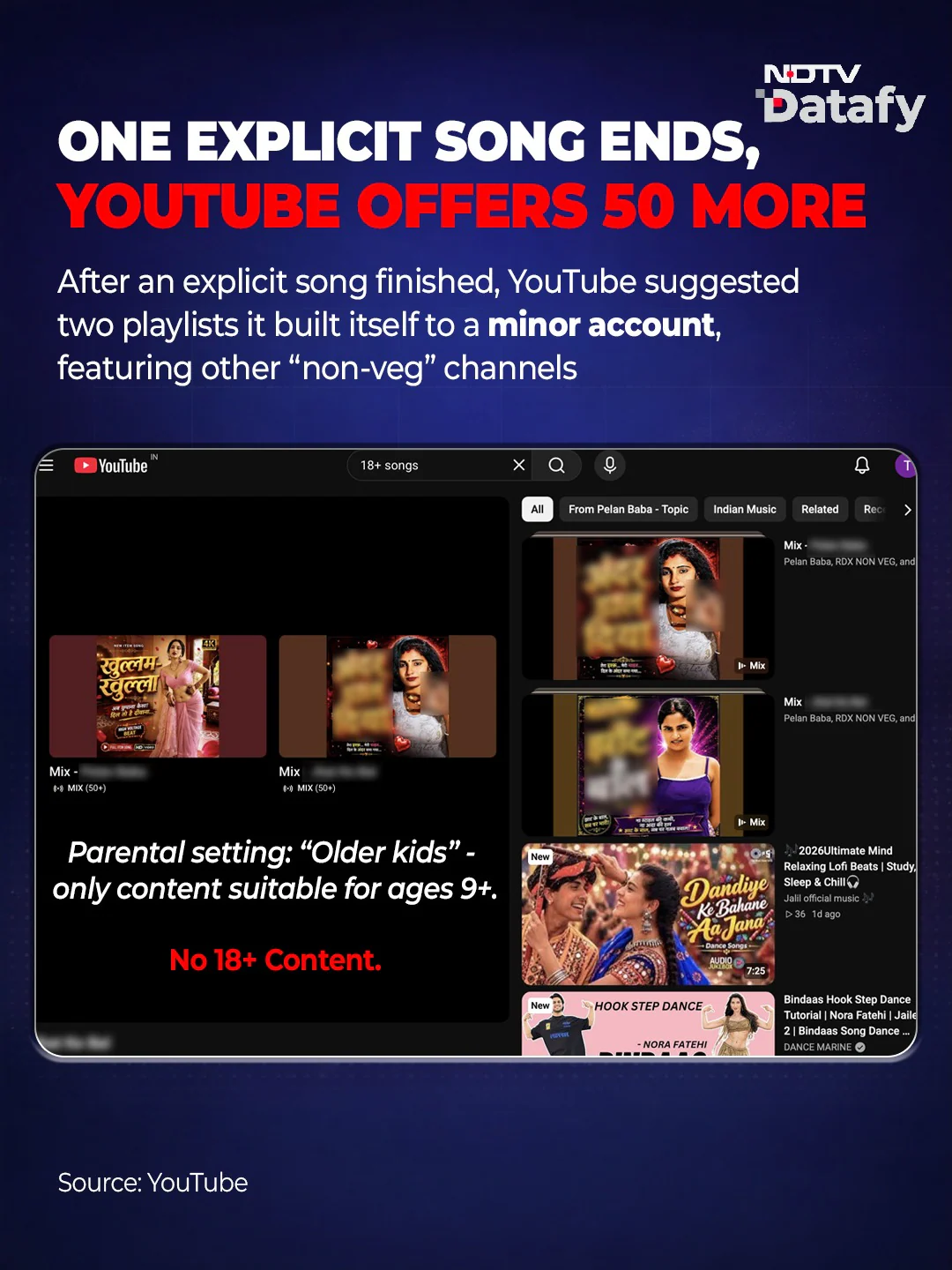
On the account allowed to watch content suitable for children over 9 years, we tested two search terms: “non-veg songs” and “18+ songs”. It offered two playlists assembled by the platform itself, each containing more than 50 songs built around the same artist and other “non-veg” channels. The account, however, blocked results for the search term “adult songs”. The results changed on the account with parental control set to “Older teens (16+)”. This account not only showed the same kind of songs for the keyword “adult songs”, but also recommended similar tracks. YouTube prohibits explicit content meant to be “sexually gratifying”. For children under 13, parents can set up supervised accounts set to “Older kids” (9+), “Teens” (13+) or “Older teens” (16+). Are the songs we found “sexually gratifying”? And such songs can affect a kid’s mental health, sexualise their tender minds, result in sexual aggression, and cause cultural degradation,” Vishnoi, the co-founder of Future Shifts Labs, told NDTV Datafy. Some carry YouTube’s own “Made with AI” label.
The scale of the platform makes the gap serious. Child psychologist Dr. “It could feel normal behaviour to them while their cognitive and emotional growth is still developing. They pick up the language, and it shapes their attitudes, including objectifying views of gender. we documented two dozen channels and YouTube-created topics that largely featured AI-generated explicit songs While accessing YouTube in a private browser without logging in. Most of them reached us through YouTube’s recommendations rather than our own searches. These are not double-meaning songs. They describe aggressive sexual acts and private body parts in graphic detail. Some reference incest. Some appear to sexualise school-aged children. Others drag Hindu festivals such as Navratri and Diwali into explicit sexual content. Every one of them played without restriction. None of the songs we documented was age-restricted. These songs do not look like the work of struggling singers, but the output of a production line. They display several signs commonly associated with AI-generated content, including the absence of conventional music videos, highly polished thumbnails, repetitive high-pitched music and inconsistent lyrical flow. Some videos explicitly stated that they were made using AI tools. Most of the channels were only a few months old. Several channels were publishing songs at a pace that would be difficult for conventional music creators. That works out to roughly five songs a day. Most songs credited no identifiable singer, lyricist or composer. The same artist names appeared across several channels. None of the channels featured verifiable social media accounts for their supposed artists. Data suggests AI-generated music is increasingly flooding online platforms. The songs documented by NDTV were overwhelmingly sexual from start to finish. Yet none was age-restricted. Some songs raised additional concerns. YouTube’s policies prohibit sexual content involving minors, yet songs appearing to reference schoolchildren remained available on the platform. Content that sexualises children could potentially attract the stricter provisions of Section 67B of the IT Act, which deals with child sexual abuse material and related offences. Online platforms benefit from safe-harbour protections for user-generated content, but those protections depend on compliance with due-diligence obligations. Recent amendments governing AI-generated and synthetic content have further increased compliance obligations for intermediaries dealing with illegal synthetic media, including obscene and sexually explicit content. “But US-based intermediaries such as YouTube often appear reluctant to remove content purely on the basis of complaints.
India has more YouTube users than any other country, with an estimated audience of 518 million. The songs attracted thousands of views, and at least one had amassed more than 3.2 million views as of October 29, 2026. One channel created in January had uploaded 177 songs by October 28, with 153 of them posted in the previous 30 days. We tested 16 such songs. French streaming service Deezer said AI-generated tracks averaged about 90,000 uploads a day in June 2026. Section 67 of the Information Technology Act provides penalties for publishing or transmitting obscene material in electronic form, including imprisonment of up to three years for a first conviction. The Information Technology (Intermediary Guidelines and Digital Media Ethics Code) Rules, 2021 require intermediaries to make reasonable efforts to prevent the publication and circulation of content that is unlawful, obscene or harmful to children. On December 29, 2025, the Ministry of Electronics and Information Technology reminded intermediaries of those obligations and warned that failure to discharge them could jeopardise safe-harbour protections.
Mimansa Singh Tanwar says a child’s exposure to such content can lead to behavioral issues. Studies have shown that viewing aggressive content can increase their tendency to act it out,” she says. Most did not even carry an “Explicit” tag. All were flagged as “likely AI-generated” by both Quicksilver and music distributor SubmitHub’s AI-detection tool. Among the factors YouTube says it considers for prohibiting sexually explicit content are whether language is graphic or lewd, and whether sexual content is prolonged rather than fleeting. Their content-moderation systems also face two major challenges: identifying problematic keywords in regional languages and improving AI-based detection of harmful content,” says Delhi-based advocate Aditya Joshi.