
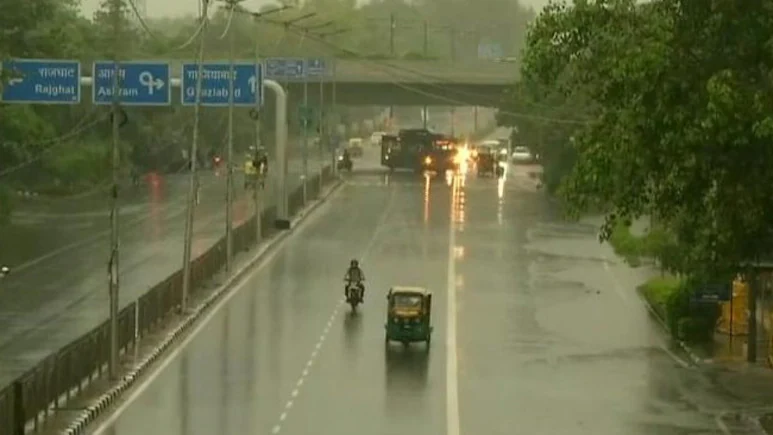
Delhi residents reached for their windbreakers and heavy shawls as wintry chills gripped the capital Friday, with the city recording its lowest October day temperature in 75 years as the maximum plunged to 20.7 degrees Celsius amid two days of persistent rain.
The maximum temperature at Safdarjung, Delhi’s base weather station, settled at 20.7 degrees Celsius, 10.3 degrees below normal, according to the India Meteorological Department (IMD). This is the lowest maximum temperature recorded in October at the station since 1951, according to available data. Amid ‘red’ and ‘orange’ alerts issued by the weather office cautioning of heavy rain, Delhi received 61.4 mm rainfall in the 24 hours ending 8.30 am Friday. Rainfall continued through the day, with Safdarjung recording 4.2 mm, Palam 3 mm, Lodhi Road 4 mm, the Ridge 1.9 mm, and Ayanagar 2.1 mm rainfall between 8.30 am and 5.30 pm. Friday proved the wettest October day in four years, and the sixth-wettest since 1951. The last time the city recorded higher daily rainfall in October was on October 9, 2022, when it received 74 mm. The minimum temperature at Safdarjung settled at 17.2 degrees Celsius, 1.1 degrees above normal. Palam recorded a minimum of 15.4 degrees Celsius, 1.6 degrees below normal, while Lodhi Road recorded 18 degrees Celsius, three degrees above normal. The Ridge and Ayanagar recorded minimum temperatures of 16.8 degrees Celsius and 17.4 degrees Celsius, respectively, 0.5 degrees below normal and 1.1 degrees above normal. An AQI between zero and 50 is classified as ‘good’, 51 and 100 as ‘satisfactory’, 101 and 200 as ‘moderate’, 201 and 300 as ‘poor’, 301 and 400 as ‘very poor’, and 401 and 500 as ‘severe’, according to the Central Pollution Control Board (CPCB). Delhi’s transport sector contributed 17.8 per cent to the city’s pollution load on Friday, while industrial emissions contributed 3.5 per cent and the residential sector 4.6 per cent, according to the Decision Support System. Among NCR districts, Faridabad contributed 8.3 per cent, Gautam Buddha Nagar 7 per cent, Gurugram 6.3 per cent, Ghaziabad 4.8 per cent, Bulandshahr 2.5 per cent, Jhajjar 2.5 per cent and Muzaffarnagar 2.1 per cent to the capital’s pollution load.
