
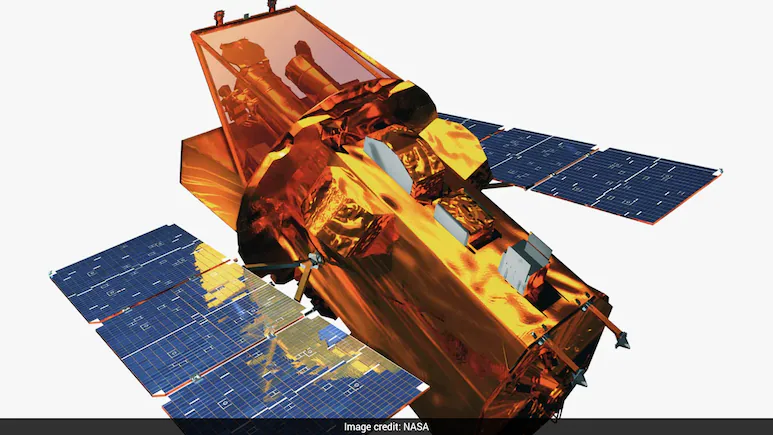
It was initially known as the Swift Gamma-Ray Burst Explorer. Most of the telescope is expected to burn up in the orbit, but a few components could reach Earth. NASA’s Neil Gehrels Swift Observatory, a 1.5 tonne space telescope, is heading back to Earth – to crash. The telescope was launched on November 20, 2004, almost 22 years ago. The telescope will hit the atmosphere on November 4 at around 3.30 am ET (2 pm IST) but there’s an 11-hour window for re-entry, according to the US space agency.
On a map, that creates a band covering portions in the middle of the Earth . NASA estimates that the telescope’s re-entry zone lies between 20.6 degrees south latitude and 20.6 degrees north latitude.
NASA’s Brad Cenko, the mission’s chief scientist, told the Associated Press that parts of Africa, Australia, India, Southeast Asia and Central and South America are within the telescope’s re-entry zone.
India has its own infrastructure to monitor objects approaching atmospheric re-entry. ISRO’s Multi-Object Tracking Radar (MOTR), located at Sriharikota, tracks space objects, including rocket bodies and satellites, during their final few orbits before atmospheric re-entry.
However, there is no word from ISRO if it is tracking the descending space telescope. Some experts believe that the Neil Gehrels will land in the ocean. NASA’s efforts to save the falling telescope were unsuccessful.
