
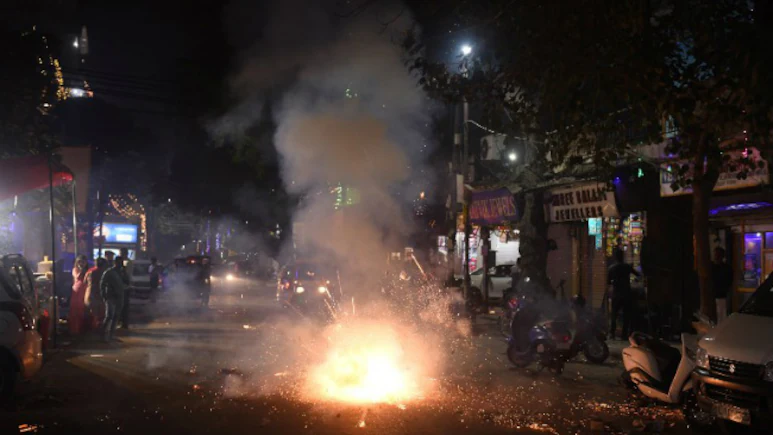
The measure has been invoked as the capital region enters its most hazardous environmental phase of the year. Ahead of Diwali, the air quality in Delhi dropped significantly, triggering low visibility and foggy conditions all across the national capital. The Commission for Air Quality Management (CAQM) has enforced Stage 3 of the Graded Response Action Plan (GRAP) across Delhi-NCR.
Air quality worsening around the tail end of the year is not a new phenomenon. The constant dip in air quality makes one question the efficiency of pollution control measures as well as the factors that contribute to it. a true public health disaster unfolds in the background – one created by a variety of factors While public attention during the festive season centres around firecrackers. From vehicular and industrial pollution to stubble-burning-induced pollutants, a host of factors add up to choke the capital. Especially as temperatures drop in winter, a mix of stagnant meteorology, peak stubble burning, and baseline industrial pollution locks the National Capital Region into a prolonged, heavy smog phase. Kandhari explains, “Why, after a decade of worsening air pollution, is toxic air being normalised instead of addressing its sources? We have gone from a total ban on firecrackers to allowing so-called ‘green’ crackers. This is not progress; it is a dilution of precaution when public health demands stronger protection. Green crackers are not pollution-free, nor do they make the cumulative burden of toxic emissions disappear. For that matter, we cannot afford to add any emissions in these meteorological conditions. Expressing concern over pollution levels in the week after Diwali, she adds, “Delhi cannot afford another post-Diwali pollution emergency. How can governments keep experimenting with people’s lungs and calling it a solution? Post-Diwali Pollution: Festive Pollutants And More The foundational problem with Delhi’s winter air is that the city enters the festive week already breathing toxic air. Manoj Kumar, analyst at the Centre for Research on Energy and Clean Air (CREA), stresses that focusing exclusively on festive fireworks misses the core systemic failure:
Historically, one has seen pollution levels spike and air quality dip during the festive season.
Another factor that contributes immensely is farm fires. As per data made available by the agriculture ministry, a total of 6,226 burning events were detected in the six states between September 15, 2026, and November 6, 2026. These incidents are distributed as 3,144 in Punjab, 89 in Haryana, 479 in UP, 02 in Delhi, 1,097 in Rajasthan, 195 in Uttarakhand, and 1,220 in MP.
This could very well be one of the leading factors behind the rising pollution, according to experts.
