
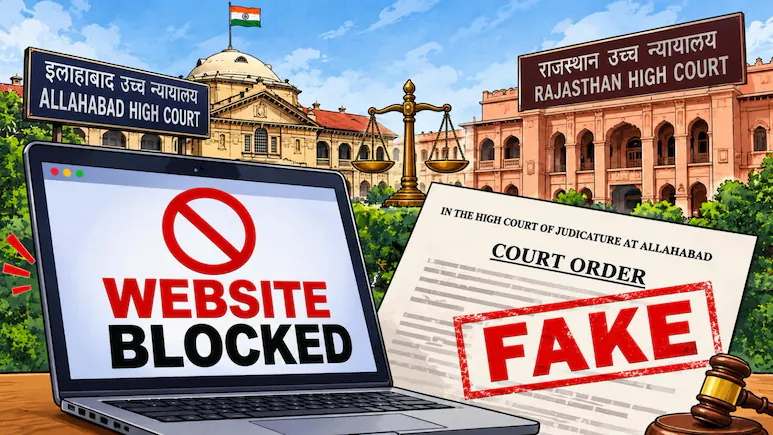
A Reuters investigation has revealed that two purported orders from the Rajasthan and Allahabad High Courts were forged to mislead the Department of Telecommunications (DoT) into directing Internet Service Providers (ISPs) to block the websites. The Central government ordered the blocking of 129 websites based on court orders that have now turned out to be fake.
However, checks with the official records of both courts revealed that neither order had been registered. Both directives were accompanied by emailed copies of what appeared to be orders issued by the respective High Courts. The revelations have raised concerns over the use of artificial intelligence and forged court seals to fabricate judicial orders and target websites, as well as the verification mechanisms in place within the Central government before issuing website-blocking directives. The Allahabad High Court also found that an order purportedly issued in its name to affect another round of website takedowns was fake. An investigation has been initiated against unknown persons on charges of forgery and cheating.
The DoT issued the blocking directives on July 21 and September 2, acting on the basis of the purported court orders submitted to it. The court subsequently filed a police complaint on November 6, Reuters reported. After the court’s internal inquiry confirmed the forgery, the Registrar General, acting on the Chief Justice’s instructions, directed that police action be initiated on November 5. A case was subsequently registered against unknown persons at the Cantt Police Station in Prayagraj on November 6, following a written complaint by the High Court’s Joint Registrar (Civil).
