
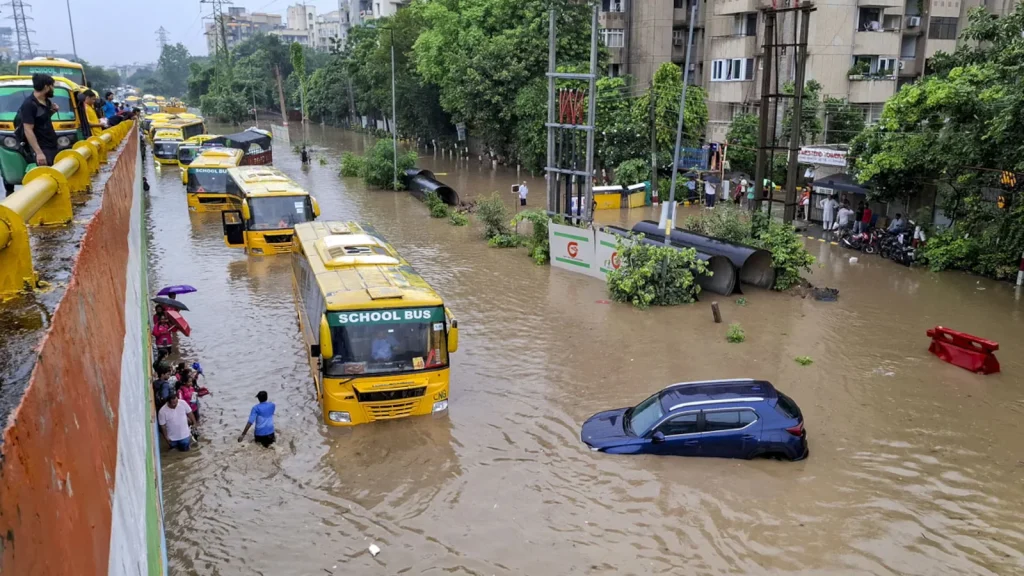
Every monsoon, Gurugram is confronted with the same paradox. A city celebrated as one of India’s most modern urban economies can be brought to a standstill by a few hours of intense rainfall. Roads become channels, underpasses become reservoirs, and traffic corridors become temporary floodplains.

Roads Must Be Part Of The Solution
On natural ground, rainfall is divided between infiltration, evaporation, temporary storage, and surface runoff. On a heavily paved urban surface, a much larger proportion becomes immediate runoff. The greater the impervious area, the faster water reaches the drainage network, and the higher the peak discharge becomes. In engineering terms, the issue is not simply the total quantity of rainfall. It is the rate point at which rainfall is converted into runoff and the timing of that runoff reaching a drainage system. The first four stages should happen as close as possible to where rainfall occurs. Only the residual water should enter the larger drainage network. Research on Gurugram has demonstrated the potential of precisely this approach. One recent study proposed integrating retention ponds into the existing drainage network and found substantial reductions in simulated flood volumes under both regular and extreme rainfall scenarios. This requires moving towards catchment-level stormwater modelling, using high-resolution Digital Elevation Models, rainfall intensity data, soil characteristics, land-use and land-cover data, drainage capacity, and existing water bodies. GIS and hydrological models such as EPA-SWMM can then simulate how different development scenarios perform under varying rainfall intensities. This should become part of the development approval itself. This is particularly important as rainfall patterns become more uncertain. A drainage system designed around historical rainfall statistics may perform adequately under an old climate regime but fail when rainfall arrives in shorter, more intense bursts.
