
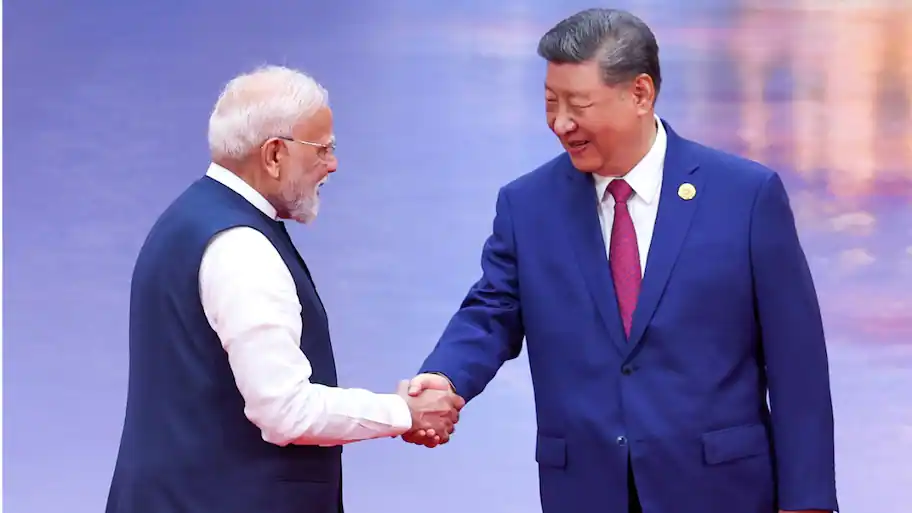
Prime Minister Narendra Modi held a bilateral meeting with Chinese President Xi Jinping on Saturday on the sidelines of the BRICS Summit in New Delhi, as the two countries seek to build on a recent improvement in relations following years of tensions.
“We urge to ensure the protection of civilians and civilian infrastructure in accordance with the purposes and principles of the Charter of the United Nations in their entirety and interconnectedness, including respect for the sovereignty and territorial integrity of the States.
We encourage increasing efforts, through dialogue and diplomacy, towards a long-term understanding that will contribute to lasting peace, security and stability in the region,” the declaration said. “We stress the need to work together to maintain smooth flow of global trade, supply chains and energy, in accordance with applicable international law,” it added. “We express serious concern over deliberate attacks on civilian infrastructure and peaceful nuclear facilities under full safeguards of the International Atomic Energy Agency (IAEA), in violation of international law and relevant resolutions of the IAEA,” the resolution stated. Addressing the summit in New Delhi, Xi said China would work with other BRICS members towards that goal, arguing that the conflict in the Middle East “does not serve the common interests of the international community”, according to Reuters.
He suggested that BRICS members could develop the proposals into a BRICS Reform Roadmap by the next summit. During his address at the 18th BRICS Summit, PM Modi proposed 10 measures for reforming global governance.
The Prime Minister also called for the Global South to move from being a “rule-taker” to a “rule-shaper”. Addressing the session on Inclusive Global Governance and Strengthening in New Delhi, PM Modi said the Global South remains at the forefront of major global crises but continues to have limited influence over international decision-making.
