
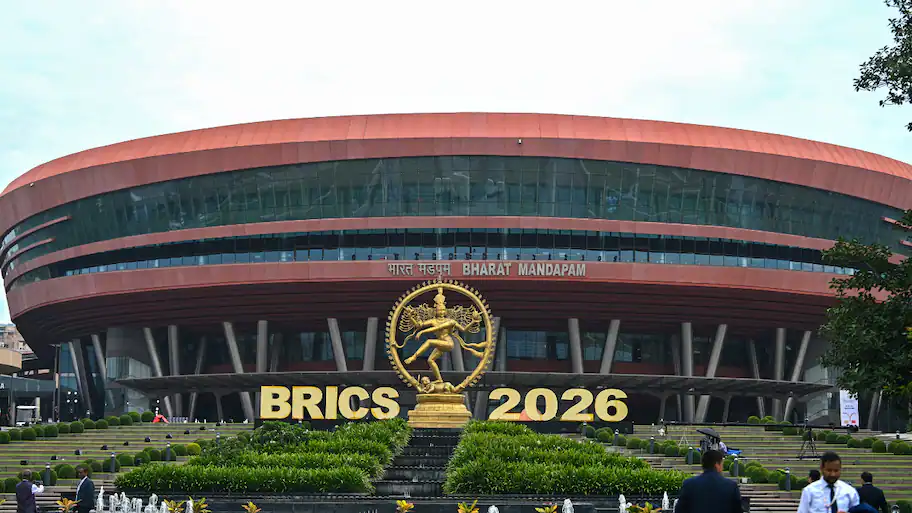
During the 18th BRICS summit held in New Delhi on Saturday, leaders from the bloc collectively endorsed the New Delhi Declaration 2026. This declaration emphasizes critical global issues, including the situation in West Asia, the ongoing conflict in Gaza, nuclear safety, and the fight against terrorism. Additionally, it highlights the importance of global trade and advocates for reforms in the international system.
The consensus came against the backdrop of deep geopolitical divisions and continuing conflicts in West Asia. The agreement on a joint declaration was seen as an important test of BRICS unity, particularly as the expanded grouping includes countries with differing positions on regional conflicts. The declaration expressed deep concern over the continuing escalation of tensions in West Asia and called on all sides to exercise maximum restraint. The bloc urged countries to avoid actions that could further worsen the situation. It also stressed the need to protect civilians and civilian infrastructure in line with the UN Charter, including respect for the sovereignty and territorial integrity of states. BRICS called for greater use of dialogue and diplomacy to work towards a long-term understanding that can bring lasting peace, security and stability to the region. The declaration also highlighted the need to keep global trade, supply chains and energy flows running smoothly in accordance with international law. The issue is particularly significant for the expanded BRICS grouping, which includes countries directly affected by the wider West Asian crisis. The bloc’s ability to reach a common position despite these differences was a key feature of the New Delhi summit. The BRICS declaration also focused strongly on the situation in Gaza. The bloc called for the implementation of relevant UN General Assembly and UN Security Council resolutions. It urged all parties to maintain the ceasefire and ensure full and unhindered humanitarian access to the Gaza Strip. The declaration opposed policies aimed at the forced displacement of Palestinians from Gaza. It also raised concerns about arrangements that could undermine the rights of the Palestinian people or legitimise or prolong occupation. BRICS reiterated that a just and lasting solution to the Israeli-Palestinian conflict can only be achieved through peaceful means. It stressed the legitimate rights of Palestinians, including their right to self-determination and return. Nuclear safety emerged as another major concern in the declaration. BRICS expressed serious concern over deliberate attacks on civilian infrastructure and peaceful nuclear facilities operating under International Atomic Energy Agency safeguards. The bloc stressed that nuclear safeguards, safety and security must be maintained at all times, including during armed conflicts. The declaration also highlighted growing risks linked to nuclear weapons and conflict. BRICS called for renewed efforts towards disarmament, arms control and nuclear non-proliferation. The grouping reaffirmed its support for nuclear-weapon-free zones and backed efforts to establish a zone free of nuclear weapons and other weapons of mass destruction in the Middle East. Terrorism remained an important part of the BRICS security agenda.
Prime Minister Narendra Modi announced the unanimous adoption of the declaration during the summit, which is being hosted by India under its 2026 BRICS chairship. BRICS expressed deep concern over continued violence in Gaza despite the October 2025 ceasefire agreement.
It said protecting people and the environment from the consequences of nuclear incidents must remain a priority.
The bloc reiterated its opposition to terrorism in all its forms and manifestations and called for stronger international cooperation against terrorism financing, safe havens and the cross-border movement of terrorists. BRICS stressed that counter-terrorism efforts should be carried out without double standards and in accordance with international law and the UN Charter. The focus on terrorism is significant for India, which has consistently pushed for stronger international action against cross-border terrorism and terrorist financing. The declaration also reflected concern over the wider deterioration in the global security environment. BRICS leaders noted growing polarisation and distrust in international relations and called for political and diplomatic measures to reduce the risk of conflicts. They stressed that disputes should be resolved through dialogue, consultation and diplomacy. The bloc also expressed alarm over the sharp rise in global military spending. It argued that increasing military expenditure could come at the cost of financing development in poorer and developing countries. The declaration reaffirmed BRICS’ commitment to a more representative and inclusive international system. The bloc called for a multilateral approach that takes into account different national viewpoints while addressing issues such as sustainable development, hunger, poverty and climate change. The declaration comes as BRICS seeks to expand its role as a platform for the Global South and push for changes in global governance structures. Economic issues also featured prominently at the New Delhi summit. BRICS leaders raised concerns over unilateral tariffs and non-tariff measures, warning that such steps could distort international trade and undermine the rules-based multilateral trading system. The bloc reiterated its focus on strengthening economic and financial cooperation among member countries. Discussions have also centred on resilient supply chains, energy security, digital connectivity and greater cooperation among developing economies. India’s theme for the year is “Building for Resilience, Innovation, Cooperation and Sustainability. Building on two decades of BRICS cooperation, the members committed to strengthening cooperation under three broad pillars: political and security cooperation, economic and financial cooperation, and cultural and people-to-people exchanges. The bloc also pledged to strengthen its strategic partnership with the aim of promoting peace, sustainable development, inclusive growth and a more representative international order. India played a key role in consultations aimed at finding common ground and securing consensus.
Because the summit is taking place amid major geopolitical tensions and differences among BRICS members, the adoption of the New Delhi Declaration is significant. Because of disagreements involving members affected by the Gulf conflict, reuters reported that negotiations over the declaration were particularly sensitive. The final document therefore seeks to balance sharply different national positions while keeping the focus on issues on which the wider grouping can agree: peace and diplomacy, economic cooperation, development, energy security, multilateralism and a greater role for the Global South.
The declaration also condemned the April 22, 2025, Pahalgam terrorist attack in Jammu and Kashmir, in which 26 people were killed and several others injured, according to the declaration’s text. Earlier discussions under India’s 2026 chairship have also focused on reforming major global institutions, including the UN, IMF, World Bank and WTO, to give developing countries a greater voice in global decision-making. Reuters reported that the grouping accounts for more than 40 per cent of the world’s population and nearly a quarter of the global economy. The declaration commended the progress made under India’s BRICS chairship in 2026. For India, the unanimous adoption also provides a key diplomatic outcome from its 2026 BRICS chairship and reinforces New Delhi’s effort to position the grouping as a platform for cooperation rather than a bloc defined solely by geopolitical rivalry.
BRICS said it would explore greater cooperation in areas including conflict prevention, UN peacekeeping, African Union peace-support operations, mediation and peace processes. The declaration said the theme reflected a shared commitment to tackling common challenges through a balanced, practical, actionable, inclusive and development-oriented approach.
