
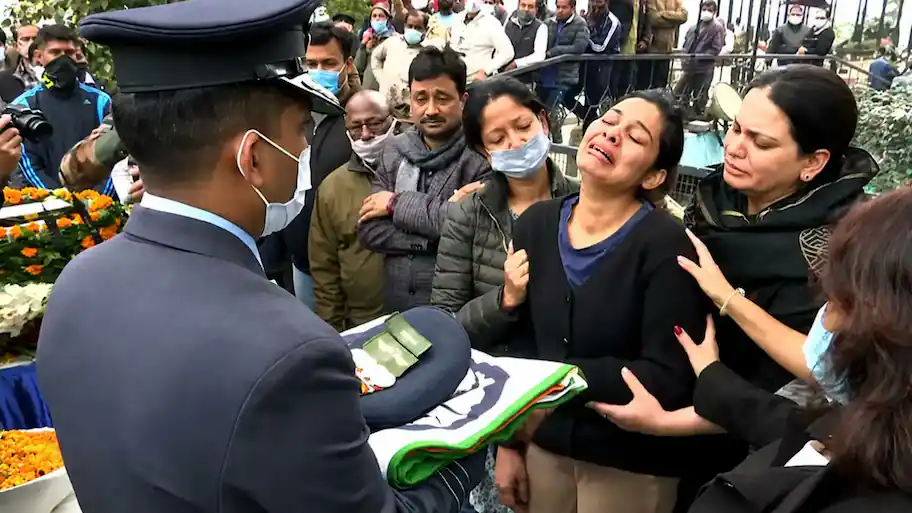
Excercising its powers under Article 142 of the Constitution, the Supreme Court ordered the reinstatement of former Indian Air Force Short Service Commissioned officer Squadron Leader Priyanka Saxena, who left service in 2013 and later became a war widow after her husband died in a MiG-21 fighter jet crash in 2021.
A bench headed by Chief Justice of India Surya Kant allowed Saxena’s appeal against orders passed by the Armed Forces Tribunal, Principal Bench, New Delhi, in 2024.
Former officer argued for age relaxation
The Indian Air Force rejected her request, citing government policy. She subsequently approached the Armed Forces Tribunal (AFT), seeking the quashing of the rejection orders. Saxena argued that, as a former woman officer who had become the widow of a defence personnel, she deserved age relaxation. She also submitted that the absence of a specific policy covering such a category could not be used as a reason to reject her case. The court also took into account that Saxena was both an ex-Air Force officer and a war widow of an Air Force officer, with two school-going minor daughters. On completing the training, she will be reinstated as a Squadron Leader in the 11th year of service, with her previous service counted. She will continue as an SSC officer with a four-year extension in accordance with policy. She will also be considered for permanent commission and promotion under the applicable policy. “It is not the service which alone was important for the War Widow.
Because of family commitments, including supporting her husband, a fighter pilot, and looking after their child, she stated that she was unwilling to seek an extension of service or permanent commission. Her husband, who was posted with the IAF’s 51 Squadron in Srinagar, died when a MiG-21 Bison crashed near Jaisalmer airfield on December 24, 2021. After his death, Saxena submitted several applications seeking reinstatement, referring to her 10 years of previous service as a Logistics Branch officer. The government opposed the plea, arguing that Saxena had given up her claim to continue in service in 2013 and that her rights had ceased. It also pointed out that she had crossed the maximum age of 35 years prescribed under a policy letter dated November 30, 2017, for the induction of widows of armed forces personnel. The Tribunal closed the compliance proceedings on July 2, 2024.
The court said her inter-se seniority would be fixed with her current peer group. Commenting on the judgment, Saxena’s lawyer, Major Sudhanshu Shekhar Pandey (retd.), said the issue was about more than the officer’s return to service. She wanted her two small daughters’ life should not be affected and they should live life the way it would have been had her husband not sacrificed life for the call of duty,” Pandey said. He said the Defence Ministry ought to have framed a policy for officers in such circumstances by providing the necessary exemptions and relaxation, keeping in view the larger objective of such policies. (with ANI inputs)
the Supreme Court observed that Saxena’s case was ‘very peculiar’ and was not covered by any existing policy While hearing the appeal. Allowing the appeal, the Supreme Court directed that Saxena undergo refresher training for one year from the next course. During the training period, she will be governed by trainee rules and will have to meet the prescribed medical requirements.
Article 142 of the Constitution empowers the Supreme Court to pass any order necessary to secure complete justice. Squadron Leader Saxena was commissioned into the Indian Airforce 2003. She completed her 10-year Short Service Commission tenure and left the IAF in December 2013.
The court directed that the case be treated as a single instance without creating any precedent, describing it as “very peculiar”. The court noted that the noble objective of the war widow rehabilitation policy had left out a class such as the appellant and said her previous service should have been given due weightage. It said her case deserved sympathetic consideration and that she should not be required to undergo fresh pre-commission training like other widows inducted on academic qualifications.
