
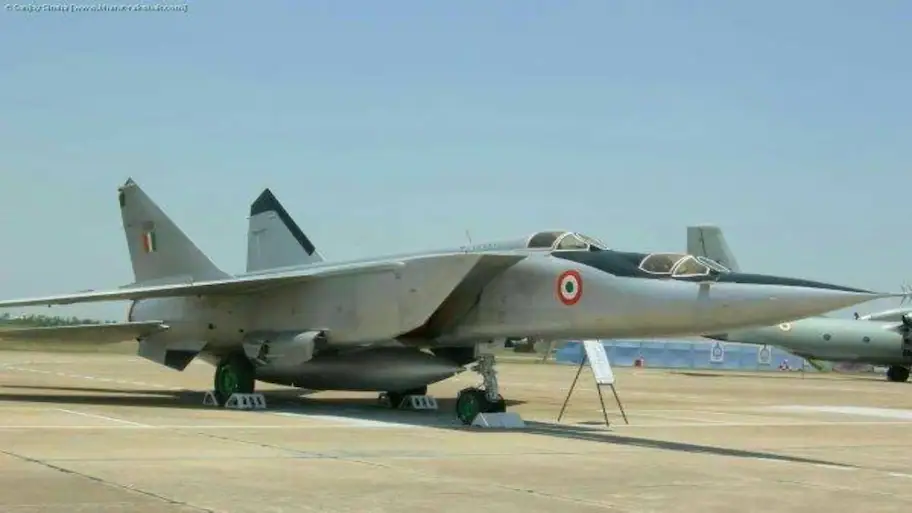
New Delhi: The story of an Indian military aircraft flying over Pakistan in 1997 was officially denied at the time. Nearly three decades later, a former Indian Air Force (IAF) pilot from the MiG-25 squadron has confirmed that the jet did cross into the neighbour’s airspace.
Its job was reconnaissance. Cameras photographed selected locations in Pakistan. Also known as the ‘Foxbat’ under NATO’s nomenclature, the MiG-25was built for extreme altitude and speed. Eight were MiG-25R single-seat reconnaissance aircraft and two were MiG-25U two-seat trainers. These were sonic booms produced by the aircraft travelling faster than the speed of sound. New Delhi denied that any military aircraft had crossed the international border. Retired Wing Commander Pradeep Jaswant Thakur, who served with the Trisonics, recounted the mission in an interview. The sonic booms must have been heard,” he added. He also disputed the popular version that the aircraft had deliberately flown supersonic simply to challenge Pakistan. Retired Air Marshal Sumit Mukerji, who commanded the Trisonics squadron in the mid-1990s, also recalled the incident. “The fact of the matter is that there was nobody else flying in Pakistan at that time. There was nobody in that airspace, and this happened, and that is why (the story) has gone maybe out of proportion,” he recalled. The aircraft’s combination of altitude and speed gave it a narrow window in which an interceptor could attack it. Thakur explained that an interceptor needed an accurate head-on attack. A small change in the Foxbat’s flight path could spoil that opportunity. Its pilots depended on information from controllers on the ground. Its primary role was to collect photographs. The reconnaissance version carried five cameras in its nose. A fifth camera pointed directly downwards and recorded geographical coordinates along with the image. The system allowed the IAF to use the photographs for precise intelligence about locations on the ground. The equipment was large. The missions were also tightly controlled. A commanding officer would receive the tasking at headquarters and then assign the mission to a pilot. The pilot planned the route without telling other squadron members what the mission involved. Even the pilots’ families were given very little information. “The families didn’t know… How many days? They were not given its exact departure or return time. No times are given… Nobody should know when he is getting airborne, when he is going to enter, when he is going to exit. Indian fighter pilots had difficulty identifying some targets on the ground. Three practice sorties were flown first to establish camera settings and fuel requirements. Flying lower and slower reduced the protection normally provided by the Foxbat’s extreme altitude and speed. After the sorties, the aircraft landed at Adampur. A Dornier transport aircraft then carried the exposed film to Bareilly for processing. Thakur was mentioned in dispatches for the missions. The Foxbat was also used for a scientific mission far removed from military reconnaissance. A large Hasselblad camera was installed in the aircraft. He used a small aluminium piece with graph paper and a tiny hole to keep track of the Sun during the flight. “The scientists were very happy with the results. By the early 2000s, satellite imagery had reached a level of resolution that made the aircraft less necessary for photographic intelligence. He added that satellite cameras were producing sub-metre resolution imagery that was better suited to the task. The pilots who flew the Foxbat described such missions in much simpler terms, even as they later became stories of high-speed flights over hostile territory. “No, everything looks the same anyway. There is no border to see. Mukerji summed up the job in even simpler terms, “You plan a route, you fly it. That’s it.”
Because of the risk of information leaking out, orders were not passed over the telephone. The mission took place on May 27, 1997. An Indian MiG-25 flew at about 20 kilometres (65,617 feet) at Mach 2.4. At that speed, the aircraft was travelling at roughly 2,550 kmph. India operated only 10 of the aircraft. They formed the 102 Squadron, known as the Trisonics, based at Bareilly in Uttar Pradesh. The 1997 mission came to light in Pakistan after residents heard loud explosion-like sounds in Islamabad and other places. Islamabad blamed an Indian MiG-25 for the sounds. “So the 20 kilometres (65,617 feet), 2.4 Mach, it did happen. The Pakistan Air Force detected the aircraft and identified it as possibly an Indian MiG-25 at an estimated altitude of around 60,000 feet. Later reports said F-16 fighters were scrambled, but the Foxbat had left the area before they could get close. At about 20 kilometres and Mach 2.4, the jet could cover around 40 kilometres in a minute. The MiG-25 also did not have a radar warning receiver. The MiG-25 was not sent into Pakistani or Chinese airspace to engage enemy aircraft. Four photographed areas to the sides of the aircraft and could capture a strip of land up to about 100 kilometres wide. Thakur recalled that the camera package was nearly as large as a sofa, while Mukerji remembered film rolls measuring around 30 to 32 inches across. “When the MiG-25 flew, they were told that you are likely to expect something. The MiG-25 was used differently during the 1999 Kargil war. Mirage 2000 pilots could reach the coordinates they had been given but could not always identify the positions they were supposed to attack. “I remember the Mirage guys (Mirage 2000 pilots). The MiG-25 was brought into the mission at a much lower altitude than its normal reconnaissance flights. Thakur flew at around 10 kilometres (33,000 feet) and about 5 kilometres above the mountain peaks. Its speed was reduced to Mach 0.95 (roughly 1,020 kmph). The targets were about 400 kilometres from the base. Mirage 2000 fighters were assigned to escort it, with MiG-29s providing cover from above. It was the first time fighter aircraft had escorted a MiG-25. On October 24, 1995, Mukerji flew a two-seat MiG-25 to photograph a total solar eclipse for scientists at the Udaipur Solar Observatory. The aircraft flew at around 80,000 feet and about Mach 2.5 while following the path of the eclipse. A total eclipse could be seen from the ground in India for about 42 seconds that day. By following the moon’s shadow in the MiG-25, Mukerji observed it for about 2 minutes and 23 seconds. The MiG-25 eventually lost its reconnaissance role to satellites. The United States had retired the SR-71 Blackbird in the late 1990s. India kept the MiG-25 in service for several more years. The IAF finally retired the aircraft on May 1, 2006, after nearly 25 years of service. The MiG-25 had been operated by only a small number of IAF pilots, and the aircraft’s final years included its use during the Kargil conflict.
“See, the major part of the story is correct … the aircraft went across,” he said, confirming the altitude and speed recorded during the mission. “But saying that the MiG-25, just to thumb the Pakistanis, went supersonic, that is all (a) made-up story because you cannot be subsonic (in a MiG-25) at 20 kilometres,” he said. “It just called for a five-degree alteration of course to spoil the whole equation,” he said. Mukerji recalled his experience with the aircraft by saying, “in my lifetime, I have not heard a radar tell me anything”. “The vertical camera… actually gave you the lat-long (latitude-longitude),” Mukerji said. You just told them you are going. I said, I don’t know. I will be back shortly,” Mukerji said. Other air bases were told only to expect an aircraft that might need to land. After that, accept him wherever he comes,” Mukerji said. They would go to the coordinates, but they could not pick up the targets,” Thakur said. “By night, I had the processed film,” Thakur recalled. I think we did our job,” he said. “Satellites had come in, and they were giving you fantastic pictures,” Mukerji said. So you are just following your route,” Thakur said.
The photographs provided coordinates for targets that fighter pilots had previously struggled to identify.
