
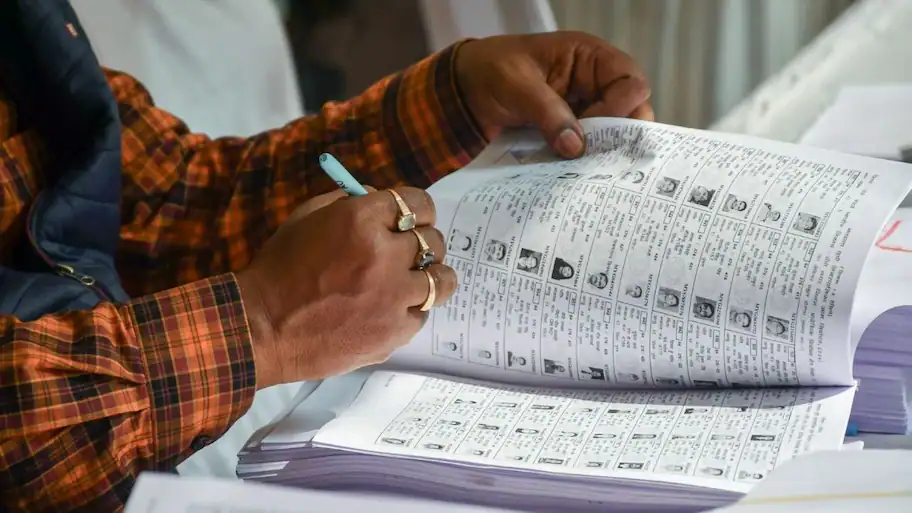
The move aims to prevent misuse of the process. The Election Commission of India (ECI) on Friday directed the Chief Electoral Officers (CEOs) of all States and Union Territories to impose strict caps on the number of Form-7 applications an individual can file. Form-7 is used to raise objections to the inclusion of names in electoral rolls or seek their deletion.
Such practices have caused significant inconvenience to genuine voters whose names were challenged and placed an unnecessary administrative burden on election officials working at the field level. Every such application must undergo mandatory scrutiny by the Electoral Registration Officer (ERO). However, the absence of clearly defined limits on offline bulk submissions left the matter to the ERO’s discretion, leading to administrative ambiguity. To address this issue, the Election Commission of India (ECI) has issued fresh directives to regulate individual applications seeking the deletion of names from electoral rolls. Forms must contain full details and bear the original signature of the objector. Use of signature seals is strictly prohibited. EROs must cross-check the applicant’s credentials against the electoral roll to verify genuineness. The directives were issued by Sandeep Kumar, Under Secretary, Election Commission of India. The letter is addressed to the Chief Electoral Officers of all States and Union Territories. As per the implementation details, CEOs have been directed to inform all EROs, Assistant EROs (AEROs) and field functionaries for immediate compliance, while ensuring widespread public awareness. Copies of the letter have been marked to DG (IIIDEM), Sr. DEC (MG), Sr. DEC (PKS), DEC (YB), DG (Media), DG (IT), DDG (Law), Director (SS), and all Directors, Principal Secretaries and Secretaries. With the inputs from ANI…
The decision follows repeated instances of individuals submitting Form-7 objections in large numbers on unsubstantiated grounds. Under Rule 13(2) of the Registration of Electors Rules (RER), 1960, a person can submit an objection or request for deletion through Form-7 only if they are already registered as an elector in the electoral roll of the constituency concerned. up to 50 forms per day before the publication of the draft electoral roll during the Special Intensive Revision (SIR) period and 10 forms per day thereafter, no explicit numerical limits had previously been prescribed for offline applications filed by individual electors While Booth Level Agents (BLAs) appointed by political parties are subject to specific limits on bulk submissions. The existing guidelines under the Manual on Electoral Rolls, 2023 prohibited bulk filings and required the Electoral Registration Officer (ERO) to personally cross-verify cases when an individual raised objections in more than five instances. Under the revised rules, an individual elector can submit a maximum of 10 Form-7 applications during the entire Claims and Objections period, covering both online and offline submissions. During the Continuous Updation period, the limit will be five Form-7 applications per individual elector per month. Verification and Signature Requirements (Rule 17, RER 1960): Applications not filed within the specified period, form or manner must be rejected by the Electoral Registration Officer (ERO).
If satisfied with the validity, the ERO will provide an opportunity of hearing to the person being objected to before passing a final order. Hearing and Dispute Disposal Process (Rule 19 & 20, RER 1960): Prior to disposing of an objection, the ERO must issue a notice to the objector, hear them personally, and record separate statements for every Form-7 submitted. If an ERO discovers a complaint to be false or fabricated, action will be initiated against the applicant under Section 31 of the Representation of the People Act, 1950 for knowingly making false statements or declarations.
