
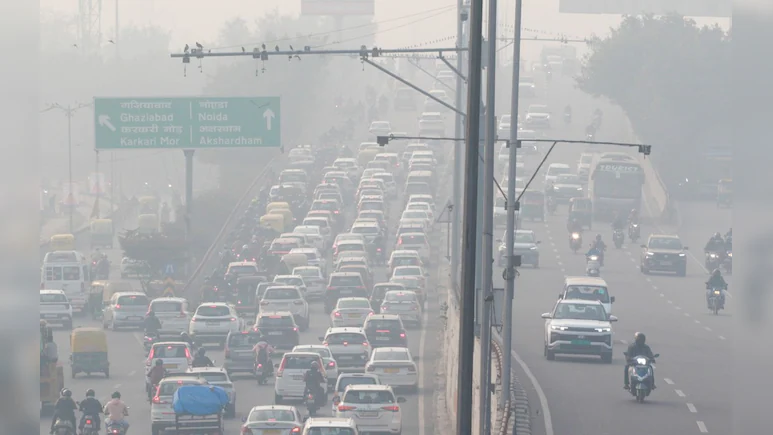
As October comes to an end, the National Capital Region (NCR) stands in familiar terrain once again, one that sees hazardous air and environmental pollution. This season, Delhi received a temporary window of respite which pushed back the traditional early-October onset of thick winter smog. However, now that the respite has evaporated, the capital is bracing to tackle deteriorating air quality.
“Just issuing orders won’t clean the air; the government will have to take action on every source of pollution and enforce the rules strictly. Experts and activists delve deeper into what chokes Delhi and what can be done to tackle it. But this year was different. Lingering late-monsoon rainfall and sustained surface wind speeds through early October helped flush out fine particulate matter for longer than usual. However, the relief may be short-lived. Manoj Kumar, analyst at the Centre for Research on Energy and Clean Air (CREA) points towards long-term trends that show little reason for complacency despite short-term weather shifts. Kumar explains that Delhi’s winter AQI has fluctuated over the past four years, with no consistent improvement. When studying these shifts, the El Nino factor cannot be ignored. This year was marked by larger global climatic influences coming into play. The presence of El Nino conditions disrupts regional weather patterns across the Indian subcontinent, creating atmospheric conditions that amplify air pollution. These changed weather patterns cause long periods of still, calm surface winds which trap heavy airborne pollutants instead of letting them blow away. Not only this, as temperature drops in winter, the atmospheric boundary layer compresses which traps vehicular, industrial, and biomass emissions close to the ground. At the same time, late rains delayed the crop harvest in Punjab and Haryana this year . This pushed the peak stubble-burning season directly into late October and November-the exact time when winter winds are at their calmest, leaving the smoke with nowhere to go. How Impactful Is GRAP? When air pollution reaches alarming levels, the Commission for Air Quality Management (CAQM) activates the Graded Response Action Plan (GRAP) to contain the pollution. The GRAP is a tier-based system enforcing temporary measures ranging from dust control to bans on specific vehicle categories and construction activity. “Making rules is easy, but strict checking, monitoring, and enforcement at the borders is very crucial. So, it is also necessary for the government to state how much pollution is expected to decrease from this step. Beyond vehicular bans, Kandhari argues that policy focus must expand to provide viable, systemic alternatives for commuters. “Government and policy makers must look into ways to strengthen public transport. Yes, we are moving to EV buses, but they are not enough, and a lot of improvements can be made. But there is no talk about this as of now. She believes that a robust public transport ecosystem would fundamentally alter commuting habits and reduce overall private vehicular load on congested roads. Tackling Non-Vehicular Sources Vehicular emissions are not the only source of particulate matter that causes air pollution in Delhi. The Way Forward While Delhi’s late onset of winter pollution provided temporary relief, it did not change the fundamental reality. As experts argue, until policy shifts from seasonal emergency management to continuous, year-round emission reductions, Delhi will remain locked in a cycle of repeated air crises.
Because we have seen in past years as well, when the Supreme Court in fact sent several court commissioners to highways and all these checkpoints, and there was hardly any enforcement there. At one time there used to be chartered buses, buses from one area to another for offices so that people switch from private cars and pay attention to public transport. With the first level of pollution control measures, GRAP 1, in place, a plethora of questions come up, including how much difference do these restrictions really make.
“The mean AQI rose from 280 in winter 2022-23 to 304 in 2023-24, fell to 285 in 2024-25 and increased again to 295 in 2025-26,” he said. Kandhari says that focusing exclusively on road traffic overlooks the municipal and industrial emission sources such as “road dust, construction, burning garbage, failed waste management system, and industrial pollution”. Still, this is a good step,” she said.
Calm Before The Storm: Why Smog Was Late This Year In recent years, Delhi’s air quality would fall sharply by mid-October as the southwest monsoon withdrew and stubble burning began across neighbouring agricultural states.








However, data reveals that relying on GRAP as a primary tool to combat the blight of pollution is reactive, not pro-active. Speaking about Delhi’s dependence on such emergency measures, Kumar said that stricter GRAP stages remain a regular feature of winter, with the capital spending around 78-83% of observed days under Stage II or higher across the last four winters.
CREA’s analysis of pollution trajectories shows that emergency bans rarely reverse pollution spikes once they begin. In the other two, it declined. This shows that pollution often remained high or increased even after the restrictions got stricter. Kumar emphasises that it alone cannot replace structural prevention While GRAP is important during critical spikes. “GRAP remains essential for responding to severe pollution, but it cannot substitute for preventing it. It must remain the last line of defence, backed by stricter emission controls throughout the year. Ground Enforcement And Need For Robust Public Transport System As extreme pollution measures kick in, such as bans on non-BS-VI vehicles, environmentalists point to repeated gaps in on ground implementation. Bhavreen Kandhari, an environmentalist who has been working on the issue for decades, highlights the challenge of implementing border restrictions and vehicle bans without strict enforcement.
Detailing the analysis, Kumar said, “To understand what happens when pollution worsens, we analysed 12 episodes in which Delhi moved from Stage II or below into Stage III or IV. In 10 of these episodes, the average AQI was higher in the following week than in the preceding week. The focus needs to shift towards reducing PM2.5 and its precursor gases, including SO₂ and NO₂, across all major pollution sources throughout the NCR airshed.
“This means the city continues to require emergency restrictions on roughly four out of every five winter days,” he said. Without addressing emissions at source, Delhi risks continuing to face severe pollution every winter,” he said. Kandhari says that while vehicular pollution bans are necessary, their implementation and impact on people raise apprehensions.
