
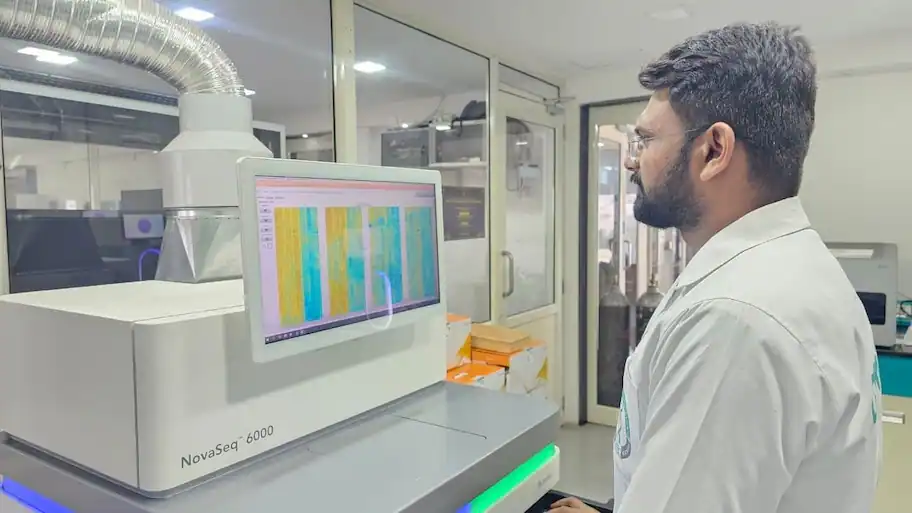
Now, Gujarat is exploring whether a champion can also be identified through their DNA. New Delhi: As India celebrates National Sports Day on August 29 to mark the birth anniversary of hockey legend Major Dhyan Chand, a new experiment is seeking to bring science into the hunt for sporting talent.
Major Dhyan Chand, remembered as the “Wizard of Hockey”, helped India win Olympic gold medals in 1928, 1932 and 1936. He once said that a champion athlete is identified by dedication, while fame and recognition come later.
The Gujarat government has launched a Sports Genomics Programme, under which the genetic profiles of athletes will be studied to help guide sport selection, training, diet and fitness. The findings reported in such studies have fuelled interest in the use of genetics in sports, although DNA alone cannot determine whether someone will become a champion. The programme is being implemented by the Gujarat Department of Science and Technology in collaboration with the Gujarat Biotechnology Research Centre. DNA samples have already been collected from athletes associated with the Gujarat State Tennis Association, while players from archery, judo, boxing and shooting are also expected to be tested. But how can DNA help an athlete? Certain genes have been linked to physical traits that can influence sporting performance. Variations in this gene are associated with fast-twitch muscle fibres, which are important for explosive activities such as sprinting, weightlifting and boxing. Another gene, ACE, has been studied for its association with cardiovascular performance and endurance. Such genetic information could potentially help coaches tailor training and nutrition to an athlete’s individual characteristics. Genetic testing may also help identify a person’s susceptibility to certain injuries, allowing training programmes to be adjusted accordingly. The idea is to move away from a one-size-fits-all approach and towards personalised training, nutrition and sport selection. China, Uzbekistan have already explored genetic testing India is not the first country to explore the use of genomics in sport. China and Uzbekistan have also conducted programmes aimed at identifying and developing sporting talent through genetic research. China studied the DNA of hundreds of elite athletes across disciplines requiring speed, endurance and physical strength. Training, coaching, nutrition, environment, motivation and access to facilities remain crucial. Can DNA help India become a sporting superpower? It could also create opportunities for growth in India’s wider sports economy. But there is a basic problem that no DNA test can solve: athletes need somewhere to play. Mumbai football ground faces fight for survival While Gujarat is investing in sports science, football players in Mumbai are fighting to protect one of the city’s playing fields. The Neville D’Souza Football Ground in Mumbai has become the centre of a dispute after the Brihanmumbai Municipal Corporation (BMC) approved a proposal to change the status of the ground and use it as an exhibition centre. It has also been associated with players such as Rahul Bheke, Raynier Fernandes and Amay Ranawade. The BMC was approached for its response but declined to speak on camera. The use of genomics could add another tool to that effort. But the basic equation remains unchanged: India cannot produce champions without giving children a place to become athletes in the first place. A DNA test may help identify an athlete’s potential. It cannot build a football field, provide a coach or give a young player an affordable place to train.
A nationwide approach to identifying and developing talent could therefore have a significant impact, supporters of the idea argue. Because affordable football facilities are already limited in Mumbai, the players say the ground is vital. As India looks towards the 2030 Commonwealth Games and future Olympic Games, the challenge may therefore be twofold, using science to identify and develop talent, while ensuring that the country’s playgrounds remain available for that talent to grow.
The initiative is being seen as an attempt to use genetic science to improve India’s sporting performance ahead of the 2030 Commonwealth Games and future Olympics. Watch Here: Gujarat’s DNA talent hunt Under the programme, the Gujarat government plans to conduct genetic testing on 2,000 athletes every year, covering 10,000 athletes over five years. The government has allocated Rs 26 crore for the project, with a database of athletes’ DNA being created as part of the initiative. A 2021 study involving 228 athletes also examined whether genetic information could help predict sporting potential among young athletes. Uzbekistan has also been working since 2014 on using DNA samples to study sporting potential among schoolchildren. India has around 260 million schoolchildren, with about 64 per cent taking part in some form of physical activity or sport at school. However, only around 1 per cent compete in sport at a high level. India’s sports market is currently worth around Rs 5 lakh crore and could reach Rs 10 lakh crore by 2030, according to a Google-Deloitte study cited in the analysis. The sector currently employs around 4.7 million people, with that number projected to rise to 10 million by 2030. The matter has also reached court, with the next hearing scheduled for September 18. They moved after a private firm took over the facility and began charging Rs 3,000 an hour, making regular training difficult for many players. The Neville D’Souza Ground is named after the Indian footballer who scored a hat-trick at the 1956 Melbourne Olympics. DNA cannot replace the playing field The government has allocated around Rs 2,500 crore for sports and athletes, while thousands of officials and employees work across India’s sporting institutions. More than 10 major sports programmes are also being run across the country to identify talent and prepare athletes for international competition.
One of them is ACTN3, often referred to as the “sprinter gene”. Young footballers have been campaigning against the proposal, with “SAVE PLAYGROUNDS” posters appearing as part of their campaign.
That raises a bigger question for India: could genetic screening eventually be used much earlier, at the school level, to identify promising athletes? Some of those using Neville D’Souza Ground had previously played at Cooperage Ground.
