
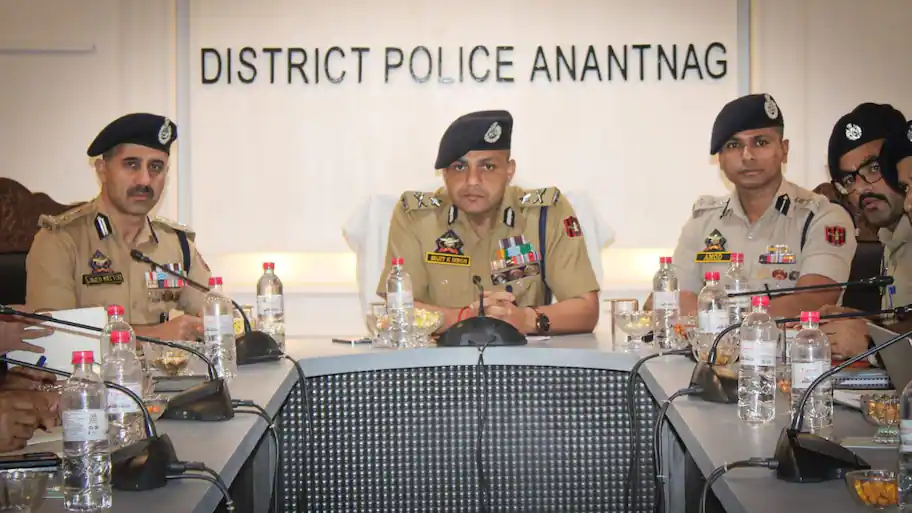
Inspector General of Police (IGP) Kashmir Zone Sujit Kumar (IPS), who recently assumed charge of the Kashmir Zone, on Thursday visited Anantnag and chaired his first security and crime review meeting for the strategically important South Kashmir region.
The meeting was held at the District Police Office (DPO) Anantnag and was attended by DIG South Kashmir Range Javid Iqbal Matoo-IPS, SSP Anantnag Amod Ashok Nagpure-IPS, and other senior officers from the district. During the meeting, IGP Kashmir reviewed the overall security situation and crime scenario in Anantnag, underlining the strategic importance of South Kashmir in the Valley’s broader security framework. He took a detailed assessment of security arrangements, crime prevention measures, case investigations and ongoing police operations. During the deliberations, security forces were also provided with maximum inputs regarding the presence of active terrorists. The IGP stressed the need to further strengthen the security grid, maintain close coordination among field formations and ensure timely and effective action against criminal and anti-social elements. He also emphasised preventive measures and heightened vigilance to maintain peace and security in the region. Senior officers briefed the IGP on the prevailing security and crime situation in the district, as well as measures being taken to strengthen policing and public safety. Security agencies also continue to remain alert to the presence of hybrid terrorists and overground workers (OGWs). Such individuals may have no prior criminal record and lead seemingly normal lives, while receiving remote digital radicalisation or instructions to carry out quick attacks, often using pistols or grenades, before blending back into the population. The thick forests and mountainous terrain across Anantnag, Kulgam, Shopian and adjoining areas can provide hideouts and movement corridors. Foreign terrorists, some of whom are battle-hardened, can exploit these areas to evade security forces and survive for extended periods. South Kashmir continues to face a low-intensity but persistent security challenge, marked by adaptive hybrid tactics, small foreign-led teams and opportunistic attacks on soft targets While large-scale insurgency has been significantly degraded. Maintaining a multi-layered security grid, real-time intelligence and public cooperation remains crucial to preventing any resurgence.
On July 31, 2026, two non-local migrant labourers from Chhattisgarh were killed at a brick kiln in Kulgam. Recent high-level security reviews, including the one chaired by newly appointed IGP Kashmir Sujit Kumar, who took charge in late August 2026, underscore the focus on anti-terror operations, tighter coordination, heightened vigilance and sustained pressure on remaining terror networks.
South Kashmir has historically remained one of the key terrorism-affected regions of Jammu and Kashmir.
Ongoing Threats in South Kashmir
On July 22, 2026, a policeman was shot and killed in Anantnag near Lal Chowk while on duty for the Amarnath Yatra. The Resistance Front (TRF), which is regarded by Indian agencies as a proxy group for Lashkar-e-Taiba, has claimed responsibility for this attack.
Despite a notable decrease in large-scale insurgency, South Kashmir remains a region of concern. Its dense forests, rugged mountains, and historical ties to terrorist networks contribute to its strategic significance. Additionally, the area serves as a transit and support hub, connecting the Valley to other regions.
Recent incidents underscore the persistent risk of violence against soft targets in the region, indicating that the threat has not been entirely eradicated.
