
Written by Anuvesh Rath, Reporter, Zee News
Defence budgets tend to get discussed purely as security spending — money that protects but doesn’t build. India’s naval shipbuilding programme is a useful reminder that this framing misses half the picture. Constructing a warship at home, as opposed to importing one, drags an entire industrial ecosystem into motion: steel plants producing specialised marine-grade alloys, propulsion and gearbox manufacturers, electronics and sensor makers, and shipyards that have to train welders, machinists and engineers to tolerances far tighter than most civilian construction demands. Every one of those capabilities, once built for a warship, doesn’t disappear when the ship is delivered — it becomes available to the wider manufacturing economy. The frigate programme illustrates the pace best.
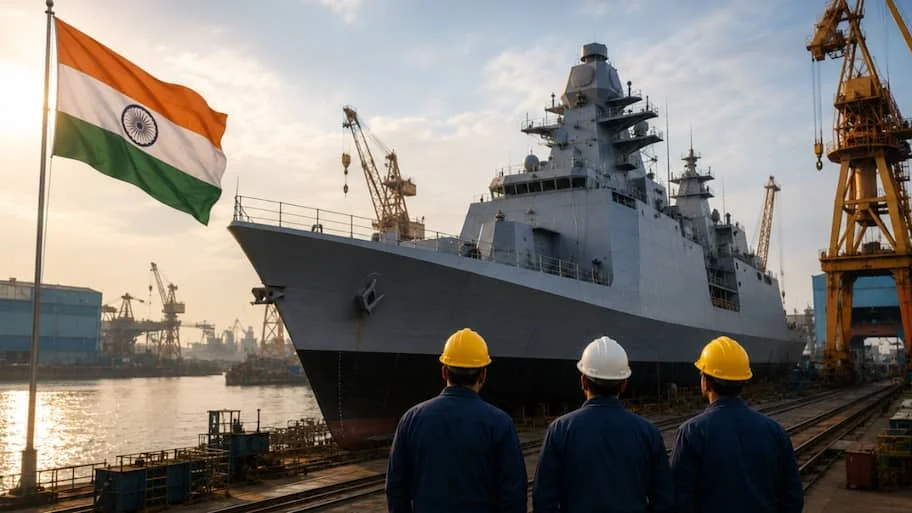
Six of the seven planned Nilgiri-class (Project 17A) stealth frigates have been delivered and commissioned between 2024 and 2026 — a programme built almost entirely around Indian design and construction, with only the propulsion and a handful of sensor packages sourced abroad.
That maturity didn’t happen by accident. The industrial stakes attached to keeping that spending domestic are larger than they’ve ever been. Shipbuilding, in that sense, isn’t a line item competing against manufacturing policy. For a growing stretch of India’s industrial base, it has become manufacturing policy. Public shipyards have also been expanding apprenticeship and ITI-linked training programmes specifically to keep pace with the induction rate, since the constraint on further expansion is increasingly skilled manpower rather than order books or capital. That’s the kind of downstream effect that doesn’t show up in a defence ministry press release but tends to matter more, over a twenty-year horizon, than the headline value of any single warship contract.
INS Vikrant, India’s first indigenous aircraft carrier commissioned in September 2022, forced Cochin Shipyard and its vendor network to master systems — flight-deck design, aviation fuel systems, integrated combat management — that simply didn’t exist in India’s industrial base a generation ago. The same shipyard is expected to lead construction of IAC-2, the proposed second indigenous carrier, which the Navy is pushing for formal government clearance in 2026; that decision would lean heavily on the institutional knowledge Cochin Shipyard doesn’t need to rebuild from scratch. The Defence Acquisition Council has already cleared the Navy’s Acceptance of Necessity for 74 additional warships worth roughly ₹2.35 lakh crore, on top of an active pipeline that includes new frigate classes, further submarines, and a nascent nuclear-attack-submarine programme (Project 77) that received Cabinet clearance for its first two boats in 2024.
