
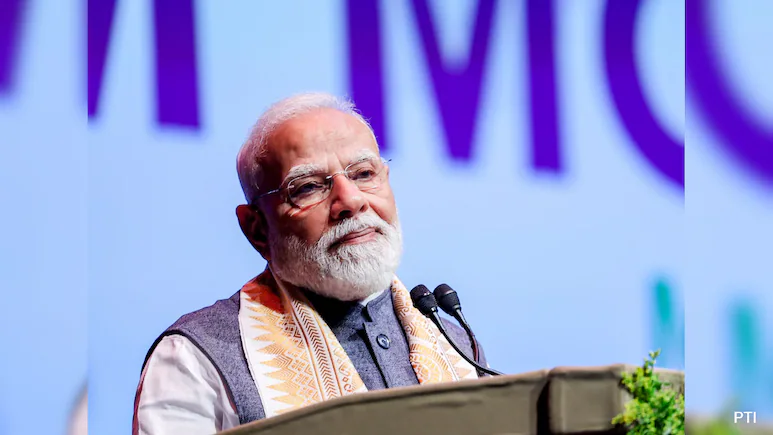
Prime Minister Narendra Modi embarked on his two-nation visit to Uzbekistan and Kyrgyzstan on Saturday, expressing confidence that the diplomatic engagement will reinforce India’s strategic partnerships across Central Asia.
Commencing the itinerary, the Prime Minister will first travel to Tashkent for a two-day bilateral visit at the invitation of Uzbekistan President Shavkat Mirziyoyev. I look forward to my discussions with President Mirziyoyev on further deepening our cooperation in trade and investment, digital connectivity, defence, energy, and on advancing our shared visions of Viksit Bharat and Yangi Uzbekistan. Following the bilateral leg in Tashkent, PM Modi will proceed to Bishkek at the invitation of Kyrgyzstan President Sadyr Japarov to attend the 26th SCO Summit, which commemorates a quarter-century of the organisation. I look forward to advancing India’s vision for the region, anchored in Security, Connectivity and Opportunity, and to working with fellow members for a region free from the scourge of terrorism, separatism and extremism, which continue to threaten peace and stability in our neighbourhood and beyond.”
This marks PM Modi’s fourth visit to Uzbekistan, following previous diplomatic engagements in 2015, alongside subsequent visits in 2016 and 2022 to attend SCO Summits. Bilateral and multilateral cooperation between New Delhi and Tashkent has expanded steadily over the years, highlighted by President Mirziyoyev’s State Visit to India in 2018 and his participation in the Vibrant Gujarat Global Summit in 2019. Highlighting regional priorities, PM Modi said in the departure statement, “India has been an active and constructive member of the SCO since 2017.
Outlining expectations for the bilateral engagement, PM Modi said in his departure statement, “In recent years, India-Uzbekistan Strategic Partnership has seen significant advancement. As part of the schedule in the Uzbek capital, the Prime Minister noted that he will also visit the Shastri Memorial and the Mahatma Gandhi Centre at the Tashkent State University of Oriental Studies, which he described as “a tribute to the close cultural and people-to-people ties” connecting both countries.
