
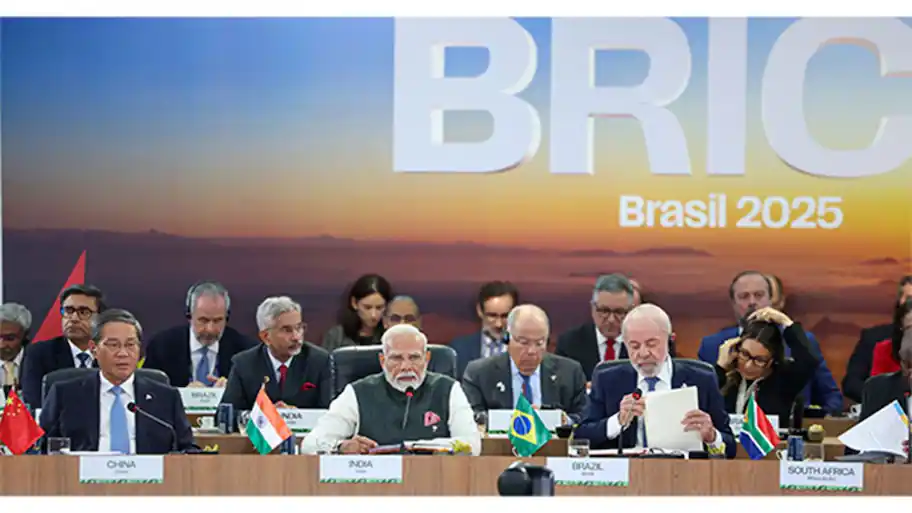
As India prepares to host the 18th BRICS Summit in New Delhi on September 12-13, 2026, New Delhi is navigating a complex balancing act. Having assumed the rotating chairmanship on January 1, 2026, India is steering an expanded 11-member grouping under the theme “Building for Resilience, Innovation, Cooperation and Sustainability.
This redefines the BRICS acronym itself and emphasises a “Humanity First” and people-centric approach focused on practical outcomes for the Global South rather than geopolitical confrontation.
Across the expanded membership, India is pushing deliverables in four pillars. Resilience covers economic and supply-chain robustness amid global shocks. Innovation centres on digital public infrastructure, AI frameworks and knowledge-sharing suited to developing economies. Cooperation emphasises policy coordination, trade facilitation, and Global South priorities. Sustainability targets green finance, clean energy transitions and climate action aligned with developmental needs.
Officials have advanced work on a BRICS Strategy for Economic Partnership 2030, counter-terrorism cooperation, and maritime security of critical waterways.
The summit comes two decades after the group’s informal origins and follows significant expansion. Partner countries further broaden engagement. The bloc represents a substantial share of global population and economic output on purchasing-power parity terms, amplifying its potential voice in global affairs. Russian President Vladimir Putin and Chinese President Xi Jinping are expected to attend, raising the stakes for bilateral side meetings amid India’s ongoing efforts to stabilise ties with Beijing. External Affairs Minister S. Jaishankar and other officials stress that the grouping should complement the existing multilateral system, not replace it or serve as a platform for confrontation with the West. New Delhi prioritises reformed multilateralism: stronger representation for emerging economies in the United Nations Security Council, IMF quota reforms, and capital expansion for the New Development Bank (NDB) to support sustainable infrastructure without onerous conditions. From China, India wants constructive engagement that advances this practical agenda without allowing the bloc to become China-centric. New Delhi has resisted any linkage of BRICS initiatives to the Belt and Road Initiative, which it opposes, and seeks criteria-based approaches to further expansion or institutional changes to preserve consensus and coherence.
Full members now include the original five, Brazil, Russia, India, China and South Africa, plus Egypt, Ethiopia, Iran and the United Arab Emirates (joined in 2024) and Indonesia (2025).
India has consistently framed BRICS as “non-Western” rather than “anti-Western.
