
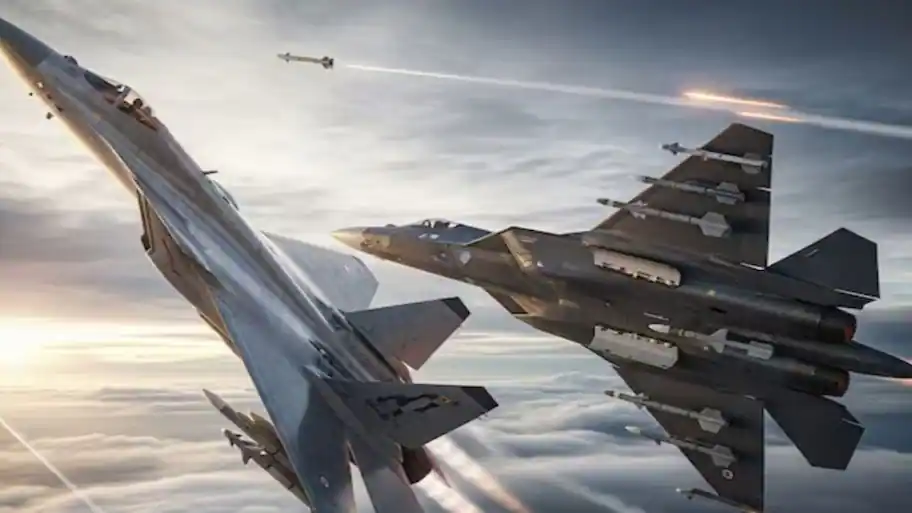
New Delhi: India is looking at joining an international sixth-generation fighter programme even as several major indigenous and foreign fighter projects are competing for funds, technology and manufacturing capacity.
The possibility of joining a sixth-generation project would add another major fighter programme to that list. The interest is understandable. Future combat aircraft are being built as part of larger networks rather than as standalone jets. A sixth-generation fighter is expected to combine stealth, artificial intelligence, advanced electronic warfare, long-range sensors, secure communications and networked operations. New Delhi would need to negotiate access to technologies, intellectual property, design responsibilities and manufacturing work. The role of Indian companies would also need to be clearly defined. The FCAS presents another set of complications. The original programme was built around a next-generation fighter supported by unmanned aircraft, sensors and a larger combat cloud. France’s Dassault Aviation and Airbus, representing Germany and Spain, were involved in the fighter project.
The Indian Air Force (IAF) is pursuing the Tejas Mk2, the 114-aircraft Multi-Role Fighter Aircraft (MRFA) programme and the Advanced Medium Combat Aircraft (AMCA).
It is also expected to work with autonomous or semi-autonomous “loyal wingmen”, drones, sensors and weapons. Experts said that would make the country’s terms of entry important. They said a partnership would have greater value if Indian firms could take part in designing and producing major systems instead of functioning mainly as suppliers.
The Cabinet has cleared the allocation. The final cost is expected to rise as development progresses. It would be one of India’s biggest defence modernisation commitments. A sixth-generation fighter would bring another long-term financial requirement, covering development, testing, engines, sensors, weapons, electronic warfare systems and the overall network needed to operate the aircraft. India is also looking at international partnerships to share some of that burden. The two programmes being examined are the Global Combat Air Programme (GCAP), involving Britain, Italy and Japan, and the Future Combat Air System (FCAS), associated with France, Germany and Spain. The GCAP has moved well beyond the concept stage. The programme is being developed through Edgewing, a joint venture between BAE Systems, Leonardo and Mitsubishi Heavy Industries. France and Germany abandoned the joint fighter project, while parts of the larger combat-system architecture continued and new European approaches began to emerge. It requires expertise in metallurgy, turbine technology, thermal management, advanced materials, precision manufacturing and testing. India has not independently developed and produced a modern high-thrust fighter engine at the level required for an advanced combat aircraft. The engine question is a major part of the sixth-generation project. A country can build an advanced airframe with foreign technology, but achieving greater control over the complete aircraft requires domestic capability in propulsion as well as sensors, electronics, weapons and software. India’s fighter plans now cover several generations and procurement routes. A sixth-generation partnership would add another project with a development timeline extending well into the future. At the same time, the IAF needs missiles, drones, air-defence systems, electronic warfare equipment, space-based assets, cyber capabilities, transport aircraft, helicopters and naval aviation. The government is also trying to expand India’s domestic defence manufacturing base. Each fighter programme needs engineers, test facilities, production lines, suppliers, specialised materials and long-term research funding. The Tejas Mk1A, the Tejas Mk2, the AMCA, the MRFA and a possible sixth-generation fighter can form a progression across different generations of combat aircraft. That would require clear timelines, defined roles and a technology roadmap that gives industry enough capacity to deliver each programme as planned, they added.
India would therefore be entering a programme where three countries have established the industrial structure, funding arrangements and division of work. The sequencing of projects would therefore determine whether the different aircraft programmes strengthen each other or compete for the same resources. The Aeronautical Development Agency (ADA) has put the research and development cost of the AMCA at around $1.8 billion or approximately Rs 15,000 crore. The Chinese J-20 Mighty Dragon, which has a similar operational role to the AMCA, is believed to have required around $5 billion for development. Turkey’s TF Kaan and Russia’s Su-57 Felon, including the Su-57E programme, have each been estimated to have absorbed more than $10 billion during their development cycles. Tejas Mk2 adds another estimated $1.5 billion to the bill. The MRFA programme is on a different scale, with an estimated cost of $39 billion. Britain, Italy and Japan merged their next-generation fighter efforts in 2022 and are aiming to field the new aircraft around 2035. In July, the three governments awarded Edgewing a GBP 4.6 billion contract for the next major design and development phase. Britain has also committed GBP 8.6 billion to the GCAP over four years. The partnership broke down in June 2026 after years of disagreements over industrial responsibility and workshare. The estimated cost of developing such an engine is around $10 billion that makes it one of the most expensive pieces of the country’s aerospace technology programme. The Tejas Mk1A is moving into service, the Tejas Mk2 is under development, the AMCA is being pursued as India’s fifth-generation fighter and the MRFA is intended to add 114 aircraft through an international procurement programme.
The bigger issue is how the country would finance and manage such a programme while several other aircraft projects are still under development, according to defence analysts. Defence Secretary Rajesh Kumar Singh said in April that India had approached the two major international sixth-generation fighter partnerships and expressed interest in participating in one of them. He highlighted the huge investment required for such an aircraft and said partnership would be needed. The defence experts said the experience shows how difficult multinational fighter development can become once countries start dividing design responsibilities, intellectual property and industrial work. The defence analysts said developing a modern fighter engine is a huge undertaking. The experts said the challenge is not simply finding money for another aircraft. They said India’s defence industry would have to support all these programmes at the same time.
The engineering challenge is only one part of building a fighter. Countries also have to agree on who designs main systems, who owns the technology and where the manufacturing work takes place. The engine is likely to be one of the biggest tests for India’s fighter ambitions. AMCA prototypes are expected to use the GE F414 engine. For the later AMCA Mk2, India wants a high-thrust indigenous engine developed with an international partner. Rolls-Royce has also made a major proposal involving co-development, technology transfer and Indian ownership of intellectual property.
Safran has been associated with a proposed 120-kN-class engine collaboration.
They said India would have to deal with the same issues in any international programme.
