
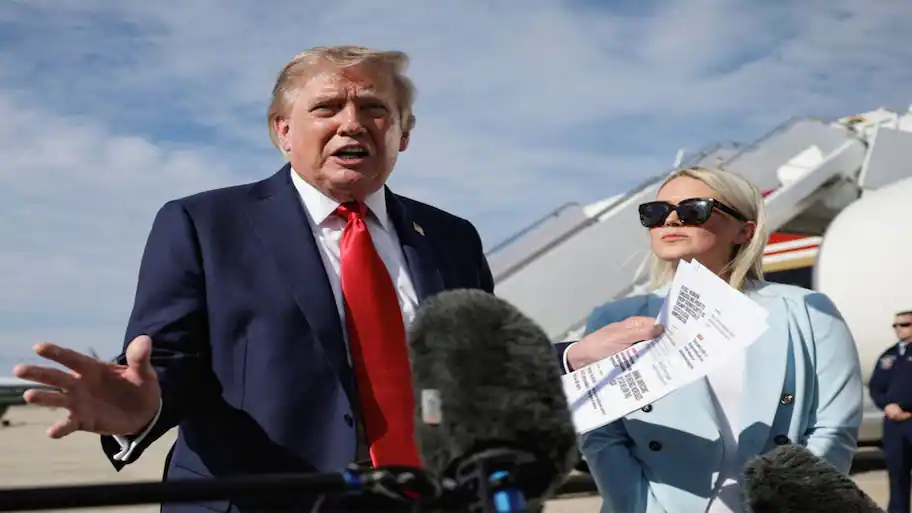
US-Iran Tensions: US President Donald Trump returned to the White House on Saturday (September 19) after cutting short his stay at Camp David as tensions spread across West Asia, with Iran setting seven conditions for renewed talks with Washington and Yemen’s Houthis launching attacks towards Saudi Arabia.
Reuters also reported that flames and smoke were seen near Riyadh’s main airport. Fighting has also been reported in parts of Yemen, including Marib, Taiz, Lahj, al-Jawf and al-Bayda. Saudi-led coalition forces said a ballistic missile fired towards Riyadh was intercepted and destroyed on Saturday. Russia Today reported that a US bomber has departed from a British air base for West Asia, while Iranian state broadcaster Press TV reported air defence activity near the Kharab al-Jir base in Al-Hasakah in northeastern Syria.
No reason was given for the change in his schedule. “We remain in contact with the mediator Qatar, which has conveyed our conditions to Washington with the aim of ending the war. Iran has publicly disclosed three of its seven conditions. Tehran wants the war to end on all fronts, the release of frozen Iranian funds and an end to the US naval blockade. He also warned that Iran is prepared for a larger military confrontation if Washington rejected its demands. “It is in Washington’s interest to accept these conditions. Trump’s threats will not achieve any results. The developments were followed by a US security warning covering several countries in the Middle East. Americans in or travelling through Iraq, Bahrain, Oman, Saudi Arabia, Iran, Qatar, Lebanon, Kuwait and Jordan were urged to exercise caution. It warned Americans about possible flight cancellations, airspace closures and other travel disruptions. The State Department has also warned that American diplomatic facilities and US interests could face attacks in locations outside the Middle East. The security alert came after a fresh escalation involving Yemen’s Houthi movement and Saudi Arabia. The latest attack was the first time an air raid alert had been sounded in Riyadh since fighting between Saudi-backed forces and the Houthis intensified in July. Saudi Crown Prince Mohammed bin Salman also addressed the conflict in Yemen, saying, “If it weren’t for our fear for the innocent people of Yemen, we would have conquered it in one week and eliminated the Houthis. The military developments have also put US military movements in the region under close watch. Those reports come as Washington assesses its next steps in the conflict with Iran. Iran’s latest message gives mediators a set of conditions to take to the US as diplomatic efforts continue.
At least one explosion was heard in Riyadh on Saturday (September 19), while residents near the airport reported seeing a large plume of smoke. The clashes have been described as the most intense since a period of relative calm that followed the April 2022 truce.
The move came hours after Iran’s Supreme National Security Council Secretary Mohsen Rezaei said Tehran had sent seven conditions to the United States through Qatar for resuming negotiations and was waiting for Trump’s response. We are awaiting President Trump’s response,” he told Al Jazeera. “Our conditions are an end to the war on all fronts, the release of our frozen funds and an end to the naval blockade,” Rezaei said. We are prepared for a decisive war,” he said. The US State Department said the security environment in the region is complex and can rapidly change. The department also said Iran and groups supporting Tehran could target US interests, businesses and institutions outside the Middle East. The warning comes as Washington maintains a Level 3 “Reconsider Travel” advisory for Saudi Arabia because of the risk of Iranian drone and missile attacks, armed conflict and terrorism. The coalition also said the Houthis attempted to target civilians and civilian infrastructure in Bisha, Taif, Farasan and Yanbu. Saudi authorities had issued emergency alerts across the kingdom overnight after warning of a “hostile aerial threat”. Saudi authorities said there were no casualties or damage. Houthi military spokesperson Yahya Saree said the group had targeted “sensitive” sites in Riyadh and an Aramco oil facility in Yanbu. He said the attacks involved cruise and ballistic missiles and drones. Saudi-backed government forces said they had stopped a Houthi infiltration attempt in southern Marib. Trump said earlier this week that the United States was in contact with Tehran and that he was considering his options for the war. He has also said he wants to consult Gulf leaders during the UN General Assembly meetings in New York. The White House has not said that Trump’s early return from Camp David was related to any particular military development.
The president had travelled to Camp David for an overnight weekend stay but returned to Washington earlier than planned. Qatar and Pakistan have been working to reopen a channel between Washington and Tehran after an earlier memorandum of understanding expired last month.
He also claimed that Iran had recently test-fired a multi-warhead anti-ship missile near a US vessel or aircraft carrier. The latest developments come as world leaders prepare to gather in New York for the UN General Assembly. The United States has approved visas for Iran’s delegation, including President Masoud Pezeshkian and Foreign Minister Abbas Araghchi, giving both sides another international setting for diplomatic contacts.
Rezaei has also said that Tehran’s military planning has changed after two earlier rounds of fighting. He told Al Jazeera that another US strike was “very much on the cards” according to Iranian military assessments. The Iranian security chief said Tehran’s planning now includes US naval assets operating from the Gulf through the Gulf of Oman and into the Arabian Sea. Rezaei said Iran would respond to another US attack by targeting American military bases in the region and potentially US commercial interests and companies operating there.
