
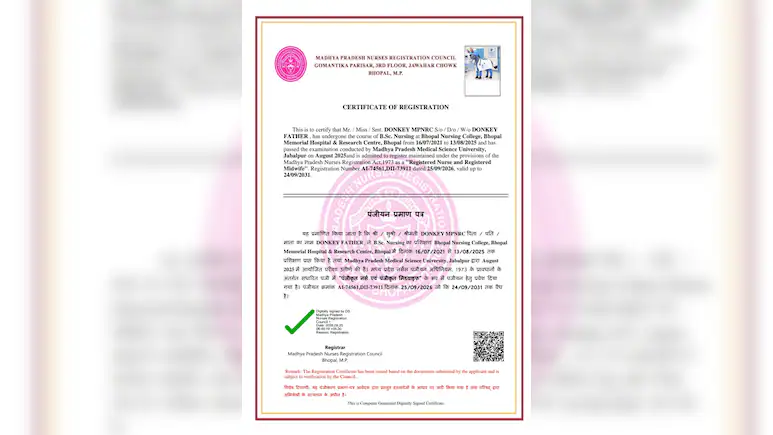
A donkey allegedly secured a nursing registration certificate in Madhya Pradesh. Its photograph was uploaded, documents that did not establish any genuine nursing qualification were submitted, a fee was paid and the state nursing council’s online system allegedly generated the certificate.
NDTV’s investigation into the nursing scandal had revealed how institutions without adequate campuses, teachers or clinical facilities were allowed to function. Years after NDTV exposed nursing colleges operating from cramped rooms, institutions existing only on paper and an investigation subsequently tainted by allegations of bribery, the latest case raises a disturbing question: What has changed in the system meant to protect nursing education and patient safety? But it has also put the registration process on hold to introduce additional checks. The matter reached the High Court, the CBI began investigating, and recognition was withdrawn from colleges. Then came another scandal. Officers entrusted with inspecting institutions were themselves accused of accepting money to clear them. Now, scrutiny has shifted from the colleges permitted to train nurses to the system registering them. NSUI state vice-president Ravi Parmar claims he tested the council’s online portal to check whether mandatory documents and an applicant’s identity were verified before a registration certificate was issued. After he paid the prescribed fee, he claims, the portal issued a nursing registration certificate in the donkey’s name. “If a donkey can get registered, how is the verification of genuine documents actually being handled? Parmar asked. He alleged that the exercise exposed a serious gap in scrutiny, with implications for the credibility of professional registration and patient safety. His claim concerns the issuance of a registration document. It does not establish that a permanent nursing licence was granted or that the certificate was used to secure employment. NDTV returned to the ground to examine those findings. A government college in Rewa had been declared unsuitable, while a college cleared as fit in Bhopal listed a rented building where a school was operating. In Sidhi, NDTV found a nursing college operating from a four-room shop. In Shahdol, the Sharda Devi College had been functioning from two rooms, with enrolled students even appearing for examinations. The investigation then took a more damaging turn. The alleged network operated through middlemen, with bribe money routed through Jaipur. Officers Rahul Raj, Sushil Kumar Majoka and Rishi Kant Asathe were arrested in connection with the case.
Officers tasked with checking whether colleges met the required standards were accused of accepting between Rs 2 lakh and Rs 10 lakh for favourable inspection reports. Searches at 31 locations across Madhya Pradesh and Jaipur recovered more than Rs 2.3 crore in cash, four gold bars and documents.
The Madhya Pradesh Nurses Registration Council says the certificate was provisional, subject to verification, and that submitting fraudulent information amounts to fraud. He uploaded a donkey’s photograph and submitted documents that did not establish any genuine educational qualification, according to Parmar. The CBI’s report on 308 colleges classified 169 as “suitable”, 73 as “deficient” and 66 as “unsuitable”. Investigators allegedly used code words including “glass of buttermilk”, “jar of pickles” and “kilo of mangoes” for bribe transactions.
A registration number is generated on application, followed by online verification of qualifications and documents in a second phase. A data exchange mechanism involving DigiLocker and the council is also planned. That explanation leaves a central question unanswered: What safeguards prevent an unverified applicant from misusing a provisional certificate before those checks are completed? For Madhya Pradesh, this is the latest controversy in a nursing education system whose failures NDTV has repeatedly documented. NDTV’s ground reports subsequently found colleges operating from two or three rooms and institutions lacking basic infrastructure. The government had promised strict action. Investigations, arrests and cancelled approvals followed. Yet the latest allegation suggests that basic questions about verification remain unresolved. The question raised by the alleged donkey registration is what an official certificate certifies if the applicant’s identity and qualifications have yet to be checked.
Registrations can be cancelled within seven to 15 days if fraudulent information, photographs or documents are detected, she said. NDTV exposed how during the COVID-19 pandemic, when hospitals were struggling to provide beds, questions emerged about whether nursing colleges possessed the clinical facilities on which their recognition depended. The number of recognised institutions stood at 450 in 2019-20 and 670 in 2020-21. Yet, when colleges were asked to provide hospital beds, 34 reportedly sought cancellation of their recognition. Following the revelations, the state nursing council withdrew recognition from 19 colleges. The High Court ordered a CBI investigation into colleges registered during the 2020-21 academic session.
The process is being implemented under Central Government guidelines, according to her. The council’s defence rests on one word: “provisional”.
Responding to NDTV, council president Dr Venu Kushwaha defended the distinction between provisional registration and permanent certification. “This is subject to verification by the Council. Applicants upload their documents and receive a provisional certificate, she explained, while bearing responsibility for the authenticity of their submissions. Students bore the consequences of the scandal through delayed examinations, disputed recognition and uncertainty over their qualifications.
Based on NDTV’s expose, the opposition alleged in the Assembly that not a single nursing student in Madhya Pradesh had graduated between 2020 and 2025.
Essentially, anyone doing this (registering a donkey) is committing fraud,” she said. Dr Kushwaha said the online process was intended to make registration transparent and remove middlemen. “Since such cases have surfaced recently, we have put the process on hold to implement additional system checks,” she told NDTV.
