
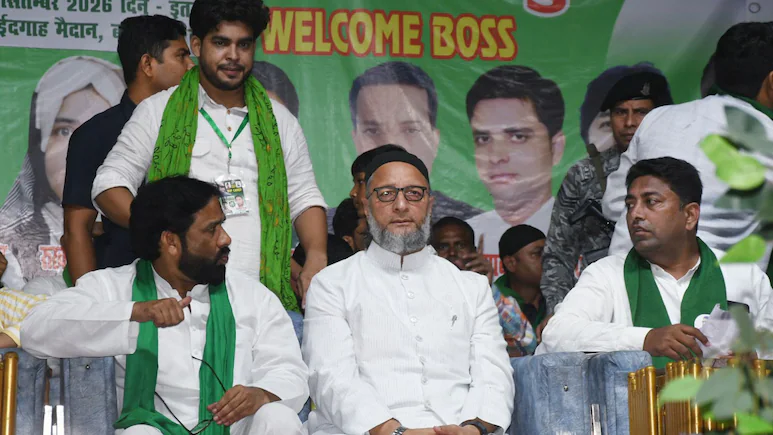
All India Majlis-e-Ittehadul Muslimeen (AIMIM) chief Asaduddin Owaisi has put a date on his Uttar Pradesh alliance strategy, saying the party will decide by October 2 whether it will enter the 2027 assembly election in alliance with other parties.
The party has announced further programmes in Shravasti and Azamgarh. The announcement came at a public meeting in Kanpur’s Cantonment constituency on Sunday, where Owaisi made an open pitch to parties seeking to prevent the BJP from returning to power in Uttar Pradesh for a third consecutive term. Its campaign has so far concentrated heavily on constituencies and districts with sizable Muslim populations. Owaisi has addressed meetings in Matera (Bahraich), Najibabad (Bijnor), Saharanpur and Moradabad, before returning to the campaign with the Kanpur rally. Owaisi’s message now is unmistakably transactional in the sense he wants to build the organisation first, negotiate from strength and seek a share of power rather than merely transfer votes. Owaisi is now attempting to move beyond that limited electoral footprint by combining ground-level expansion, candidate preparation and alliance bargaining. The message from Kanpur was that AIMIM is prepared to contest a large number of seats on its own, but at the same time it is also willing to negotiate with parties that want to join hands against the BJP.
“We will make a decision by October 2,” Owaisi said to NDTV when asked about an alliance. “We will make a decision by October 2,” he said in Kanpur.
But the party’s significance in UP politics is not necessarily measured only by seats won. At his Kanpur rally on Sunday, AIMIM chief and Hyderabad MP however made his intention very clear: “We do not want a BJP government to be formed in UP for a third term. Owaisi warned parties not to interpret AIMIM’s relatively restrained alliance messaging as weakness. The figure is a planning target rather than a final list of seats, and Owaisi has kept the possibility of an alliance open. AIMIM’s stated organisational focus includes Saharanpur, Moradabad, Bijnor, Muzaffarnagar, Rampur and Amroha, particularly in western Uttar Pradesh. Owaisi’s current strategy is not limited to projecting AIMIM as a Muslim-interest party. His alliance outreach points towards a wider arithmetic involving Muslim, Dalit and regional caste-based political formations. Sources say the party had already kept an alliance with Mayawati’s organisation open while preparing its UP plan. The party is also working on separate dimensions through Chandrashekhar Azad’s Azad Samaj Party, which has sought to consolidate Dalit political representation. Owaisi’s recent political engagement with Jat leader Hanuman Beniwal’s RLP in Rajasthan provides another example of AIMIM experimenting with alliances that bring together different regional and social constituencies. The AIMIM and RLP recently joined hands for Rajasthan’s civic elections, with Beniwal publicly projecting a Jat-Muslim political combination which many believe will influence Jats of Uttar Pradesh also. Owaisi has simultaneously spoken favourably of RLD leader Jayant Chaudhary, defending him after criticism from Samajwadi Party chief Akhilesh Yadav. Owaisi’s larger pitch is to turn AIMIM from a Muslim vote platform into an alliance vehicle linking Muslim, Dalit, regional and OBC constituencies. Talks involving smaller parties, including Azad Samaj Party and the BSP option are part of that wider plan. Its candidates polled thousands of votes in several constituencies, sometimes in contests decided by relatively narrow margins. That has made AIMIM a factor watched closely by the Samajwadi Party and others seeking to consolidate Muslim votes.
Because rLD has a political base among Jats in western Uttar Pradesh, precisely the region where AIMIM is increasing its own organisational activity, the intervention is notable. The October 2 deadline comes as AIMIM has substantially stepped up its organisational and electoral activity in Uttar Pradesh. The party formally launched its 2027 campaign from Matera in Bahraich in June and has indicated that it is preparing an organisational network across roughly 200 assembly constituencies. AIMIM says it is preparing an organisation across 150-200 UP seats. The test is electoral conversion as AIMIM won no UP assembly seat in 2022, despite contesting about 95 seats; in the Saharanpur assembly seat itself, AIMIM polled 8,187 votes (3.15 per cent) – while BSP polled 62,637. In the 2022 assembly election, AIMIM contested 95 seats, secured about 0.49 per cent of the statewide vote, and won none. Its strongest result came in Mubarakpur, while 94 of its 95 candidates lost their deposits, according to election data reported after the poll.
We have told all political parties that if you wish to stop the BJP from returning to power, then come and join hands with the AIMIM. Referring to the party’s experience during the Bihar election, he said political parties had rejected its proposal when AIMIM had sought six seats, and alleged that rival parties had subsequently targeted him and the organisation. “We will wait until October 2, and then, whoever we form an alliance with, we will announce it on that very day and contest the UP elections alongside them,” he said. The party says it has been working to strengthen its booth-level organisation in these areas. Calling this simply a “Muslim-Jat-Dalit combination” is currently more a strategic direction than an established electoral bloc as the evidence is stronger for AIMIM’s Muslim-plus-Dalit outreach and its engagement with Azad Samaj Party; the Jat component is more prospective, linked to western-UP politics and Owaisi’s favourable positioning toward Jayant Chaudhary and RLD.
AIMIM is attempting to turn that demographic presence into an argument for independent political representation, rather than remaining solely within the traditional SP-led opposition vote structure. Put together, these moves clearly point to an AIMIM strategy of keeping several possible social and regional combinations available rather than committing prematurely to a single opposition formation. Because these districts contain several constituencies where Muslim voters form an important part of the electorate, the geographical strategy is significant.
Owaisi’s UP game plan is getting clearer: AIMIM is building a western UP to Rohilkhand footprint while keeping the alliance card open until October 2. Saharanpur is a key – not a Congress or Samajwadi bastion – Muslim-heavy battleground where 2022 saw BJP win 5 of 7 assembly seats, while Congress captured the Lok Sabha seat in 2024.
However, amid all this it is also true that AIMIM entered the UP contest with no assembly seat, and its 2022 performance shows both the scale of its challenge and the potential relevance of its vote in closely fought constituencies.
