
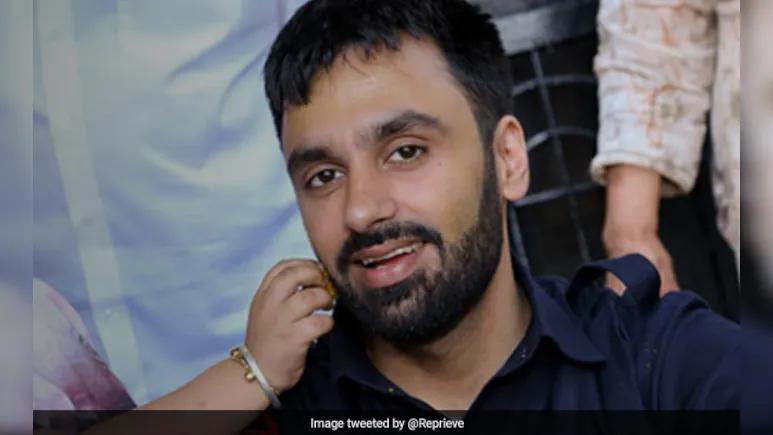
The Delhi High Court on Friday directed the release of UK national Jagtar Singh Johal alias Jaggi on bail in seven cases being investigated by the National Investigation Agency (NIA), after noting that he had remained in custody for more than eight years and that the trials were not likely to conclude in the near future.
A Division Bench of Justice Navin Chawla and Justice Ravinder Dudeja set aside the orders passed by the trial court refusing bail to Johal and directed his release subject to a series of stringent conditions, including surrender of his passport, restrictions on communication and social media activity, fortnightly reporting to the Investigating Officer and a prohibition on contacting or influencing witnesses. The High Court ordered that Johal shall use only one mobile phone and/or one landline number during the trial and the number shall remain switched on. He has been directed to furnish his residential address, contact number and email address to the Investigating Officer as well as the trial court. The court further directed that he shall not change his place of residence or contact particulars without giving at least seven days’ prior written intimation to the Investigating Officer and the trial court. He has been specifically barred from engaging in any conduct that may have the effect of delaying the trial proceedings. The High Court further directed Johal to report to the concerned Investigating Officer once every fortnight, or at such intervals as may subsequently be directed by the trial court. The appeals were considered together as the allegations and submissions in the cases were similar. The High Court noted that Johal had been in custody for more than eight years. The court referred to the Supreme Court’s judgment in Union of India v. K.A. Najeeb and subsequent decisions dealing with the right to speedy trial and prolonged incarceration in UAPA cases.
The court directed Johal to execute a personal bond of Rs 5 lakh with two sureties of the like amount to the satisfaction of the trial court. The Bench passed the directions while dealing with seven criminal appeals filed by Johal challenging orders passed by the Additional Sessions Judge-03, New Delhi, in cases involving allegations under provisions of the Indian Penal Code, the Unlawful Activities (Prevention) Act and the Arms Act. only 40 prosecution witnesses had been examined, while another 123 witnesses remained to be examined Although charges had been framed. The Bench noted that around 63 witnesses were common to the different cases, but nevertheless concluded that the trials were “certainly not likely to conclude any time soon. The court also noted that despite directions issued by the Supreme Court on May 20, 2025, December 11, 2025 and May 8, 2026, the pace of the trial had not substantially picked up and the statements of protected witnesses had not been recorded. The Bench examined the impact of prolonged incarceration on Johal’s fundamental rights under Article 21 of the Constitution, particularly in the context of the restrictions imposed by Section 43D(5) of the UAPA. It noted that statutory restrictions under Section 43D(5) do not completely exclude the jurisdiction of constitutional courts to grant bail where continued incarceration raises concerns under Part III of the Constitution.
It also directed him to surrender his passport, if any, before the trial court and, if he does not hold a passport, file an affidavit to that effect. Johal has also been directed to cooperate with the trial and appear before the trial court on every date of hearing, unless exempted from personal appearance by the court. The court made it clear that in the event of a breach of any of the bail conditions, the prosecution would be at liberty to seek cancellation of bail before the appropriate court.
On the allegation of threats to witnesses, the Bench observed that no document had been produced before it to substantiate that the alleged threats were emanating from Johal or were being issued at his behest. The court consequently held that the impugned orders passed by the trial court could not be sustained and set them aside. (Except for the headline, this story has not been edited by NDTV staff and is published from a syndicated feed.) Because he was a foreign national and said appropriate conditions could be imposed to ensure that he did not become a flight risk, the High Court, however, held that Johal’s liberty could not be curtailed merely.
As part of the bail conditions, the High Court directed that Johal shall not directly or indirectly contact, influence, threaten or communicate with any prosecution witness, protected witness, complainant or any person acquainted with the facts of the case. The court also prohibited him from tampering with evidence, electronic material, records, devices or documents relating to the cases. The Bench further directed that Johal shall not make any public statement, including through print, electronic media or social media, touching upon the merits of the cases, evidence, witnesses or the pending trials. He has also been directed not to participate in any activity which may prejudice public order or the integrity of the trial. It also prohibited him from uploading, sharing, disseminating or circulating any such material on social media or otherwise. At the same time, the High Court noted that delay cannot be treated as an automatic or mechanical ground for bail in every UAPA case. It referred to the Supreme Court’s observations that such an assessment must be contextual and take into account factors including the nature of allegations, stage of proceedings, realistic trajectory of the trial, causes of delay, the role attributed to the accused, the prima facie material, availability of safeguards and risks associated with release. State Government of NCT of Delhi. The High Court, however, noted that the reference did not prevent it from deciding the present case on the basis of the law binding upon it. At that stage, he had undergone around five years of custody, and the Punjab and Haryana High Court had directed his release on regular bail while taking into account the delay in the commencement of the trial. The court was informed that the acquittal had attained finality and had not been challenged by the prosecution. The Bench observed that although the Moga acquittal could not operate as res judicata in the present proceedings, the fact remained that Johal was being implicated as a co-conspirator in the present cases on similar averments. The NIA had opposed bail, arguing that Johal was a foreign national and a flight risk. It had also contended that some witnesses had complained of threats and that his release could prejudice the trial.
The court also took note of the fact that the Supreme Court has referred the issue concerning the interplay between Article 21 and Section 43D(5) of the UAPA to a larger Bench in Tasleem Ahmed v. The Bench also considered the earlier bail order passed by the Punjab and Haryana High Court in March 2022 in another case involving similar allegations against Johal. The Delhi High Court further took note of a March 4, 2025 judgment of the Additional Sessions Judge, Moga, Punjab, in which Johal had been acquitted in a case involving similar allegations.
The court held that the earlier acquittal had “strong persuasive value” for the limited purpose of considering his bail plea.
The court directed him to furnish an undertaking to this effect before the trial court.
