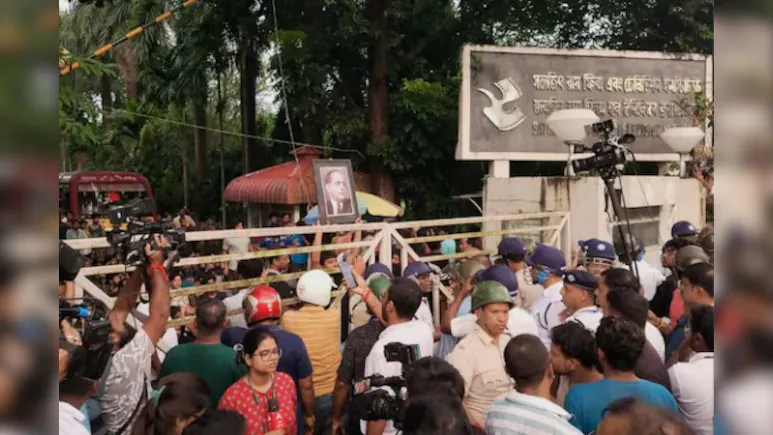
After the recent incident of violence, students at the Satyajit Ray Film and Television Institute in Kolkata have demanded that the institute authorities explain how a group of outsiders could enter the campus and allegedly chase and assault students on their own premises.
Today, Suvendu Adhikari has to confront this entire history. After clashes over an event organised by an RSS-linked outfit, the Kolkata Police registered FIRs against students. Taking cognisance of the incident, police registered three FIRs-two against unknown students and one against an unknown individual. The Kolkata Police also took suo motu cognisance and registered another FIR based on a complaint filed by the Akhil Bharatiya Grahak Panchayat, or ABGP, the RSS-linked organisation. That FIR, too, named unknown students. The only FIR registered on the basis of a complaint lodged by the institute’s Dean was also against unknown persons. But the larger question that has now emerged is this: Can West Bengal finally get rid of its culture of political violence? There was a similar situation at Jadavpur University, where clashes took place between outsiders and students. But the concern in Bengal runs much deeper. There appears to be a long history-a kind of political DNA-of political violence in West Bengal that has continued for several decades. Law and order comes under Chief Minister Suvendu Adhikari. But a serious question is already staring the new dispensation in the face: Why has Bengal not been able to get rid of political violence? The Naxalite movement emerged in the late 1960s and became a major force in Bengal in the early 1970s, during the Congress regime under Siddhartha Shankar Ray. It brought a new form of political violence to the streets of Bengal. Read | Students, Teachers Injured In Clashes At Kolkata Film Institute Statues of prominent figures of the 19th-century Bengal Renaissance were vandalised and destroyed by Naxalite activists. In response to the Naxalite movement, a Youth Congress force emerged and began engaging in counter-violence. It was not officially a Congress organisation. However, political analysts at the time argued that Siddhartha Shankar Ray had encouraged or organised the group to combat the Naxalites. Later, when Sushil Kumar Shinde was Home Minister during the Congress-led UPA government, a similar assessment was reportedly discussed at another DGP conference. Bengal had acquired a reputation for political violence-and, unfortunately, that reputation remained. Marxist theorist Herbert Aptheker wrote extensively about revolution, force and violence. If the ultimate objective is considered just, violence can be presented as a means towards that end. Gandhian thinking differs fundamentally from this approach. The Gandhian philosophy holds that the means cannot be separated from the ends. Both must be rooted in a good cause and in ethical values. Modern historians, however, also point out that war and peace have both existed throughout India’s long history. Even within Hindu traditions, the Ramayana and the Mahabharata contain wars. But these are presented as conflicts for particular causes, justified within the moral frameworks of the respective epics. The Mahabharata, in particular, contains extensive descriptions of conflict and violence. Historian Upinder Singh, daughter of former PM Manmohan Singh, has also written about the history of violence in ancient India, including the presence of warfare and conflict in the period associated with the Mahabharata. There is another cultural dimension to this debate. Some commentators have even drawn a connection between this radical tradition and the Shakta religious tradition. Gandhi, on the other hand, represented a Vaishnavite tradition of non-violence. Bengal has always been a combination of different traditions, influences and communities. It is a peculiar and deeply heterogeneous society. The immediate challenge is political violence. Even the egg attacks on TMC workers cannot be justified as political protest; they are themselves a form of violence. Recently, BJP workers have also been killed. That, too, is a troubling indication. If violence continues, it raises questions about whether a government can ensure protection even for its own political workers. Against this backdrop, the continuing violence in West Bengal presents a difficult political challenge for the BJP’s central leadership as well. The BJP state government must address the situation urgently. Suvendu Adhikari has already sought to bring in an anti-Goonda Bill aimed at giving the police greater powers to deal with criminal and anti-social activities. The legislation has faced criticism from the Opposition, which has raised concerns about the possibility of those powers being misused. The Bill is currently under consideration at the Centre. But there is another dimension to Bengal’s political culture. Dilip Ghosh, when he was BJP state president, was known for making extremely aggressive political statements. At one point, RSS chief Mohan Bhagwat reportedly questioned Ghosh over his violent rhetoric. Amit Shah also reportedly sought an explanation. Ghosh’s explanation was that such rhetoric was intended to give BJP workers inspiration, enthusiasm, a sense of confidence and psychological strength. His argument was that if such language helped workers feel prepared to face political confrontation, then he saw a purpose in using it. In his view, this was also part of Bengal’s political culture. There is another example from Rahul Sinha’s tenure as BJP state president. During a political agitation, a bus was set on fire. The incident generated enormous publicity. Newspapers carried the story prominently, and it received extensive coverage across the media. LK Advani was reportedly unhappy about the incident and called Rahul Sinha to question him about it. This captures one of the more distinctive features of Bengal’s political culture. It is not necessarily communal or caste violence. The question now is whether the BJP, with Suvendu Adhikari at the helm of the state government, wants to change this political DNA. Suvendu Adhikari is presenting himself differently from the traditional image of Bengal politics. His emphasis is on industry, development and the industrialisation of the state-objectives that are difficult to pursue if political violence continues. His interventions around Jadavpur University and the Satyajit Ray Film and Television Institute, among other institutions, are part of a larger attempt to reshape the political and cultural environment of the state.
Therefore, breaking this cycle of political violence is a new challenge for the BJP leadership as well. Suvendu Adhikari took charge four months ago, in May, and the political honeymoon period is therefore still on. For a revolution, therefore, there can be an argument for armed struggle in the interests of the common people. Therefore, it would be inaccurate to suggest that violence never existed in India’s earlier history and suddenly appeared in modern times. Because of that we received so much publicity and support, sinha’s response was essentially: “We only set a tyre on fire, but. The larger question, therefore, is whether Bengal can move away from a political culture in which confrontation, aggression and violence have historically been treated as instruments of political mobilisation, and towards a politics centred more on development, administration and institutional functioning.
For the first time since 1947, a BJP government has come to power in West Bengal.
The group became popularly known as “Cong-Xal”-a combination of “Congress” and “Naxal”. In his writings on the ideological differences between Gandhi and Subhas Chandra Bose, NC Chaudhuri has drawn a contrast between “Vaishnavism” and “Shaktism”. The BJP’s central leadership has traditionally projected the RSS tradition as one rooted in discipline and non-violence, while the Left has, at different points, used the term “Hindu terror” in its political criticism, including in the context of the demolition of the Babri Masjid. He once said, in effect, that if the hands or legs of BJP workers were attacked, they would respond by cutting the hands and legs of those who attacked them.
The Marxist argument has historically held that violence can, under certain circumstances, become part of a revolutionary struggle. Bengal has historically contained strong radical and revolutionary currents within its social and cultural life. Rather, there has historically been a tendency towards political confrontation, combative behaviour and aggressive political action.
From the famous Saibari incident in Burdwan during the Congress period to the large number of political clashes and killings reported in Midnapore during the CPI(M) era, violence became deeply embedded in Bengal’s political culture. Chief Minister Ajay Mukherjee was targeted by the Opposition over the state’s law-and-order situation and continuing political clashes. The Left, in time, also became associated with major episodes of political violence and killings. So, from the Congress regime to the Left Front period, political violence continued to evolve. Then came the Trinamool Congress. Mamata Banerjee fought this political violence and challenged the CPI(M)’s organisational dominance. Clashes continued between TMC students, youth and workers on one side and the CPI(M) on the other. Later, when the BJP emerged as the principal Opposition force, another phase of political clashes began-first between the BJP and the CPI(M), and subsequently between the BJP and the TMC. The players continued to change, but the violence did not disappear. During LK Advani’s tenure as Union Home Minister, a DGP conference was held at Vigyan Bhavan where state intelligence agencies submitted reports to the Home Ministry. The situation was different in Uttar Pradesh and Bihar at the time, where communal or caste violence was seen as a more prominent concern. In Bengal, political violence was regarded as the bigger issue.
In 1977, the Left came to power after the United Front period, whose tenure had also witnessed serious law-and-order problems.
When the CPI(M) eventually came to power, many of the lumpen elements and local strongmen associated with the Congress are said to have moved towards the CPI(M). Gradually, the idea of a “lumpen proletariat” finding shelter within the Left’s political structure became part of the political narrative. The reports highlighted political violence in West Bengal, according to accounts of those discussions.