
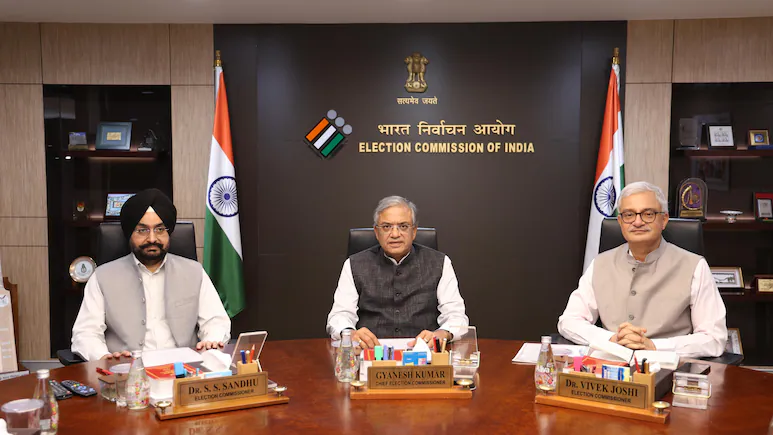
The Election Commission (EC) on Saturday moved to blunt reports of dissent within, holding an all-member meeting and issuing a point-by-point clarification on allegations about its functioning. Chief Election Commissioner (CEC) Gyanesh Kumar and Election Commissioners Sukhbir Singh Sandhu and Vivek Joshi met at Nirvachan Sadan in New Delhi on Saturday afternoon, the press release said. It reasserted that key decisions, including the Special Intensive Revision (SIR) of voter rolls, were taken unanimously by the full commission. Attached was a photo of the three at a table, amid a row over a media report that Sandhu and Joshi had raised objections on several occasions to decisions and orders related to SIR.
The controversy spans objections raised by Joshi and Sandhu on issues such as changes to Form 6 used for new voter enrolment, the functioning of the online system ECINET, the redistribution of work in the IT division, appeals in the West Bengal SIR, and the handling of cases involving voters in Goa, for instance. On the Form 6 issue, questions were raised over a declaration attached to the form during the SIR process, asking prospective voters to map to the previous SIR via their parents’ names. It added that outside the SIR period, forms prescribed under the Registration of Electors Rules, 1960, would be used.
The commission’s note said the declaration was upheld by the Supreme Court.
It also announced a review of the ECINET by a committee headed by a Senior Deputy Election Commissioner and including an independent expert from an IIT or IIIT. Opposition parties have cited the reported objections by Joshi and Sandhu to question the functioning of the Commission and have demanded Gyanesh Kumar’s ouster. On ECINET, concerns were raised over access to the electoral-roll database and the functioning of the portal. The controversy, however, has moved beyond questions of internal procedure. The dispute has also become closely linked to the wider political battle over SIR, with Opposition parties demanding greater transparency from the poll panel.
The commission pointedly addressed the case of 97 voters in Goa who had been left out of the electoral rolls. Of the 97 voters, 81 had already filled Form 6 for inclusion.
The commission said field officers have role-based access according to their statutory powers. The commission said any further flexibility required by field officers would be made operational too. Another issue concerned a letter sent to the Cabinet Secretary over the redistribution of work “involving an officer on deputation to the EC”. The commission said the letter was not related to any policy matter of the EC or its IT division, but to the functioning of the officer. It said the work redistribution orders objected to were not implemented after directions from the two commissioners, and that oversight of the IT division by a Deputy Election Commissioner was never withdrawn. It said the Goa Chief Electoral Officer had directed Booth Level Officers to conduct house-to-house visits and collect their forms.
It also decided that all new initiatives involving IT modules and portals would be discussed by the committee of officers before being placed before the commission for approval.
