
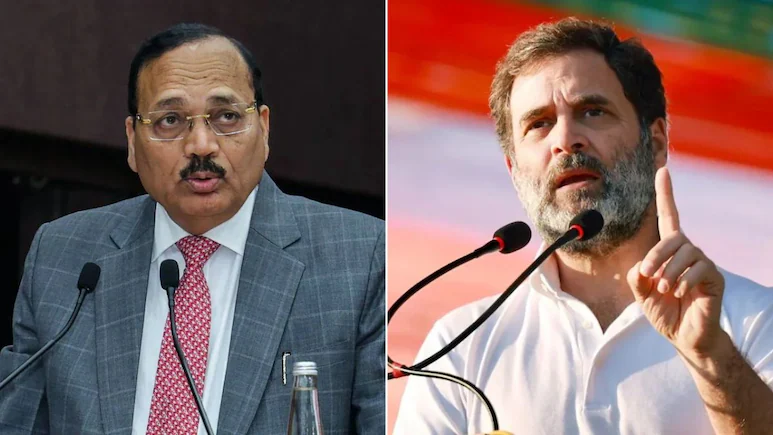
Chief Justice of India Surya Kant on Tuesday reprimanded a lawyer for raising a case of alleged “disproportionate assets” against Rahul Gandhi without any basis.
The Chief Justice remarked that the attempt to raise this issue lacks both a clear basis and any substantive merit. Based on this, the lawyer sought to have the matter listed for a hearing. The entire matter originated from a complaint filed by Vignesh Shishir, a BJP worker from Karnataka. He had levelled several allegations concerning the assets of Congress leader Rahul Gandhi. The court had sought responses from the complainant, the CBI, and the ED regarding the matter. Rahul Gandhi challenged the Allahabad High Court’s order and sought the transfer of the case to the Delhi High Court.
The lawyer claimed that Rahul Gandhi had recently stated at an event that he was in contact with 200 officials from the ED and CBI. Read | 1 Million People, 20,000 Vehicles And Gridlock: Traders’ Note To Rahul Gandhi It should be noted that in August, the Supreme Court granted an interim stay on an order in May by the Lucknow bench of the Allahabad High Court, which had directed the CBI and ED to investigate Rahul Gandhi’s assets.
The Supreme Court has already stayed an earlier order from the Allahabad High Court in this matter and has also restrained the ED and CBI from filing any reports before the High Court. Furthermore, the Supreme Court instructed the CBI and ED not to file any reports regarding this matter before the High Court for the time being.
“For Media Attention?” Chief Justice Slams Lawyer’s Rahul Gandhi Assets Plea
In response, the Chief Justice asked, “Have you consulted a news channel about this? You only want to raise this matter for the sake of media attention. The Supreme Court questioned how the High Court could have issued such an order without hearing Rahul Gandhi.
The Chief Justice further directed his staff to discontinue the live streaming of the “mentioning” process – the procedure through which lawyers request the listing of cases for hearing – in the Supreme Court.
